Quiet Life in a Wooded Glen 林麓幽居圖
Wang Meng · Yuan dynasty (1279–1368), dated 1361
Explore the painting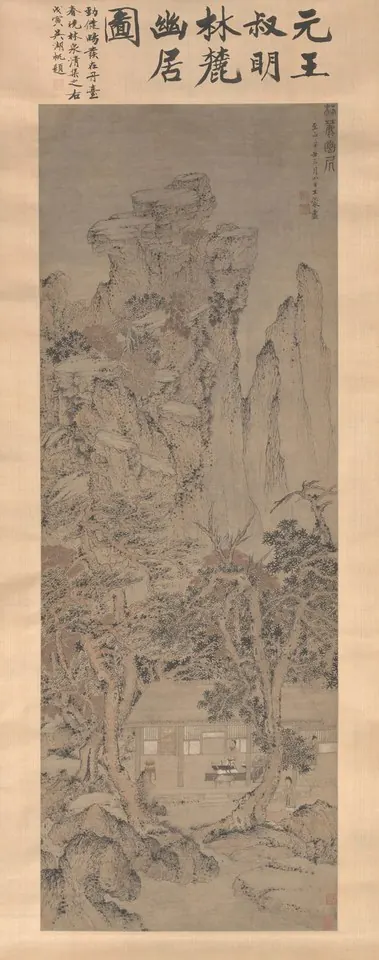
The painting’s story and details
In 1361 Wang Meng painted a man living among mountains, playing a qin and keeping a book close at hand. Beyond this refuge, the Yuan dynasty’s order was breaking down. The artist had served as a legal clerk before withdrawing from official life. Seclusion was therefore a real choice for him, and landscape offered a means of imagining its proper form.
Mountains occupy almost the entire height of the scroll. Fine, dry, repeated strokes construct their slopes. These describe the porous, folded surface of rock while also displaying the movement of the brush. Among China’s educated painters, individual brushwork mattered alongside the landscape’s convincing presence.
A narrow peak rises on the right, separated from the main mass by a pale interval. Space must gradually be assembled from slopes and overlaps. This slow reading suits the scroll format. Attention moves between peaks, altering our sense of distance and depth.
The resident sits in an open house below. A long stringed instrument, the qin, stands before him, with an open book nearby. Music and reading identify the pursuits of a cultivated scholar. Withdrawal from government service could mean continuing cultural life elsewhere, with a different routine and set of interests.
Large trees shelter the house on either side. Figures attending its resident appear among them. These servants matter to the meaning of seclusion. The freedom to devote time to music and books depends on someone else’s labour. Even an ideal retreat from public concerns preserves this condition.
A large calligraphic inscription appears above the landscape, in a separate section of the mounting; smaller inscriptions and seals occupy the painted area. Such an object could accumulate traces of reading and ownership. Landscape belongs within a written culture in which works were examined, discussed and passed between connoisseurs.
Dense vegetation surrounds the small buildings on almost every side. The dwelling appears protected, but its approaches are complicated. Wang Meng is counted among the Four Great Masters of the Yuan dynasty. His concentrated brushwork makes mountains into an environment where private life acquires its own measure of time.
The museum suggests that the scholar may be an indirect self-portrait of Wang Meng. Under this reading, the refuge becomes the artist’s reflection on his own life during political disintegration. It also presents an ideal available to an educated person with material support. The scroll joins a desire for independence to the question of what sustains it.
Featured in tours
Chinese landscape. The scholar’s life
Public service, retirement, gardens, poetry and the memory of earlier masters.
More paintings to compare
Period, style and subject
- Movement
- Chinese painting
- Genre
- Landscape
- Medium
- Hanging scroll; ink and light colors on paper
- Collection
- Art Institute of Chicago
- Dimensions
- 177.8 × 64.2 cm
- Accession number
- 1947.728
Sources
Image provided under CC0. Image licence
Adapted and translated from Art Institute of Chicago materials. · Text licence