Summer Mountains
Attributed to Qu Ding · ca. 1050
Explore the painting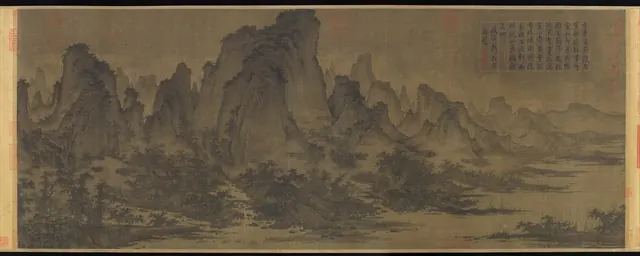
The painting’s story and details
A high mountain dominates a valley containing trees, dwellings, water, and human routes. The scroll dates to about 1050 and is attributed to Qu Ding. The artist’s name is linked to an imperial collection catalogue, while pictorial techniques support the dating. Summer Mountains belongs to a Song culture in which landscape could embody the order of an entire world.
The principal peak rises well above its neighbors. Its slopes consist of successive ledges fringed with dark trees. The museum compares this structure to a sovereign surrounded by subjects. That interpretation belongs to the court’s historical culture, while the mountain remains a convincing element of natural space.
At the right, mountains gradually descend toward water. Pale passages separate banks, trees, and distant outlines. Alternating barriers and openings replace a single continuous mass. The landscape invites imagined movement along the water or inward between the slopes.
Small buildings shelter among trees. Almost inconspicuous beside the mountains, they introduce a human measure into the immense view. The landscape includes the possibility of dwelling. Its natural order incorporates people, locating their activities within a larger environment.
A temple building appears on the slope at the left. In the museum’s reading, the picture’s journey leads toward a mountain retreat. Withdrawal from daily life involves a route and an ascent. The secluded place belongs to a complex setting, progressively separated from the open plain by banks, vegetation, and rocks.
Short strokes and ink washes cover the mountains. Some marks indicate vegetation, while others convey the folded structure of rock. Close viewing reveals greater variety than the broad dark silhouette suggests. A large geographical form emerges from numerous small brush decisions, without equal sharpness throughout the image.
An inscription and red seals belong to the scroll’s life in collections. Its ownership marks include seals of Emperor Huizong. They help establish the work’s history and connect its proposed artist with a palace catalogue. Imperial authority is present quite literally through marks of possession on the landscape’s surface.
Mountain withdrawal and political order could coexist within one artistic culture. For a cultivated viewer, landscape offered an imagined release from obligations; for an imperial collection, it became evidence of possessing art. This immense natural setting accommodates both positions. People are small within the painting, yet its makers and collectors determined the world available to view.
Featured in tours
Chinese landscape. The scholar’s life
Public service, retirement, gardens, poetry and the memory of earlier masters.
More paintings to compare
 Mi Youren
Cloudy Mountains
1130 Wen Zhengming
Autumn Mountains 秋山圖
Ming dynasty (1368–1644), early 16th century 明朝 Wang Meng
Quiet Life in a Wooded Glen 林麓幽居圖
Yuan dynasty (1279–1368), dated 1361 Guo Xi
Old Trees, Level Distance
ca. 1080 Ma Yuan
Scholar viewing a waterfall
early 13th century Xia Gui
Mountain Market, Clearing Mist
early 13th centuryPeriod, style and subject
- Movement
- Chinese painting
- Genre
- Landscape
- Medium
- Handscroll; ink and color on silk
- Collection
- The Metropolitan Museum of Art
- Dimensions
- Image, 45.4 × 115.3 cm
- Accession number
- 1973.120.1
Sources
Image provided under CC0. Image licence