Old Man with a Gold Chain
Rembrandt van Rijn · 1631
Explore the painting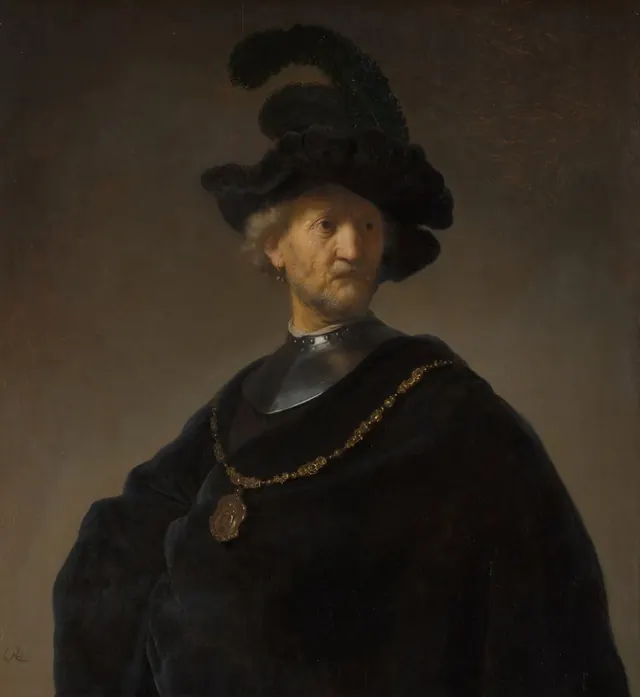
The painting’s story and details
Rembrandt painted this old man in 1631. Rich costume and a turned head resemble formal portraiture, yet the work belongs to another category: a tronie, a study of face and character. Rembrandt and Jan Lievens made such images desirable on the Northern European market. Buyers acquired an expressive figure, usually more affordable than commissioning a named sitter’s portrait.
A large plumed beret almost merges with the dark background. Inventive headgear gives the model an unusual silhouette and historical dignity. Costume suggests a role beyond the sitter’s everyday life. Such freedom of transformation helped make tronies attractive independent paintings.
Light describes folds beneath the eyes and a short prickly beard. Age remains apparent among elaborate attributes. Rembrandt and other artists in his circle repeatedly painted this man. Familiar features allowed changes of clothing, illumination and head position to produce different images.
A steel gorget protecting throat and chest reflects a broad band of light. Beside soft skin, metal feels cool and hard. Economical highlights distinguish materials. Even in a more affordable work, the painter offered craftsmanship capable of attracting a discerning collector.
The gold chain appears in other paintings from Rembrandt’s Leiden and Amsterdam periods and probably belonged to his studio props. It could suggest honour and rank. Rubens and Van Dyck received gold chains from monarchs; Rembrandt never received such a royal gift himself.
A pendant completes the chain’s broad curve. Small highlights pick it out against black cloth. The object enhances dignity and invites close inspection. It functions within a costume while demonstrating the painter’s ability to render an expensive material.
Heavy dark folds shape the cloak. Subtle tonal differences preserve shoulder and bent arm. A large dark mass makes the lit face dominant. Head turn and gaze create presence without a detailed interior.
The model was long called Rembrandt’s father. Later research proposes a Leiden almshouse keeper instead. Identity remains open, while the genre explains the freedom of costume. The tronie turns real age and appearance into a marketable image of imagined dignity. A distinctive tension emerges among the model’s position, honorary attributes and a collector’s pleasure in painting.
More paintings to compare


Period, style and subject
- Movement
- Baroque
- Genre
- Portrait
- Medium
- Oil on panel
- Collection
- Art Institute of Chicago
- Dimensions
- 83.1 × 75.7 cm
- Accession number
- 1922.4467
Sources
Image provided under CC0. Image licence
Adapted and translated from Art Institute of Chicago materials. · Text licence