Aristotle with a Bust of Homer
Rembrandt van Rijn · 1653
Explore the painting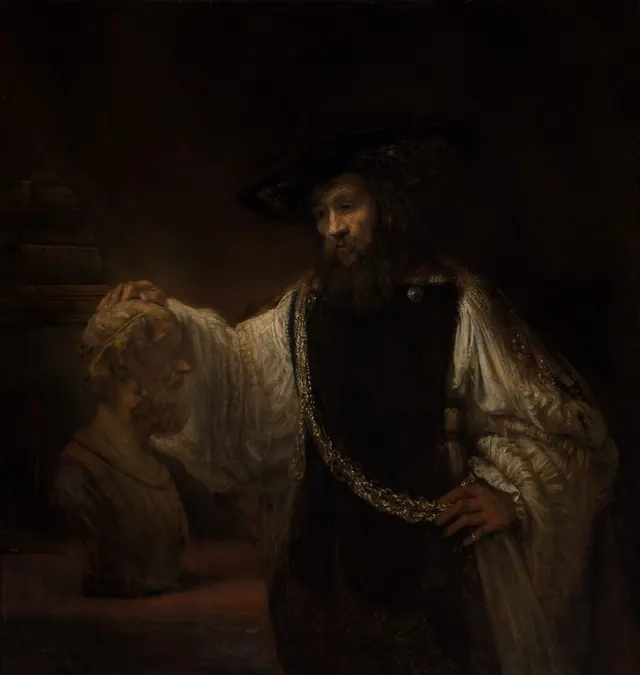
The painting’s story and details
A richly dressed man rests his hand on the head of a stone Homer. In the accepted identification he is Aristotle, standing beside the image of a poet who lived centuries before him. Rembrandt painted the work in 1653 for the Sicilian collector Antonio Ruffo. An ancient thinker in an unusual costume would travel from Amsterdam to Sicily. The commission connected people across countries through an interest in antiquity and the achievement of a living painter.
Fingers rest on the bust’s hair. Rembrandt brings warm skin close to the subdued surface of sculpture, making touch one of the painting’s principal events. The philosopher touches the sculpted likeness of a poet who lived long before him. Memory of a person survives through objects and works that outlast them. The philosopher encounters the poet through such a mediator, and we continue that encounter before Rembrandt’s canvas.
A narrow band encircles Homer’s head. His eyes are represented as unseeing, following the ancient tradition of the blind poet. Aristotle also looks away from the bust. He seems to have paused beside it, pursuing a thought that his face cannot fully disclose. The hand therefore acquires a special role. It establishes a connection where no exchange of glances is possible. The gesture is clear, while the precise course of reflection remains open.
A heavy gold chain crosses the chest. Its medallion is associated with Alexander the Great, Aristotle’s pupil. Such ornaments could signify a reward from a powerful patron. A widespread interpretation therefore compares the philosopher’s worldly success with Homer’s enduring fame. The two hands support this reading. One touches the ancient poet, while the other rests near the precious chain. Rembrandt places the objects together, leaving viewers to weigh their significance.
Brushstrokes gather into folds on the white sleeves and uneven glittering links on the chain. Beside them, black fabric remains in deep shadow. Different paint densities distinguish soft cloth, metal and a living face. Close looking makes this particularly clear as the image begins to resolve into individual brush movements. From farther away, they reassemble into a convincing human presence.
The books in shadow recall another connection between Aristotle and Homer. The philosopher examined how poetry worked, while the poet created works on which such theories could be built. Scholar Joanna Sheers Seidenstein proposes a comparison between artistic rules and natural genius. This is a distinct interpretation of the painting. It extends the discussion of fame to a question relevant to Rembrandt himself: what gives a work the power to move people centuries later?
Ruffo’s early inventory tentatively called the man Aristotle or Albertus Magnus. Even the first owner was initially uncertain about his identity; later he referred to him as Aristotle. This history shows how far the painting is from an unambiguous illustration. The commission belonged to the culture of wealthy collectors. Reflection on recognition was made possible by the very patronage it invites us to consider. Gold retains the beauty and weight of a reward, while the hand still rests on the poet’s head.
Featured in tours
World classics. Altar, palace, exhibition
Familiar paintings and the people for whom they were made.
More paintings to compare


Period, style and subject
- Movement
- Baroque
- Genre
- Portrait
- Medium
- Oil on canvas
- Collection
- The Metropolitan Museum of Art
- Dimensions
- 143.5 × 136.5 cm
- Accession number
- 61.198
Sources
Image provided under CC0. Image licence