Self-Portrait
Rembrandt van Rijn · 1660
Explore the painting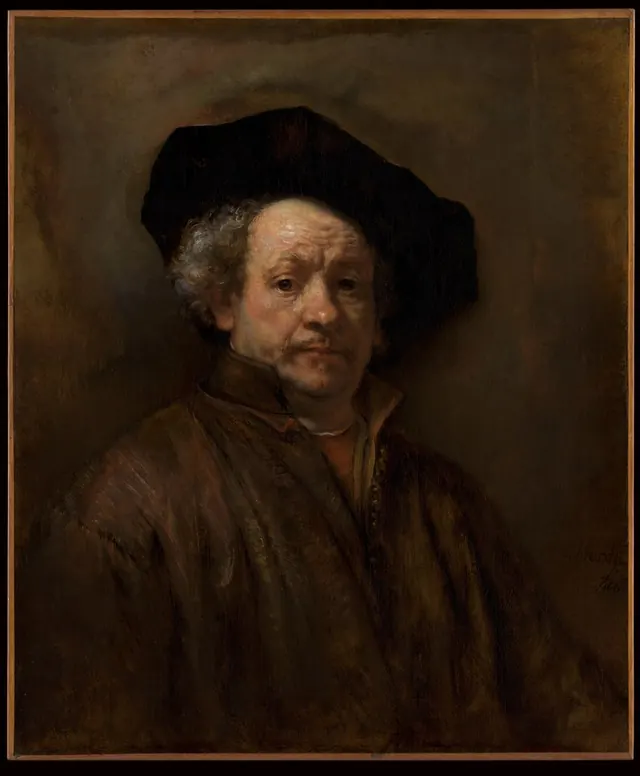
The painting’s story and details
Rembrandt is fifty-four. He painted himself using a mirror. We see a face with a lined forehead, heavy eyelids and grey curls. The self-portrait was painted in 1660. By then he had represented himself repeatedly, at different ages and in different costumes. Each work joined a readily available model to an artistic task. His own face allowed him to investigate light, paint and the impression of human presence that another viewer would encounter.
Pale paint is applied thickly across the forehead, retaining the relief of individual strokes. Shadows deepen around the eyes and small folds gather in the skin. Age becomes visible through the painted surface itself. Close up, we can follow irregularities of paint that become irregularities of a face. From farther away they read as skin again. This transition helps explain Rembrandt’s late manner: the material stays visible while convincing us of a living presence.
The eyes differ in illumination and in the position of their lids. The gaze seems direct, but our impression changes as we linger. It may suggest tiredness, concentration or attentive observation. Rembrandt supplied no narrative that selects one explanation. A human expression easily becomes a story in our minds, although the painting offers visible features and carefully chosen light. The self-portrait rewards attention to that difference.
Pale curls escape from beneath the dark beret. Some strands were scratched into the paint with the back end of the brush, a method clarified when synthetic varnish was removed during conservation. Rembrandt used the brush to apply paint and to take it away. Different actions produce different surfaces. Thick light on the forehead, soft shadow and a fine groove in the hair reveal how many decisions underlie this apparently informal handling.
The brown clothing nearly merges with the background. Its collar rises towards the chin and a broad shoulder fills the lower canvas. There are fewer sharp highlights here than on the face, so our gaze returns to the head even if we begin at the bottom. Rembrandt distributes detail unevenly. The clothing establishes the body’s mass and steady pose while giving the face the principal role in our encounter with the sitter.
The signature and date appear on the right. They remind us that this is a finished work by a recognised painter, made for someone else to see. His self-portraits attracted collectors, combining a famous artist’s likeness with an example of his own hand. That complicates the sense of entering an entirely private moment. Rembrandt chose how to present himself, and his distinctive handling was part of what viewers valued in his work.
Rembrandt had experienced insolvency, and in 1660 Titus and Hendrickje organised an art business that helped him keep working despite his debts. These circumstances matter, but cannot by themselves explain his expression. The late self-portraits also show a valued artist continuing to make deliberate choices. Aging and sustained professional work can be seen together here.
More paintings to compare


Period, style and subject
- Movement
- Baroque
- Genre
- Portrait
- Medium
- Oil on canvas
- Collection
- The Metropolitan Museum of Art
- Dimensions
- 80.3 × 67.3 cm
- Accession number
- 14.40.618
Sources
Image provided under CC0. Image licence