Composition with Red, Yellow, and Blue
Piet Mondrian · 1927
Explore the painting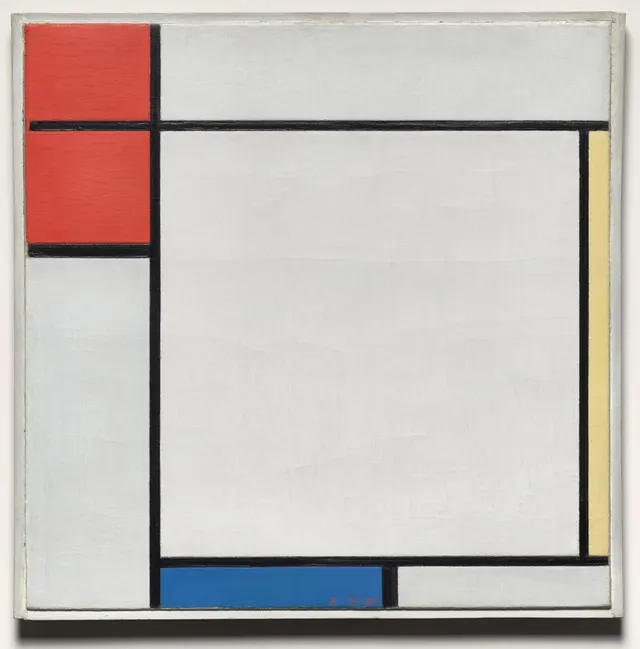
The painting’s story and details
Piet Mondrian painted this composition in Paris in 1927. A few straight lines and three colours were, he believed, capable of creating a shared language of art. After the First World War, he connected balance on canvas with the hope of a more harmonious society. He called his system Neo-Plasticism. Its rules still left countless decisions about band widths, rectangle sizes and the intervals between them.
A black horizontal crosses the red field at the left. The colour appears heavy and close although its paint occupies the same plane as the rest. The line divides the red into two unequal sections. Moving it higher or lower would change how firmly the colour anchors the upper-left corner.
A large light rectangle occupies the centre. Its spaciousness becomes especially apparent beside the narrow edge bands. Brush traces and fine cracks mark the pale paint. This geometry was made by hand on canvas. Close viewing reveals a surface unlike a perfectly uniform colour diagram.
Yellow is compressed into a narrow vertical band at the right. It occupies much less space than red yet remains bright beside the black boundary. Mondrian seeks balance through unequal means. One colour’s area can be counterweighted by another’s position and intensity.
A blue band lies along the lower edge. A short black vertical stops it at the right, followed by another light section. This offset prevents symmetry. The eye returns from blue to red and yellow, testing their relationship again.
Small irregularities in the paint appear where the black lines cross. The vertical continues towards the edges, while horizontal sections end at different distances. The arrangement is strict without being assembled from identical cells. Differences sustain movement within a restricted vocabulary of forms.
Mondrian also chose the narrow grey wooden frame, bringing the painting’s boundary into the same balance. His hope for a universal language leaves an open question: how similarly do different viewers feel the weight of red, the openness of white and the stability of a straight line? The painting lets that hope be tested through particular differences between its parts.
More paintings to compare
Period, style and subject
- Movement
- Neo-Plasticism
- Genre
- Abstraction
- Medium
- oil on canvas
- Collection
- Cleveland Museum of Art
- Dimensions
- Unframed, 49.5 × 49.5 cm
- Accession number
- 1967.215
Sources
Image provided under CC0. Image licence