Lozenge Composition
Piet Mondrian · 1921
Explore the painting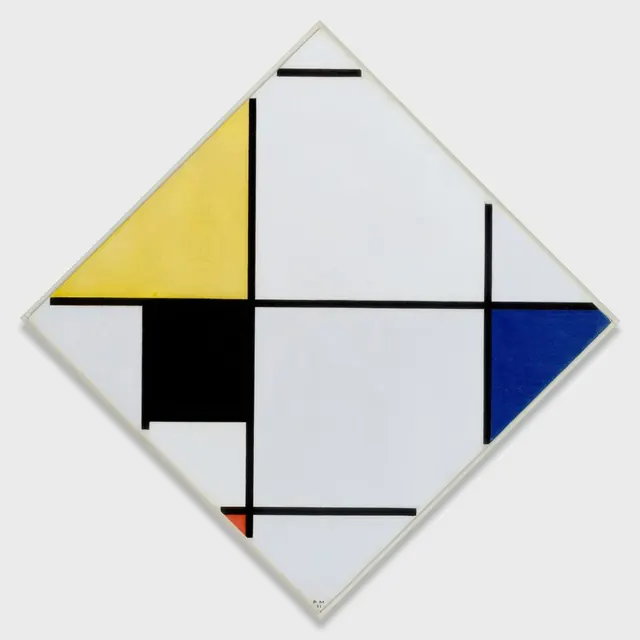
The painting’s story and details
In 1921 Mondrian painted a square canvas intended to hang on a corner. Inside it, the lines remained horizontal and vertical. He arrived at this language through landscape and the Cubism of Picasso and Braque. Trees and objects were still recognizable in earlier works; now relationships between colour and form became subjects in themselves. He called his approach Neo-Plasticism and connected pictorial equilibrium with a search for harmony in the world.
Two black bands and the canvas’s sloping edge enclose the yellow field on the left. The format itself helps construct the shape. Extending the black lines mentally suggests a larger rectangular composition from which this diamond has been cut. The National Gallery’s research catalogue illustrates precisely this comparison. The outer boundary crops the forms, allowing us to imagine them continuing beyond the painting.
The blue area occupies the right corner. The horizontal band above reaches the edge and ends in a slanting cut. The vertical to its left also meets the sloping boundary. Internal straight lines and external diagonals therefore give different edges to the same coloured field. This small passage makes it possible to imagine how much the arrangement would change if a line moved by even its own width.
Red occupies very little space: a small triangle near the lower corner. Far smaller than the yellow field, it remains easy to distinguish among pale paint and black bands. Mondrian’s equilibrium allows such differences. Colours occupy unequal areas and act at a distance from one another. You can test your own impression by covering the red with a finger. Does the composition still feel balanced?
The black rectangle below the yellow field is much broader than the dividing lines. Black occupies an area of its own, just as blue or yellow does. The geometry looks strict, yet the areas do not repeat a uniform unit. The National Gallery catalogue stresses that the lines in this work were positioned intuitively.
The upper end of the right vertical seems unattached. Look closely and one corner touches the canvas’s sloping edge. The band’s square end remains fully visible against the pale field. The line therefore connects with the boundary while retaining the appearance of a separate element. What seems from a distance to be a line ending inside the painting is more precisely adjusted than that.
Pale areas occupy most of the canvas. The upper field has several unequal sides, yet it is easy to imagine as a rectangle with its corners cut off. Below, another pale area adjoins the tiny red triangle. These spaces are painted too, participating in the relationships between colours. Surface variations and small irregularities at the edges remain visible in the reproduction: this is oil paint worked by hand on canvas.
Mondrian participated in De Stijl, which brought together artists, designers and architects. Their pursuit of harmony extended to furniture, houses and urban space. Spare painting belonged to a larger hope of transforming daily life through art. That hope is open to debate. Does balancing different colours give an artist grounds to propose a shared order for people with different desires? The painting reveals the scale of the ambition while leaving the question unresolved.
Featured in tours
How painting changed in the early twentieth century
Colour, the human figure and early experiments in abstraction.
More paintings to compare
Period, style and subject
- Movement
- Neo-Plasticism
- Genre
- Abstraction
- Medium
- Oil on canvas
- Collection
- Art Institute of Chicago
- Accession number
- 1957.307
Sources
Open-access Art Institute of Chicago reproduction, CC0. Image licence