Farmer Returning Home in Autumn
Yosa Buson · 1781
Explore the painting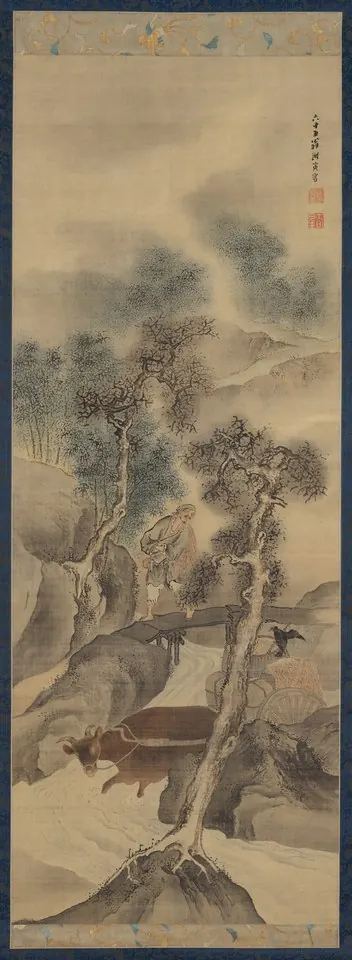
The painting’s story and details
A farmer returns with his harvest and notices a bird helping itself to the grain. Yosa Buson painted this autumn scene in 1781. One of Japan’s major haiku poets, he also worked as a professional painter. A minor incident brings together season, human character and the workings of rural labour. The landscape unfolds what a short poem might capture in a few lines.
The man pauses on a small bridge and turns towards the cart. In the museum’s account, he playfully scolds the crow pecking at the grain. His tilted head and raised hand make the distant figure part of a recognizable everyday incident. A small loss occupies his attention within a large, almost empty space.
The cart carries the gathered harvest. A small dark bird gains unexpected compositional importance because it has made the man stop. Buson connects the figure’s movement to an almost inconspicuous mark. Following this exchange requires close looking, moving in scale from an entire valley to a few short brushstrokes.
The buffalo pulls the cart through water while its owner remains on the dry bridge. The painter assigns different routes to animal and man. A dark back and heavy head connect the rural scene to the work required to transport a harvest. The landscape’s calm contains an effort that continues while the farmer attends to the bird.
Twisted foreground trunks cross pale water. Uneven lines of changing thickness form their branches, giving the place age and palpable texture. Soft reddish and grey tones sustain an autumnal character while leaving the space free of continuous dense paint.
Mountains at the top dissolve into pale mist. Buson studied Chinese painting, partly through printed manuals, learning to construct depth by alternating occupied and open areas. Travel and poetic practice complemented that education. Here a major landscape tradition accommodates a particular village incident.
The painting preserves two scales of life. Against distant mountains, the farmer’s encounter with a crow is scarcely noticeable; for him it interrupts the journey home. Buson gives this trifle duration and attention. Humour grows from the disproportion between considerable labour and a tiny thief, while autumnal calm has room for both.
Featured in tours
Japanese painting. Scrolls and screens
Literature, temples, the arrangement of rooms and everyday life.
More paintings to compare
Period, style and subject
- Movement
- Japanese painting
- Genre
- Everyday life
- Medium
- Hanging scroll; ink and light color on silk
- Collection
- Cleveland Museum of Art
- Dimensions
- Painting only, 130.8 × 46.2 cm
- Accession number
- 1970.77
Sources
Image provided under CC0. Image licence