Church Street El
Charles Sheeler · 1920
Explore the painting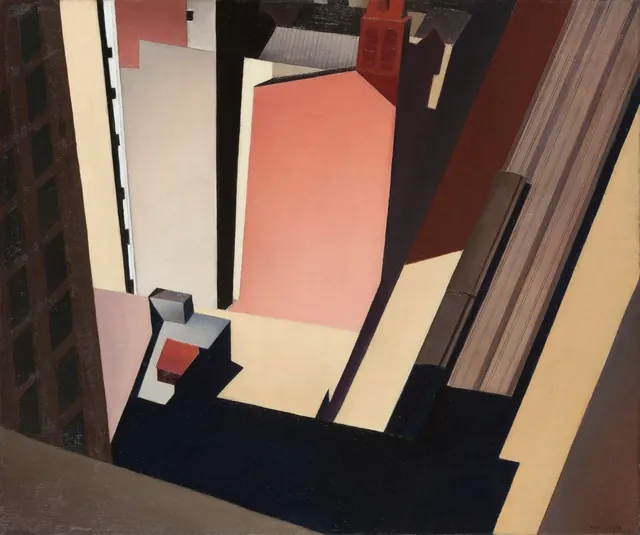
The painting’s story and details
New York is seen from a height at which the street almost disappears. Charles Sheeler painted this view in 1920, while making the film Manhatta with photographer Paul Strand. An elevated view of Lower Manhattan provided the composition’s basis. Broadway and Wall Street lie below, with the elevated railway on the right. Sheeler constructs this complex piece of city from a few coloured planes. Even the train fits the design as precisely as the stationary buildings.
The large pink wall in the centre is completely smooth, without masonry, signs or individual windows. Pale rectangles and black strips of shadow lie beside it. This simplification is characteristic of Precisionism, an approach in American art that gave familiar buildings and machines clear geometric outlines. Around 1920, artists were seeking forms for a country of expanding factories, transport networks and skyscrapers. Sheeler makes the painting’s surface as orderly as an engineering drawing.
On the right, the rails run diagonally towards the top edge. The train roof follows almost the same direction. For a city resident this is a transport route; for the painter it is a long shape linking the bottom and top of the canvas. There is no smoke or blurred trace of motion. Sheeler depicts the machine as distinctly as a wall. We recognize its construction, but have to supply its speed in our imagination.
The small structure at the lower left consists of several light facets and an almost black side. It is easy to examine this detail as a problem of volume: where an edge falls, which way light comes from, and which plane faces away. Photography helped Sheeler find unexpected viewpoints and strong lighting relationships. In paint he could reduce textures and control the amount of detail. The camera supplied material for choices that are evident in the painting’s smooth surfaces.
The black shadow at the bottom forms a stepped shape with sharp corners. Its outline is so definite that it carries almost the same weight as the walls. Depth has to be inferred from the junctions of surfaces: it can be hard to tell where a roof ends and street space begins. Sheeler uses that uncertainty. We alternate between seeing an actual city and a flat arrangement of pink, cream and black. A familiar subject remains recognizable close to the edge of abstraction.
Rows of windows on the narrow left facade remind us that these geometric volumes are intended for people. Human presence is much stronger in Manhatta. The film opens with a ferry arriving; commuters disembark for work, followed by busy streets. Lines by Walt Whitman accompany the images, which follow the city from morning arrival to sunset. In paint, Sheeler selects a single viewpoint and stops time. Comparing the works shows how much depends on choosing one image.
The high viewpoint reveals the city’s structure while distancing us from its inhabitants. Its strict order can inspire both admiration for construction and a sense of alienation. Everyday details of passengers’ and residents’ lives almost disappear from this height. The modern city changes depending on whether we look from a pavement or a rooftop.
Featured in tours
How painting changed in the early twentieth century
Colour, the human figure and early experiments in abstraction.
American landscape. Land and its inhabitants
Nature, territorial expansion, the Civil War and urban life in American painting.
Period, style and subject
- Movement
- Precisionism
- Genre
- Landscape
- Medium
- oil on canvas
- Collection
- Cleveland Museum of Art
- Dimensions
- Unframed, 41 × 48.5 cm
- Accession number
- 1977.43
Sources
Image provided under CC0. Image licence