The Holy Family on the Steps
Nicolas Poussin · 1648
Explore the painting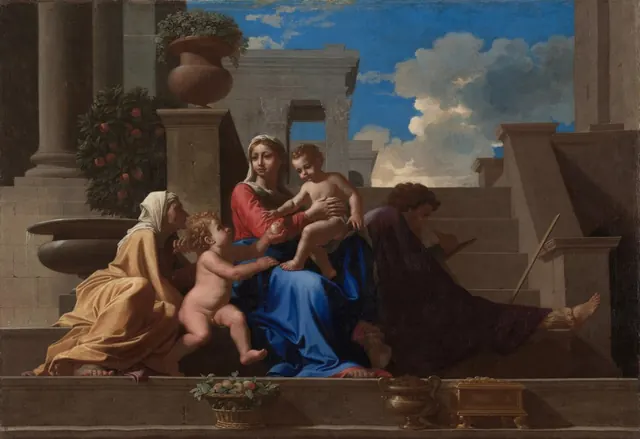
The painting’s story and details
Mary holds Jesus on her lap as the young John the Baptist reaches towards him. John’s mother Elizabeth and Joseph sit nearby. Nicolas Poussin painted this family gathering in 1648, having long been based in Rome. His mature art developed among learned collectors who valued relatively small paintings with carefully considered subjects. This quiet scene invites close examination. The arrangement of hands and a few objects connect Christ’s childhood with Christian teaching about salvation.
Mary sits at the centre, higher than the other adults. Her red clothing and blue mantle stand out against grey stone, with the well-lit child on her lap. The figures form a stable group that widens towards the base. This gives mother and son special importance without a crown or radiant halo. At the same time, Mary supports Jesus with an entirely recognizable gesture. Poussin joins bodily care for a child with his formal presentation to the viewer.
John offers Jesus an apple, and Jesus opens his hand towards it. In Christian art, an apple often recalls the Fall of Adam and Eve. In Christ’s hands it connects that early story with the promise of redemption. The Cleveland Museum reads the fruit in this way. A familiar childhood gesture expresses a complex relationship between the beginning of biblical history and Jesus’s future sacrifice. The apple itself remains an ordinary, recognizable object.
Elizabeth leans towards Jesus and supports her son. Her face is almost level with the offered apple, bringing the adult’s attention and the child’s action together. The museum interprets her inclination as foretelling Christ’s eventual death. That meaning cannot be established from her expression alone; it comes from a religious reading of the whole group. A relative’s care coexists with the viewer’s knowledge of the Gospel story, without making this a record of a particular conversation described in scripture.
Joseph sits on the right, turned away from the others. His figure is almost entirely in shadow, with tools beside him and a compass in his hand. It recalls his trade. In the museum’s interpretation, the instrument also connects him with God the Father as the maker of the world. Everyday work and theological analogy sit together. Poussin separates Joseph from the movement around the apple while including him in the larger arrangement through the long line of his leg and the shared steps.
Columns and stairs establish clear verticals and horizontals. Poussin worked through the arrangement in three surviving compositional studies. The sheet in the Morgan Library already includes the steps and a similar group of figures, while objects and background were still changing. That process helps explain the conviction of the final design. Each figure seems to have naturally found its place; the drawings reveal the alternatives tested before those positions were settled.
Poussin represents family closeness in a form that can be read through the story of salvation. The apple, compass and Elizabeth’s gesture acquire further meanings for someone familiar with Christian tradition. Those meanings preserve the simple visible subject: a mother holds her child while relatives sit nearby. The painting joins everyday care with sacred history. Imposing steps and columns give the small group an importance that church paintings often conveyed through immense scale and dramatic action.
More paintings to compare
 Nicolas Poussin
Landscape with Saint John on Patmos
1640 Nicolas Poussin
Blind Orion Searching for the Rising Sun
1658 Nicolas Poussin
The Abduction of the Sabine Women
probably 1633–34 Nicolas Poussin
The Baptism of Christ
1641/1642 Nicolas Poussin
The Assumption of the Virgin
c. 1630/1632 Bartolomé Estebán Murillo
Virgin and Child
1670sPeriod, style and subject
- Movement
- Baroque
- Genre
- Religious art
- Medium
- oil on canvas
- Collection
- Cleveland Museum of Art
- Dimensions
- Unframed, 73.3 × 105.8 cm
- Accession number
- 1981.18
Sources
Image provided under CC0. Image licence