Blind Orion Searching for the Rising Sun
Nicolas Poussin · 1658
Explore the painting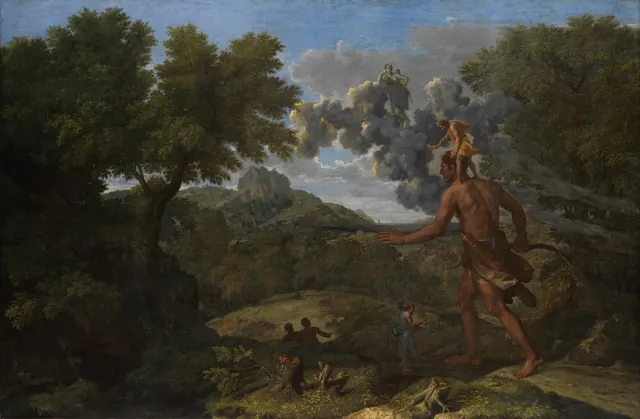
The painting’s story and details
The blind giant Orion is walking towards the rising sun, whose rays will restore his sight. Poussin painted the work for Michel Passart in 1658. Its narrative derives from the ancient writer Lucian. Yet the immense landscape occupies more space than the hero’s adventure. Trees, water and clouds participate in the story of his healing.
Orion reaches forwards, feeling his way. A quiver hangs from his shoulder and he carries a bow in the other hand: a hunter temporarily unable to use his strength. His feet negotiate uneven ground. Even a giant must adjust his stride to obstacles underfoot.
Cedalion stands on Orion’s shoulders. He bends and points out the direction. One supplies the other with sight; the other carries him above the forest. Poussin arranges them so that the guide’s gesture continues in the giant’s outstretched arm. Two bodies of different sizes share a single movement.
A person below raises a hand towards Orion. Beside the giant, an adult looks very small, yet help comes from this lower position. The turned head and open palm make the appeal legible without words. Bodily size and the ability to find one’s way are quite separate qualities in this group.
Diana, goddess of hunting and the moon, stands in the clouds. Poussin also drew on Natale Conti’s Renaissance interpretation of the myth. It connected its characters with natural phenomena, including the conversion of earthly vapours into rain. The cloud wraps closely around Orion because it belongs to the painting’s meaning as fully as the hero does.
The tree on the left rises from its roots almost to the canvas’s upper edge. Stumps, branches and small plants fill the foreground, with wooded slopes beyond. Poussin studied stones and vegetation closely. These details of nearby ground give a material foundation to a world inhabited by a giant and a goddess.
Two small figures sit to the left of the path; one extends an arm. A valley opens beyond them, crossed above by pale trails of vapour. The museum’s present interpretation connects sun, water and clouds in a cycle. An ancient story of restored sight thus becomes a way of imagining living things’ dependence on natural processes.
Poussin worked mainly in Rome, among collectors and scholars of antiquity. A painting like this could be discussed as myth, landscape and an interpretation of nature simultaneously. Its enormous hero depends on his companions and the sunlight for recovery. The largest figure on the canvas cannot reach his destination through strength alone.
More paintings to compare
 Nicolas Poussin
Landscape with Saint John on Patmos
1640 Nicolas Poussin
The Abduction of the Sabine Women
probably 1633–34 Nicolas Poussin
The Holy Family on the Steps
1648 Nicolas Poussin
The Baptism of Christ
1641/1642 Nicolas Poussin
The Assumption of the Virgin
c. 1630/1632 Giovanni Battista Tiepolo
Allegory of the Planets and Continents
1752Period, style and subject
- Movement
- Baroque
- Genre
- Myths & allegories
- Medium
- Oil on canvas
- Collection
- The Metropolitan Museum of Art
- Dimensions
- 119.1 × 182.9 cm
- Accession number
- 24.45.1
Sources
Image provided under CC0. Image licence