Monkeys by a Stream
Nagasawa Rosetsu · c. 1796
Explore the painting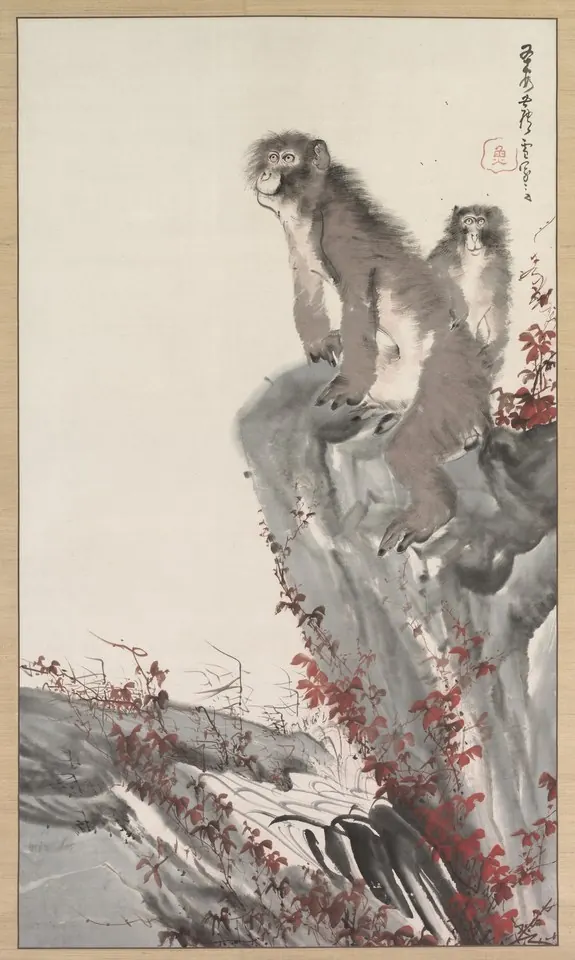
The painting’s story and details
Two Japanese macaques occupy a rock. Nagasawa Rosetsu painted them around 1796, near the end of his life. A pupil of Maruyama Ōkyo, a leading Kyoto master, he developed an individual approach to animals. Close observation combines here with an expressive staging of encounter. One monkey attends to something at the side; the other looks almost directly at the viewer.
The larger monkey turns its head to the left. Pale fur surrounds the pinkish skin of its face, and small dark marks define the eyes. Its gaze continues beyond the painting. That incompleteness holds attention: the depicted animal belongs to a world extending outside our field of view.
The smaller macaque peers from behind its companion and looks forward. Its face lies near the edge, making the gaze seem responsive to our arrival. A short muzzle and rounded eyes readily prompt human associations. Their source lies in the staging itself: the painter directs one line of attention straight towards us.
A leg hangs loosely from the rock. This small extension beyond its edge gives the body weight and ease. The pose looks comfortable, as though the animal could maintain it for some time without effort. Nearby, numerous fine strokes of fur sustain the rounded volume of its body.
Angular planes construct the rock beneath the animals. Its sharp directions differ from their soft bodies. The painter changes his brushwork with the surface: fur requires frequent light touches, while broader, firmer movements suffice for stone. Contrasting textures make the animals’ proximity especially tangible.
Fine stems and reddish leaves descend beside the rock. A few lines indicate water below. These signs give the place a season and setting while leaving much of the paper open. Attention remains with the two bodies and their different directions of gaze.
The encounter makes observation feel reciprocal. We inspect the animals while one macaque seems to inspect us. Rosetsu draws on our familiarity with human faces and gestures to bring another species close. At the same time, the other monkey’s gaze turns away, preserving a course of life independent of the viewer.
More paintings to compare
Period, style and subject
- Movement
- Japanese painting
- Genre
- Animals
- Medium
- hanging scroll; ink and color on paper
- Collection
- Cleveland Museum of Art
- Dimensions
- Overall, 164.4 × 95.4 cm
- Accession number
- 1985.192
Sources
Image provided under CC0. Image licence