Gamecocks
Katsushika Hokusai · dated 1838
Explore the painting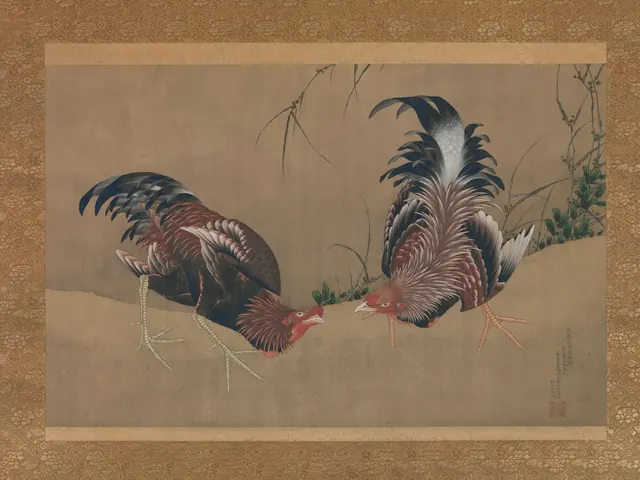
The painting’s story and details
Two cocks have brought their heads close together, leaving little space between them. Dated 1838, the scroll is associated with Hokusai, although its authorship remains debated. Japanese gamecocks were bred for fighting. The animals’ tense arrangement therefore has a specific human context. The painter presents a moment before a possible clash and lavishes on their plumage the attention that costly clothing receives in a formal portrait.
The bird at the right stretches its neck and opens its beak. Its lowered head is nearly level with its opponent’s. Sharp lines distinguish beak, eye, and red skin from the softer neck feathers. Here the large ornamental body acquires a direction of action. The distance between the beaks holds attention on the empty interval the birds have yet to cross.
The left cock also bends forward, but its body forms a different curve. The birds are not mirror images. Their heads converge, their tails diverge, and their substantial bodies rise above the possible encounter. This arrangement balances the image without making the poses tranquil. Differences between the animals remain visible even as they make related movements.
Long tail feathers at the left curve in separate bands. Colored reflections and thin pale edges appear on dark surfaces. The painter distinguishes stiff shafts from softer areas of plumage. Such detailed work on silk required time, and the museum suggests a deluxe commission. An object for sustained domestic viewing turns animals used in competition into a subject of prolonged aesthetic attention.
The feet are planted on a pale, barely described ground. Claws have sharp contours, and small points of support bear the bodies’ weight. There is no arena, owner, or audience. Their absence makes the birds the scene’s only participants, although the term gamecocks recalls breeding and entertainment organized by people. The beautiful animal image retains a connection with a practice involving injury.
The inscription at the right gives a name, an age of seventy-nine, and a date compatible with Hokusai’s life. However, its unusually long wording includes Gozaemon, a name he is not otherwise known to have used. The seal, by contrast, has parallels on accepted works. This combination of evidence keeps the question open while connecting the scroll with Hokusai and his studio.
The scroll invites two different discussions: the famous master’s involvement and the pleasure of viewing animals raised for combat. Attribution affects its place in art history and its reputation. Close attention to the birds also sustains a question about how human entertainment turns a living creature’s strength and beauty into spectacle.
More paintings to compare
Period, style and subject
- Movement
- Japanese painting
- Genre
- Animals
- Medium
- Hanging scroll; ink and color on silk
- Collection
- The Metropolitan Museum of Art
- Dimensions
- Image, 55.3 × 85 cm
- Accession number
- 14.76.56
Sources
Image provided under CC0. Image licence