White Herons
Maruyama Ōkyo · 1769
Explore the painting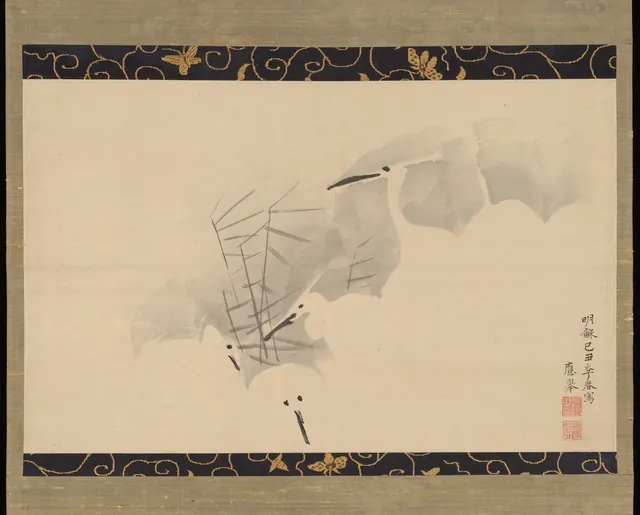
The painting’s story and details
On this scroll from 1769 the white bodies of the herons are largely unpainted. Maruyama Ōkyo defines them through grey ink around them and a few dark marks within. The birds are readily recognizable despite the absence of detailed plumage. This economy rests on a habit of observing life. Ōkyo sketched animals in different positions and selected a few precise features for a finished painting. Here the turns of the heads distinguish the herons even where their bodies merge into blank paper.
The upper bird’s beak points to the left. No continuous dark outline surrounds its neck; the curve appears against the grey wash behind it. The pale body and empty background share the paper’s colour. An edge emerges only where ink is placed beside it. The artist leaves part of the form incomplete, allowing the eye to continue it. Close viewing reveals the method of depiction; from further away the bird resolves into a whole silhouette again.
Below, one head is in profile while another is seen almost from the front. The same long beak becomes a diagonal in one view and a short narrow strip in another. Sketching from life was known in Japan long before Ōkyo. Kyoto National Museum notes that such drawings had long served chiefly as preparatory material. Ōkyo helped make direct observation a visible quality of finished works. The differences between neighbouring heads matter more than a general rule for how a heron should look.
The lowest bird’s two eyes are separate dark dots. The beak points down between them, while the rounded head almost disappears into the white. Cover those few marks and the bird becomes much harder to distinguish. Likeness depends on the distance between the eyes and the placement of the beak. Details that this angle would conceal are omitted. Close observation and elaborate description emerge as two different tasks.
Thin stems cross the space between the heads. Their crisp lines differ from the broad soft washes. On the same sheet ink creates both definite edges and an indistinct atmosphere. The birds cluster closely together, yet the composition remains spacious. The emptiness around them keeps attention on small differences of pose. Filling it with grass and a distant landscape would make these few heads harder to find among competing details.
Two red seals stand beside the inscription on the right. After the nearly colourless birds, this small area of red is immediately noticeable. Ōkyo came from a poor farming family and moved to Kyoto when young. His life-based painting became highly popular there. Kyoto National Museum cites the writer Ueda Akinari, who associated the city’s enthusiasm for this approach with Ōkyo’s emergence. His success changed both viewers’ expectations and the practice of other painters.
The Maruyama school formed around Ōkyo. Goshun, who had studied with the poet and painter Buson, came close to Ōkyo after Buson’s death and developed the Shijō school. These approaches influenced several generations of Kyoto painters. An artist teaches people to trust their own observation, and his solutions then become models for pupils. White Herons shows what could be passed on: attention to differences of pose and the ability to leave only the necessary brush marks on paper.
Featured in tours
Japanese painting. Scrolls and screens
Literature, temples, the arrangement of rooms and everyday life.
More paintings to compare
Period, style and subject
- Movement
- Japanese painting
- Genre
- Animals
- Medium
- Hanging scroll; ink on paper
- Collection
- The Metropolitan Museum of Art
- Dimensions
- 35.5 × 56.6 cm
- Accession number
- 1975.268.71
Sources
Image provided under CC0. Image licence