White Oval
Wassily Kandinsky · 1919
Explore the painting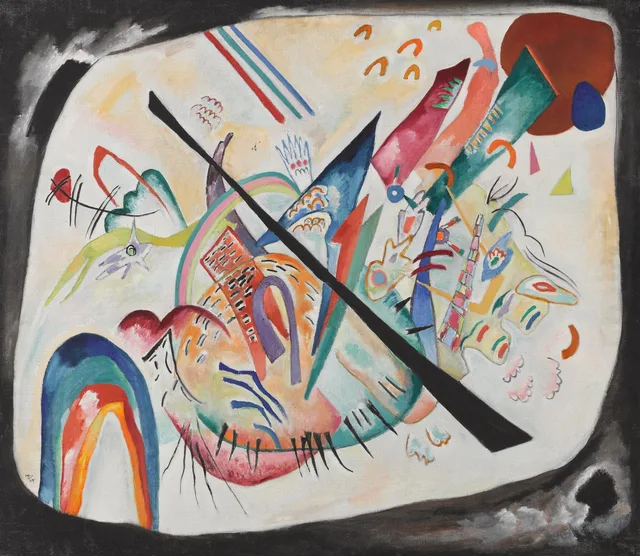
Kandinsky painted White Oval in Moscow in 1919. After the Revolution he helped reorganise artistic life and establish the Museum of Painterly Culture. Coloured forms gather within a pale shape surrounded by black. The work marks a transition from freer early abstraction towards ordered relationships of lines and planes that later became central to his art.
The white area resembles a separate picture within a dark frame, although both belong to one canvas. Its irregular edge retains free brush movement. Colours share a field on which their size and placement can be compared. The arrangement encourages us to follow relationships between forms.
A long black diagonal crosses almost the whole composition, linking distant areas through a dense group of coloured elements. Its changing width gives it weight and direction. Such qualities can organise attention as effectively as a road or human gesture in a recognisable scene.
Curves, short strokes and small patches cluster densely in the middle, producing several simultaneous rhythms. Some lines repeat while others change direction abruptly. Looking moves between the larger structure and small surface events. Kandinsky contains the complexity within the clearly bounded white field.
Several coloured arcs stand apart at the lower left as an independent rhythmic motif. They may recall a rainbow, but no single object name is required. Their sequence, relative widths and difference from nearby angular forms remain active parts of the painting.
A red area and small blue shape stand apart in the upper right. Their distance gives them independence while balancing the denser lower region. The white interval works alongside painted forms. Empty space has a concrete role: changing the distance would change the relationship between the colours.
Later in Germany, Kandinsky increasingly used regular geometric elements. The museum compares White Oval with Painting with Grey of 1923, where a related structure became more geometrical. The comparison shows abstraction as a developing method of organising experience, testing how far colour, direction and distance can sustain a pictorial event.
More works by Wassily Kandinsky
- Medium
- Oil on canvas
- Collection
- State Tretyakov Gallery
- Dimensions
- 80 × 93 cm
- Accession number
- Инв.11924
Sources
Public-domain artwork. Digital reproduction from the State Tretyakov Gallery. Image licence