Improvisation No. 30 (Cannons)
Vasily Kandinsky · 1913
Explore the painting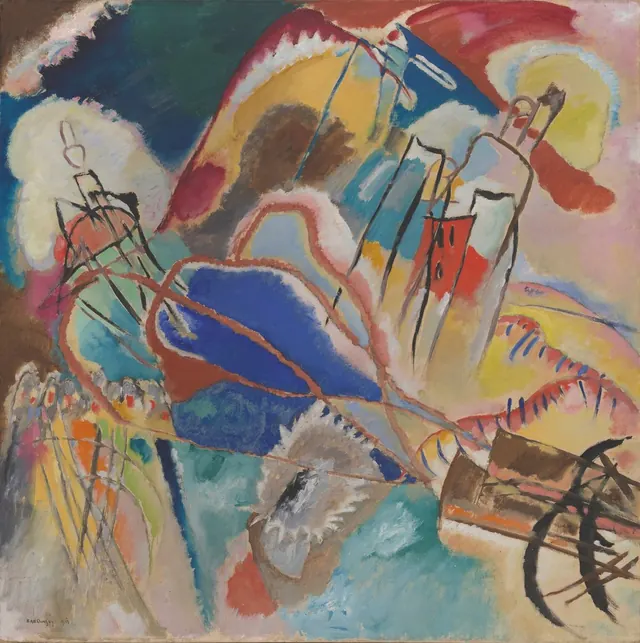
The painting’s story and details
Kandinsky painted this work in 1913 and called it Improvisation No. 30. Its buyer, the Chicago collector Arthur Jerome Eddy, recalled that workmen handling the canvas immediately called it a war picture. They had recognized cannons among the coloured patches. The artist explained the work differently in a detailed letter to Eddy. Their disagreement offers a useful introduction to abstraction: recognizable objects coexist with direct testimony about what the painter considered most important.
At the lower right are wheels and cannon barrels pointing left. Kandinsky allowed that they might have appeared because of constant talk of war during the year. He nevertheless emphasized that he had not set out to depict a battle. The painting predates the First World War, but the letter does not make it a prophecy. More revealing is the possibility that external events entered a work the artist understood as an expression of an inner state.
Tall black outlines on the right resemble leaning buildings. Red paint crosses their boundaries and continues outside them. The familiar relationship between drawing and colouring loosens: a line no longer has to contain colour within an object. Eddy saw towers and banners, while acknowledging that a viewer already thinking about war could keep finding further evidence. Recognizing an object directs our subsequent looking and can make other features harder to notice.
The large blue patch lies just below the middle. In his letter, Kandinsky called it the painting’s principal centre and said that blue itself counteracted the effect of the cannons. This was his understanding of colour; viewers need not share the same response. We can notice where our eyes are drawn: to the saturated blue, black wheels or red bands. That comparison does not require first deciding what the blue shape represents.
On the left, thin lines cross broad red and blue areas. Below, they gather into a group of elongated figures. Kandinsky described the whole design as a diagonal cross with heavier corners and a looser centre. That weight can be understood through the density of dark lines, their frequency and sharp intersections. The letter lets us compare his explanation with our own observations instead of guessing a single concealed story.
A red band curves over yellow at the top. It is much broader than the black outlines, with soft edges preserving the sweep of a wide brush. Musical terms in Kandinsky’s titles belonged to his artistic programme. In Concerning the Spiritual in Art, published in 1912, he explored how colour and form might affect people as music does through sound. The comparison explains the title without assigning a separate note to every stroke.
An irregular grey patch lies beneath the blue centre. Kandinsky assigned it almost equal importance in his explanation. He recalled even telling himself aloud to make the corners heavier while painting. Improvisation therefore did not mean an absence of decisions or control. He described strong inner tension while also judging the size, density and placement of forms. A freely emerging image coexisted with attention to the canvas’s organization.
Eddy published the artist’s explanation in Cubists and Post-Impressionism in 1914. A collector was helping new paintings find an audience and a language for discussion. Yet his own account reveals the limits of an artist’s commentary. Cannons remain recognizable even when Kandinsky asks us to attend to colour and form. We can hold both responses together. The painting raises a question about who determines its meaning: the maker explaining his intentions, or a viewer whose associations lead elsewhere.
Featured in tours
How painting changed in the early twentieth century
Colour, the human figure and early experiments in abstraction.
More paintings to compare
Period, style and subject
- Movement
- Expressionism
- Genre
- Abstraction
- Medium
- Oil on canvas
- Collection
- Art Institute of Chicago
- Accession number
- 1931.511
Sources
Open-access Art Institute of Chicago reproduction, CC0. Image licence