Herodias
Ivan Kramskoy · 1884–1886
Explore the painting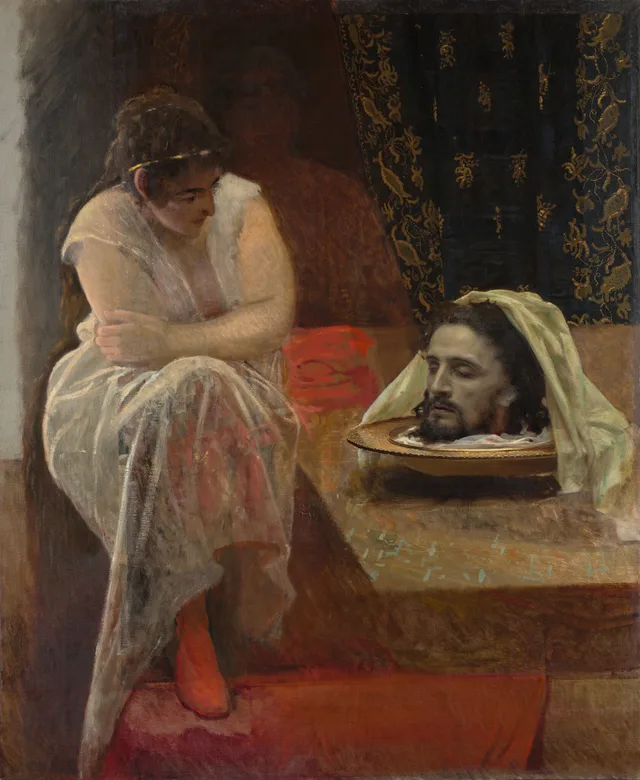
Herodias sits beside the head of John the Baptist. In the Gospel account she secured his execution through her daughter Salome’s request to Herod Antipas. Kramskoy worked on the unfinished picture in 1884–86. He chose the aftermath of killing, concentrating attention on a living person’s relation to the dead.
Herodias looks down with her arms folded before her. Her substantial seated figure fills the left half, containing movement within a closed shape. The painting offers no extended action explaining the sequence of events. Knowledge of the story establishes the encounter, while the image holds us at its consequences.
John’s head rests on a dish, its face clearly illuminated and completely still. The museum interprets the painting through Kramskoy’s interest in moral strength confronting physical violence. The composition supports that reading by concentrating on two faces without a crowded courtly setting.
Pale translucent fabric covers Herodias’s knees. Complex folds and the seated figure’s weight occupy much of the image, lending bodily conviction. Rich surroundings coexist with the consequences of cruelty, requiring us to hold the painting’s visual attraction together with the subject’s moral gravity.
Red fabrics connect the lower composition with the seat. Red also figured prominently in literary versions known in Kramskoy’s period. Turgenev translated Flaubert’s Herodias in 1877, and Massenet later composed an opera. The painting’s direct inspiration is uncertain, but the subject circulated actively between different arts.
Dark patterned fabric behind the table closes the room’s depth, returning attention to figure and dish. Uneven degrees of finish reveal the work’s incomplete state, yet the central relationship is already clear. We can see what the painter established before bringing every part of the surface to a similar finish.
After Kramskoy’s death, Repin advised Tretyakov to acquire Herodias from the 1887 memorial exhibition. Its significance did not depend on final finish. It continues the biblical questioning familiar from Christ in the Wilderness, using religious history to consider what remains of a victory achieved through another person’s destruction.
More works by Ivan Kramskoy


- Medium
- Oil on canvas
- Collection
- State Tretyakov Gallery
- Dimensions
- 145 × 120.4 cm
- Accession number
- Инв.683
Sources
Public-domain artwork. Digital reproduction from the State Tretyakov Gallery. Image licence