Jesus Mocked by the Soldiers
Édouard Manet · 1865
Explore the painting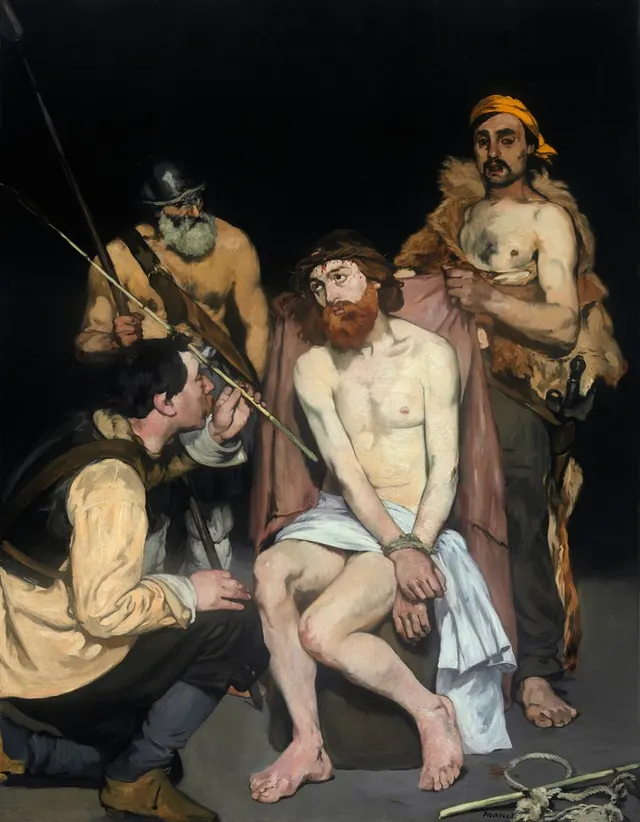
The painting’s story and details
Manet exhibited Jesus Mocked by the Soldiers alongside Olympia at the Salon of 1865. Both very different paintings met hostile attention. In the religious scene, Christ’s ordinary physicality troubled viewers. Manet revisited a long-established subject while making the sacred event resemble a difficult staging with living people directly before us.
Christ looks upwards, blood marking his forehead beneath the thorns. His head tilts and his body slackens. Manet presents someone who has suffered violence and awaits execution. Without a halo, illumination on skin becomes the main means of distinguishing the central figure.
Bound hands rest on his knees. Rope makes the passive pose concrete evidence of coercion. Sharp lighting exposes weight, skin and bodily awkwardness. Sacred dignity must be found within vulnerable human flesh.
The soldier on the right holds fabric behind Jesus. Cloak, thorn crown and reed parody royal insignia. In the Gospel account the men ridicule the title “King of the Jews.” Ordinary objects become instruments of humiliation through their use.
The seated soldier on the left comes extremely close. Pose and gesture establish action without a crowd. Manet compresses space while keeping the participants distinct. A dark background offers nowhere to divert attention from their encounter.
The reed crosses diagonally between figures, connecting the soldier’s gesture with the prisoner. Objects in Manet often retain palpable simplicity. This supposed royal sceptre looks like a slender stick, making the mockery particularly clear.
Broad strokes describe pale cloth around the legs. Visible brushwork asserts the image’s material nature. The painter’s labour and the presence of a model remain difficult to forget. Sacred narrative enters a tense relationship with the impression of a real person posing in a studio.
A rope lies below, near Manet’s signature. Sacred history shares a tangible surface with a contemporary author’s name. He claims the right to represent an image surrounded by centuries of expectations. The scandal also concerned a painter’s freedom in handling that inheritance.
Ernest Renan’s controversial Life of Jesus appeared in 1863, emphasizing the human side of his biography. The museum suggests a connection, though direct influence is unestablished. The comparison helps explain the debate surrounding the painting. Could Christ retain sacred dignity when his body looked so ordinary and vulnerable? Viewers in 1865 did not agree on the answer.
More paintings to compare


Period, style and subject
- Movement
- Realism
- Genre
- Religious art
- Medium
- Oil on canvas
- Collection
- Art Institute of Chicago
- Dimensions
- 190.8 × 148.3 cm
- Accession number
- 1925.703
Sources
Image provided under CC0. Image licence
Adapted and translated from Art Institute of Chicago materials. · Text licence