Barge Haulers on the Volga
Ilya Repin · 1870–1873
Explore the painting
The painting’s story and details
Eleven men haul a vessel along the bank of the Volga. Repin first witnessed this labour on the Neva in 1868, while still studying at the Academy of Arts. He later travelled twice to the Volga, met barge haulers and painted studies. The picture grew from these encounters. Across the broad, luminous space, each man retains an individual face, age and way of moving.
At the front is a bearded man with a cloth around his head. He is Kanin, whom the artist met during his travels. His shoulders incline, his arms hang down and his gaze faces forward. Repin gives this face room among neighbouring figures. We begin to understand the group’s work through an individual whom we can distinguish and remember.
A broad dark hauling strap crosses several men’s chests, connecting their bodies in a shared effort. The inclinations of their backs and positions of their feet differ, although they move in one direction. Repetition with small variations suggests the team’s slow progress. Following the strap helps explain why the figures stand so close together and why their postures look laborious.
The youth in a pinkish shirt straightens among his bent companions and grips the strap. His light clothing, raised head and hands stand out at the centre of the group. The pose can suggest adjusting the strap or briefly changing his movement. The picture clearly establishes the gesture; reading it as a promise of future liberation would require a further interpretation.
The last hauler lowers his head so deeply that his face almost disappears into shadow. A small gap separates him from the main group, making this solitary figure at the end of the line noticeable. Each man’s movement depends on the shared labour, yet their bodies never assume identical positions. Repin preserves both their connection and their differing physical conditions without explanatory captions.
The vessel on the right occupies less space than the men, although it is the object they are moving. Its tall mast and rigging rise above the almost horizontal river. Water and sky are lighter than the haulers’ clothes, making their figures legible from a distance. This relationship can be read as a choice of narrative scale: a great waterway is understood through its workers’ bodies.
The canvas was highly regarded at the Vienna World’s Fair in 1873 and helped establish Repin’s reputation outside Russia. Grand Duke Vladimir Alexandrovich acquired it; the Russian Museum received it from his former palace in 1918. Its ownership history adds another dimension to the labour depicted: the lives of barge haulers were viewed by people from a very different social world.
More paintings to compare
 Ilya Repin
They Did Not Expect Him
1884–1888 Ilya Repin
Religious Procession in Kursk Province
1881–1883 Ilya Repin
Portrait of Modest Mussorgsky
1881 Ilya Repin
Reply of the Zaporozhian Cossacks
1880–1891 Ilya Repin
Ivan the Terrible and His Son Ivan on 16 November 1581
1885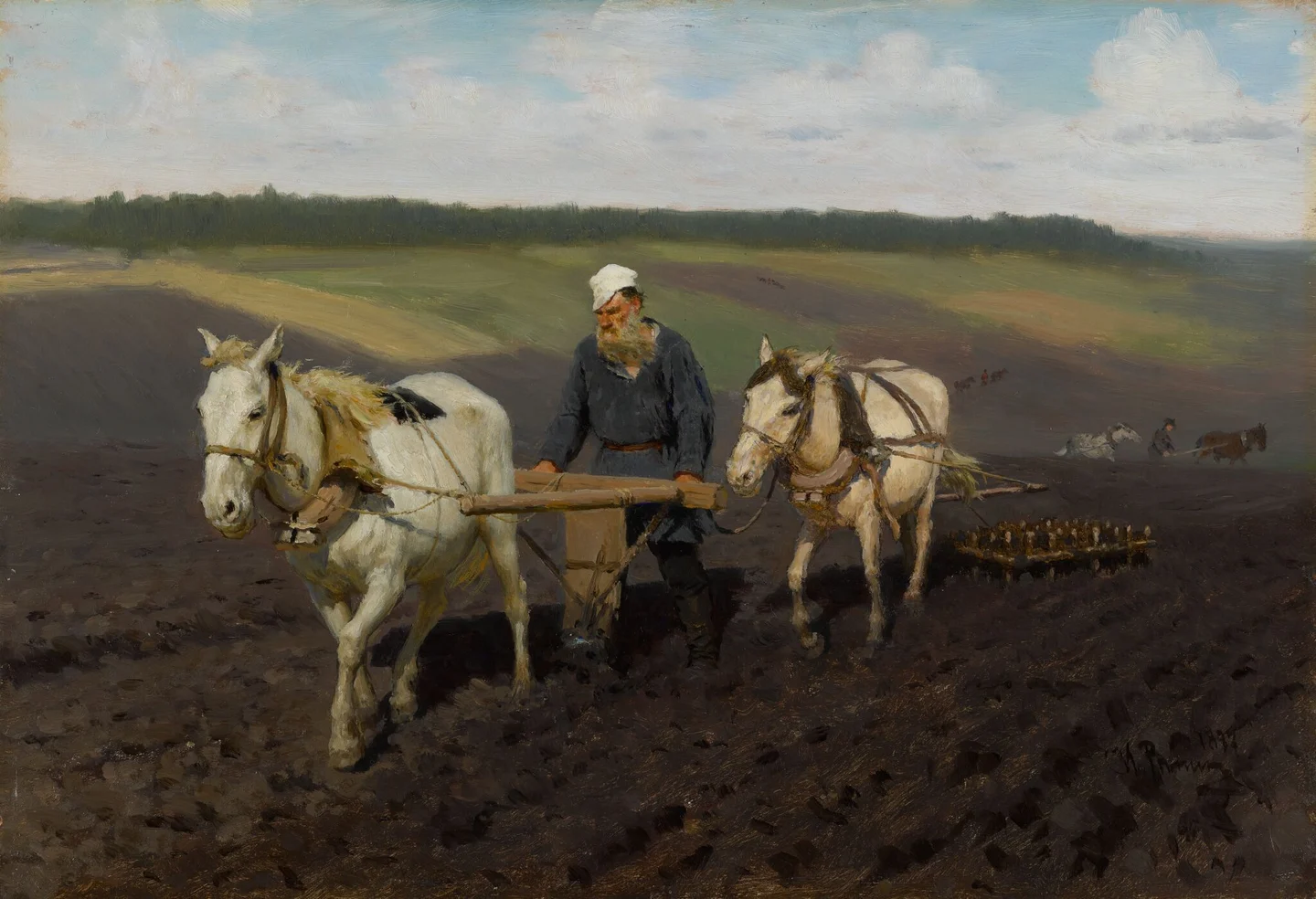 Ilya Repin
The Ploughman. Leo Tolstoy in the Fields
1887Period, style and subject
- Movement
- Realism
- Genre
- Everyday life
- Medium
- Oil on canvas
- Collection
- State Russian Museum
- Dimensions
- 132 × 283 cm
Sources
Wikimedia Commons reproduction. Public domain. Image licence