Madame X (Virginie Amélie Avegno Gautreau)
John Singer Sargent · 1883–84
Explore the painting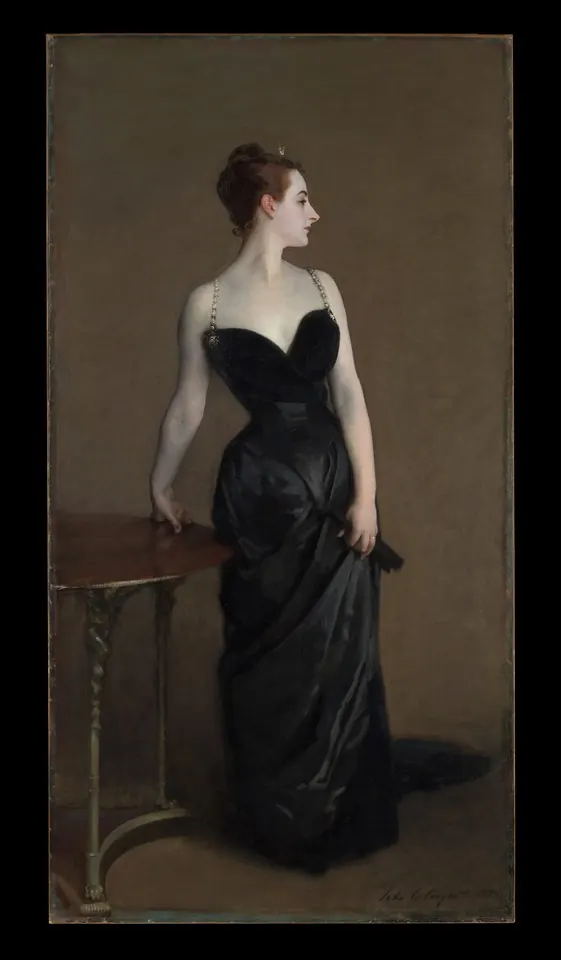
The painting’s story and details
Virginie Amélie Avegno Gautreau was a celebrated beauty in Parisian society. Born in Louisiana, she cultivated a striking public appearance through dress and cosmetics. Sargent proposed painting her without a commission, hoping to attract attention at the Salon. In 1884 that attention proved merciless. Critics debated the sitter’s appearance and respectability alongside the portrait’s artistic merits.
Gautreau turns her face into profile. The contour of nose, forehead and chin stands sharply against the brown background, while her ear is noticeably redder than her cool, pale skin. Her artificial pallor was part of the appearance her contemporaries knew. These strong colour differences make the face almost sculptural.
Both jewelled straps now rest on her shoulders. At the Salon, viewers saw the right strap slipping down. After the scandal, Sargent painted it into an upright position. A small revision altered the meaning of the entire pose for contemporary audiences. Critics linked the exposed shoulder and cosmetics to the sitter’s morals. A painted detail became grounds for passing public judgement on a particular woman.
Her hand rests on the table, with fingers extended along its edge. The shoulder and elbow turn in a way that requires visible effort. This support helps sustain the rotation of torso and head. The portrait’s apparent stillness depends on carefully coordinated bends. Sargent constructs a formal presence through posing, and the table becomes an essential part of that arrangement.
The table’s curved leg stands against the dark background. This furnishing suggests an elegant setting while revealing little about Gautreau’s daily life. The table supports her hand, fills the left side and leaves the figure in command. Sargent limits the surroundings so that clothing, skin and silhouette have greater force.
The black dress descends to the floor in a long, almost continuous mass. Light picks out only certain folds and curves. Above this dark foundation, exposed skin appears particularly bright. On a canvas more than two metres high, the figure becomes monumental. A contemporary society woman receives a scale and severity suited to formal portraiture, yet her fashionable appearance disturbed some viewers’ expectations.
Sargent kept the painting after the exhibition and retained it for more than thirty years. He sold it to The Met in 1916, asking that the sitter’s name be concealed in its title. A distance emerged between the celebrated image and the person who had endured its reception. Madame X demonstrates the risks of public portraiture: the artist seeks fame, while the woman portrayed must live with other people’s readings of her appearance.
Featured in tours
Portraits. How people presented themselves
Rulers, merchants, artists and private patrons before a viewer.
More paintings to compare

Period, style and subject
- Movement
- Impressionism
- Genre
- Portrait
- Medium
- Oil on canvas
- Collection
- The Metropolitan Museum of Art
- Dimensions
- 208.6 × 109.9 cm
- Accession number
- 16.53
Sources
Image provided under CC0. Image licence