Little Girl in a Blue Armchair
Mary Cassatt · 1878
Explore the painting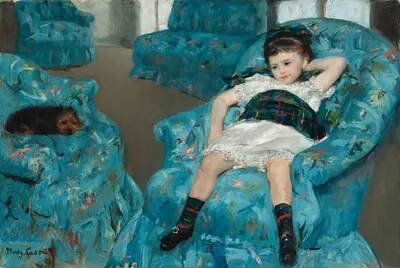
The painting’s story and details
A girl sprawls in an armchair with one hand behind her head. Her lace dress, plaid sash and polished shoes look smart, but her body has settled into its own arrangement. Cassatt painted the picture in 1878. The model was the daughter of acquaintances of Degas. The artist retained the child’s informal posture amid elegant furniture.
Her knees are apart, one arm drops along the chair, and the other bends above her shoulder. The pose occupies almost the entire seat. Large furniture designed for adults is being adapted to a child’s needs. That difference in scale helps us sense the room from a child’s perspective. An elegant interior becomes, first of all, somewhere to find a comfortable position for one’s body.
A small dog sleeps in the opposite chair. This is Cassatt’s Brussels griffon, Baptiste, which Degas helped her find. The dark ball of fur almost disappears among the patterns. Dog and girl have each settled into a seat, and their proximity makes the child’s informal posture still more noticeable. Both occupy the furniture without maintaining its formal appearance.
Her head is slightly lowered and her gaze directed sideways. We may see tiredness or boredom, although the cause is unknown. The painter supplies no explanatory action. The girl demonstrates nothing to the viewer and does not return our gaze. We notice her pause without knowing what she thinks or how long she has been sitting there.
Blue chairs recur at the back of the room, turned at different angles with patches of floor between them. Cassatt wrote that Degas advised her on the background and worked on it himself. The museum suggests his involvement in the corner of the room. The extent of his intervention remains discussed, but her testimony reveals a professional exchange that produced a particular compositional solution.
A black shoe projects forward, with a small highlight on its buckle. The stocking’s plaid repeats the sash and hair bow. The clothes were clearly chosen as a coordinated outfit. Their matching details suggest family taste and means, while the freely positioned legs disrupt the expected neatness. The picture brings together two arrangements: the appearance prepared by adults and the child’s own way of sitting.
Cassatt recalled that the American jury for the 1878 world’s fair rejected the work. Degas’s approval made the rejection particularly galling. Today the pose that disrupts a portrait’s expected formality seems central to its strength. The history of its reception reminds us that naturalness can itself need defending. What looks like simple observation may change ideas about a subject worthy of art.
Featured in tours
Early Impressionism. Paris 1860–1879
The Salon, the first independent exhibition, railway stations, studios and leisure on the Seine.
Women painters. Learning and working
Family workshops, academies, private commissions and independent exhibitions.
More paintings to compare
Period, style and subject
- Movement
- Impressionism
- Genre
- Portrait
- Medium
- oil on canvas
- Collection
- National Gallery of Art, Washington
- Dimensions
- Overall, 89.5 × 129.8 cm
- Accession number
- 1983.1.18
Sources
Reproduction of a public-domain artwork. Image licence