Self-Portrait with Two Pupils, Marie Gabrielle Capet (1761–1818) and Marie Marguerite Carraux de Rosemond (1765–1788)
Adélaïde Labille-Guiard · 1785
Explore the painting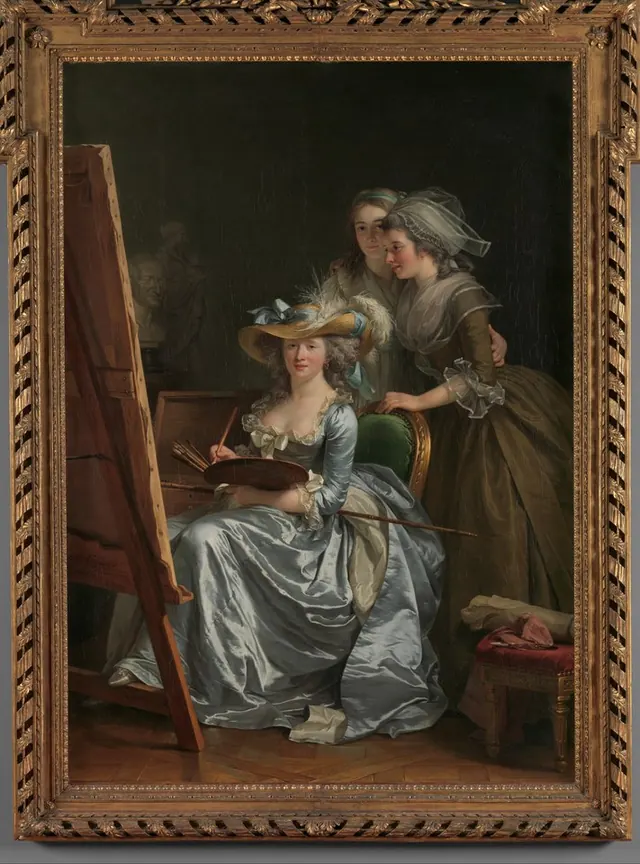
The painting’s story and details
Adélaïde Labille-Guiard presents herself at work with two pupils. When this self-portrait appeared at the Paris Salon in 1785, the French Royal Academy allowed only four women to belong at a time. She had gained one of those places two years earlier. Now her large canvas presents a whole studio in which women acquire a profession.
She holds a fine brush, with a palette and more brushes beside it. Turning from the canvas, she looks straight ahead. She is both the sitter and the professional controlling the scene. The back of the large canvas on the left occupies almost as much space as her figure, immediately establishing a workplace.
She is dressed too elaborately for painting. Yet the blue silk displays what her brush can do. Light turns its folds into silver strips and deep blue hollows. A portrait client could judge her skill through fabric, lace, and ornament. Her own gown provides a persuasive sample of that work.
Behind her stand Marie Gabrielle Capet and Marie Marguerite Carraux de Rosemond. One leans toward the easel; the other faces us. Labille-Guiard prepared their faces in a separate drawing, studying light and shade. These are portraits of actual pupils. By placing them beside herself, Labille-Guiard presented the public with the next generation of her school.
A broad hat and feathers frame her face. Labille-Guiard looks composed, showing no conspicuous effort. Her professional training had been lengthy. She learned miniature painting and pastel with different teachers, then moved to large portraits in oil. By the time she entered the Academy, she was already teaching and exhibiting.
Blue reflections from the gown reach the polished floorboards. Fine furniture, orderly possessions, and a carefully rendered interior support her position as the studio’s proprietor. This is a public image of a successful professional, comparable to the formal portraits of clients she needed to persuade to commission her.
Two years later she became official painter to Louis XVI’s aunts. During the Revolution she remained in France and portrayed National Assembly deputies. Political change did not secure lasting equality. The Royal Academy closed in 1793, and its successor institutions excluded women. The studio in this portrait offered opportunities that public institutions continued to resist.
Featured in tours
Portraits. How people presented themselves
Rulers, merchants, artists and private patrons before a viewer.
Women painters. Learning and working
Family workshops, academies, private commissions and independent exhibitions.
More paintings to compare
Period, style and subject
- Movement
- European painting
- Genre
- Portrait
- Medium
- Oil on canvas
- Collection
- The Metropolitan Museum of Art
- Dimensions
- 210.8 × 151.1 cm
- Accession number
- 53.225.5
Sources
Image provided under CC0. Image licence