Comtesse de la Châtre (Marie Charlotte Louise Perrette Aglaé Bontemps, 1762–1848)
Elisabeth Louise Vigée Le Brun · 1789
Explore the painting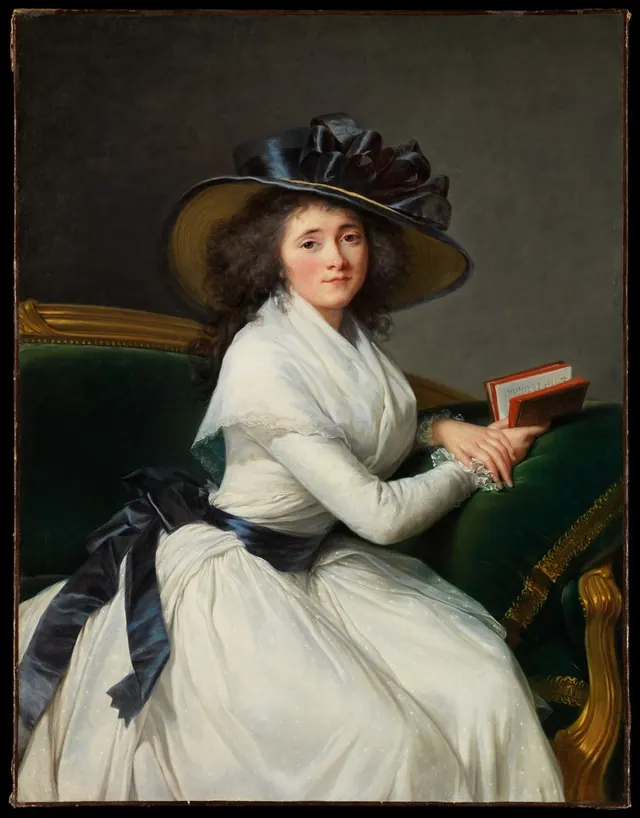
The painting’s story and details
In 1789 the Comtesse de la Châtre commissioned a portrait from an artist particularly valued by Marie Antoinette. Her choice of painter and white muslin dress linked her with courtly taste. The Revolution would soon drive both the countess and Vigée Le Brun out of France. The portrait preserves a way of presenting oneself in which closeness to the court was an asset and a source of prestige.
The countess sits sideways but turns her head directly towards the viewer. One hand rests over the other on a cushion. The pose suggests a brief pause in reading and creates an impression of easy conversation. Yet the rotation of shoulders and head is carefully coordinated. The museum proposes a connection with British portraiture, particularly George Romney’s images of Emma Hamilton, where apparent naturalness was likewise staged.
A broad straw hat carries an oversized black ribbon. Light moves across its glossy curves, while the brim casts a soft shadow above the face. This English-style accessory introduces a suggestion of relaxed country dress. The countess occupies a rich interior, but her hat brings the clothing of an outdoor walk into it. The combination made the portrait fashionable for its first viewers.
The white muslin has a small embroidered pattern and gathers into numerous folds. Light dresses of this kind became fashionable through Marie Antoinette. Their simplicity depended on fine fabric, skilful cutting and carefully chosen accessories. Lace, embroidery and translucent edges are visible here. Aristocratic restraint in dress could be as carefully arranged and expensive as a more elaborate costume.
An open book sits beside her hands. Its red edges and binding stand out against the green cushion. The book gives the pose a particular activity and contributes to an image of an educated woman. With the softly painted fingers and pale cuffs, it forms a small, self-contained group. Vigée Le Brun distributes expressive details between face and hands, sustaining interest at close range.
A large dark bow is tied at the waist. Its long ends cross the white skirt, repeating the colour of the hat ribbon. Two widely separated details unite the costume. Cool highlights appear on the black satin, while the muslin contains softer transitions of light. Distinguishing these textures allows the painter to display the quality of the clothing and her own skill together.
Gilded furniture scrolls surround deep green upholstery. The cushion supports the hands and the turned torso, while gold provides several bright accents beside the white dress. The sitter’s apparent simplicity belongs to a setting of evident wealth. A domestic portrait could retain aristocratic distinction without requiring coats of arms or ceremonial attributes.
Her connection with the queen helped Vigée Le Brun achieve recognition and exposed her to danger during the Revolution. Leaving with her daughter, she rebuilt her career in Italy, Austria and Russia. The countess’s life changed too. After divorce became legal, she ended her first marriage and in 1799 married Arnail François de Jaucourt. This composed portrait belongs to lives that continued well beyond their former courtly circle.
Featured in tours
Portraits. How people presented themselves
Rulers, merchants, artists and private patrons before a viewer.
Women painters. Learning and working
Family workshops, academies, private commissions and independent exhibitions.
More paintings to compare
Period, style and subject
- Movement
- European painting
- Genre
- Portrait
- Medium
- Oil on canvas
- Collection
- The Metropolitan Museum of Art
- Dimensions
- 114.3 × 87.6 cm
- Accession number
- 54.182
Sources
Image provided under CC0. Image licence