Venus and Adonis
Titian · 1550s
Explore the painting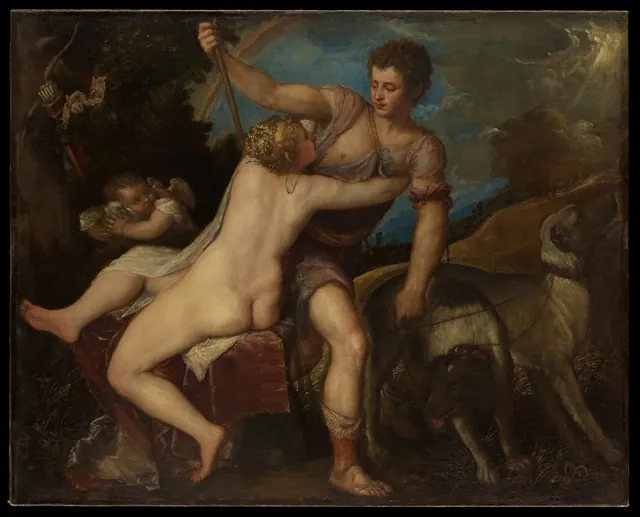
The painting’s story and details
Venus embraces Adonis, trying to stop him leaving for the hunt. Viewers familiar with the myth know that a boar will kill the young man. Titian chose a moment when love might still seem capable of changing the outcome. This version dates from the 1550s and is recognised as the master’s own work. His workshop repeatedly returned to the composition, varying details that shaped the experience of the lovers’ last farewell.
Venus turns her back to us. She twists her shoulders towards Adonis, reaches out and almost slips from the red seat. One leg lifts while the other seeks support below. Her movement is unstable. We see the effort of holding her lover while also being invited to look at her naked body. Titian connects sensual appeal with the possibility of loss. The scene’s beauty sharpens our awareness of what will soon be lost.
Adonis looks at Venus, but his hands are occupied by the equipment of the hunt. His raised hand grips the weapon’s shaft; the lowered one holds the dogs’ leashes. His gaze still connects the lovers, while his equipment already connects him to departure. His body turns towards the hunt, his face towards Venus. He is still beside her, already prepared to leave.
Two dogs are crowded against the right edge. One raises its head, while the other stands lower, close to Adonis’s leg. Their leashes gather into his hand. The animals make departure an action for which everything is ready. The boar and the fatal wound are absent; knowledge of the myth supplies them. The more closely we inspect this ordinary hunting equipment, the more strongly we may sense the approaching tragedy.
On the left, Cupid holds a dove close and watches the lovers. The bird is associated with Venus; in the child’s arms it repeats the motif of a close embrace. In the version made for Philip II, now in the Prado, Cupid sleeps. Here he is awake, becoming another witness to the farewell. This is a meaningful distinction between versions. A familiar subject acquires another emotional connection when a secondary figure watches the principal characters.
In Ovid, Venus warns Adonis about dangerous animals and then flies away. The poet does not describe the young man pulling free of her embrace. Titian invented that scene, developing the ancient account through painting. The bare back, white cloth and red seat make the bodily closeness that departure will break palpable. This helps explain his description of mythological works as painted poetry. A familiar story gave him room to construct a narrative of his own.
The goddess of love must use her hands and still cannot stop a human being. This turn brings the myth close to ordinary experience. Loving someone does not give us control over their decisions or the power to protect them from every danger. At the same time, the painting offers the vulnerable Venus as a beautiful spectacle. Sympathy and pleasure in the image remain in tension, held together in an embrace we already know to be the last.
Featured in tours
Love, marriage and encounters
Gods, lovers, spouses and people whose relationships remain unknown.
More paintings to compare


Period, style and subject
- Movement
- Renaissance
- Genre
- Myths & allegories
- Medium
- Oil on canvas
- Collection
- The Metropolitan Museum of Art
- Dimensions
- 106.7 × 133.4 cm
- Accession number
- 49.7.16
Sources
Image provided under CC0. Image licence