Venus of Urbino
Titian · 1538
Explore the painting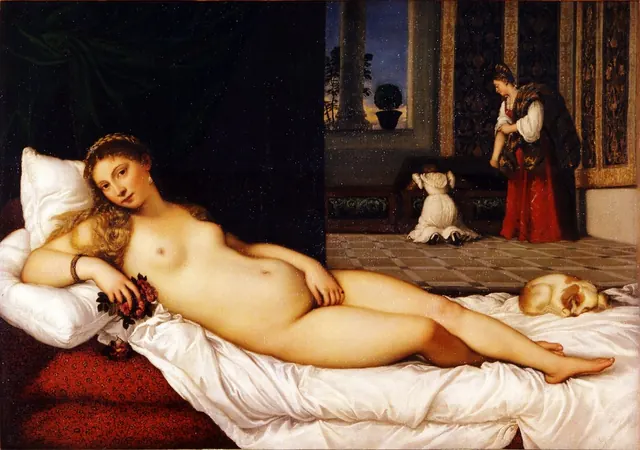
The painting’s story and details
In 1538 Guidobaldo II della Rovere purchased a painting of a nude woman from Titian. The title Venus of Urbino links her with an ancient goddess, but the interior belongs to a wealthy sixteenth-century home. Mythological beauty, marriage customs and the sensual pleasures of painting meet here. The Uffizi interprets the background objects in relation to a young woman’s preparation for marriage. In this reading, female beauty is connected to the organisation of a future marital household.
The woman looks directly outwards with her head slightly raised. Her body stretches across almost the entire foreground. Dark fabric behind her shoulders separates the pale skin, while soft transitions let us follow its curves without hard outlines. Colour and light create bodily presence for Titian. We encounter both a represented person and a carefully arranged surface inviting close attention.
The roses connect the figure with Venus. Their red and dark petals also link the cushion, hair and patterned fabric below. The object does two things at once: it participates in love imagery and organises colour relationships. Reading the painting only as a set of conventional signs can miss the material attraction that keeps a viewer looking.
The white sheet gathers in broad folds beneath the body. Its light is cooler than the skin, with greyish passages in shadow. Titian distinguishes flesh and fabric within one illumination. The sheet covers the bed while emphasising the figure’s exposure. An everyday object becomes part of an arrangement directing the eye along the body.
A small dog sleeps at the woman’s feet. The Uffizi connects it with marital fidelity. Within the composition, its motionless curled body sustains the domestic setting and repeats warm flesh tones. Manet would later replace the dog with a black cat in Olympia. The comparison shows how one small substitution can change a scene’s character while preserving the recognisable reclining pose.
In the background one maid bends into a chest while another holds clothing. Here the sensual image reveals its household economy. Someone stores fabrics, provides clothes and sustains this wealthy domestic life. Space is distributed unequally: the reclining woman occupies most of the canvas, while service is placed at a distance. We can admire the luxury while noticing the social relationships that make it possible.
The painting reached Florence in Vittoria della Rovere’s dowry. At the Uffizi it was displayed beside the ancient Medici Venus. It became a valuable object passing between dynasties and part of a comparison between ancient and modern art. The marital interpretation of its imagery intersects with its marital ownership history. Beauty is connected with love, but also with family wealth, prestige and control over an image.
Featured in tours
Love, marriage and encounters
Gods, lovers, spouses and people whose relationships remain unknown.
World classics. Altar, palace, exhibition
Familiar paintings and the people for whom they were made.
More paintings to compare


Period, style and subject
- Movement
- Renaissance
- Genre
- The nude
- Medium
- Oil on canvas
- Collection
- Uffizi Galleries, Florence
- Dimensions
- 119 × 165 cm
- Accession number
- 1890 n. 1437
Sources
Reproduction of a public-domain artwork. Image licence