The Feast of the Gods
Giovanni Bellini and Titian · 1514/1529
Explore the painting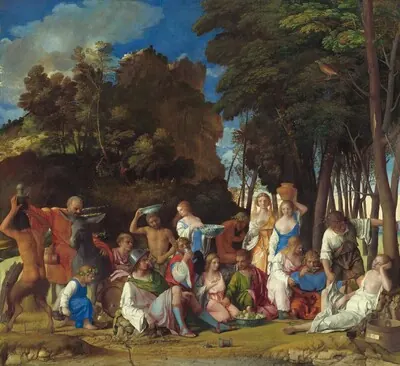
The painting’s story and details
Alfonso d’Este, Duke of Ferrara, commissioned The Feast of the Gods for his private study. Giovanni Bellini completed it in 1514. Few people could enter the room, which was decorated with expensive paintings of classical subjects. In that setting, knowledge of ancient poetry accompanied enjoyment of painting and the display of wealth. Amid food, wine and sumptuous fabrics unfolds an episode from Ovid’s Fasti.
The guests sit in small groups across the foreground. Their poses resemble an ordinary gathering, although the company includes classical deities. On the left, a child in blue fills a vessel with wine. His ivy wreath identifies Bacchus, the wine god. Such attributes allowed an educated viewer to work out who was present, moving from a familiar action to a mythological identity.
On the right, Priapus lifts the clothing of the sleeping nymph Lotis. In Ovid’s account, he tries to take advantage of her sleep. The donkey on the left is about to bray, wake her and thwart the assault. Without that ending, the feast might look like carefree relaxation. The literary source changes our view: behind the beautiful fabrics and calm poses is a threat to someone unable to defend herself.
The rocky mountains behind the guests belong to later revisions. After Bellini, Dosso Dossi and Titian worked on the landscape. By 1529 Titian had given the picture its present appearance. The changes may have helped it harmonize with other works in the duke’s study, including Titian’s own mythological scenes. The room as a whole could matter more than preserving an individual painting’s first version.
Tall trees on the right screen the feast from the distant landscape. Shade and the closely grouped guests give it a secluded setting. The painting’s private purpose matters to its subject. The duke and those admitted to his study could examine an explicit classical story in circumstances quite different from viewing a public devotional image. The freedom to choose a subject also depended on who would see the painting.
Blue patterns on white bowls evoke Chinese porcelain, rare and expensive in Italy at the time. Venetian glass may have provided models for the transparent vessels. The gods use objects prized by earthly collectors. Through this tableware, the ancient feast connects with sixteenth-century trade and taste. A viewer in the duke’s study could recognize the myth while enjoying images of coveted luxury goods.
On a slip of paper at the lower right, Bellini left his name and date. The inscription survived other painters’ revisions to the landscape. It reminds us that the present picture emerged from decisions made years apart. The patron assembled an ensemble, artists altered its components, and the paintings later dispersed to museums. The Feast of the Gods now appears independent; its unusual history becomes clearer when we imagine its neighbours and the private study.
More paintings to compare


Period, style and subject
- Movement
- Renaissance
- Genre
- Myths & allegories
- Medium
- oil on canvas
- Collection
- National Gallery of Art, Washington
- Dimensions
- Overall, 170.2 × 188 cm
- Accession number
- 1942.9.1
Sources
Reproduction of a public-domain artwork. Image licence