The House of Bijapur
Kamal Muhammad and Chand Muhammad · ca. 1680
Explore the painting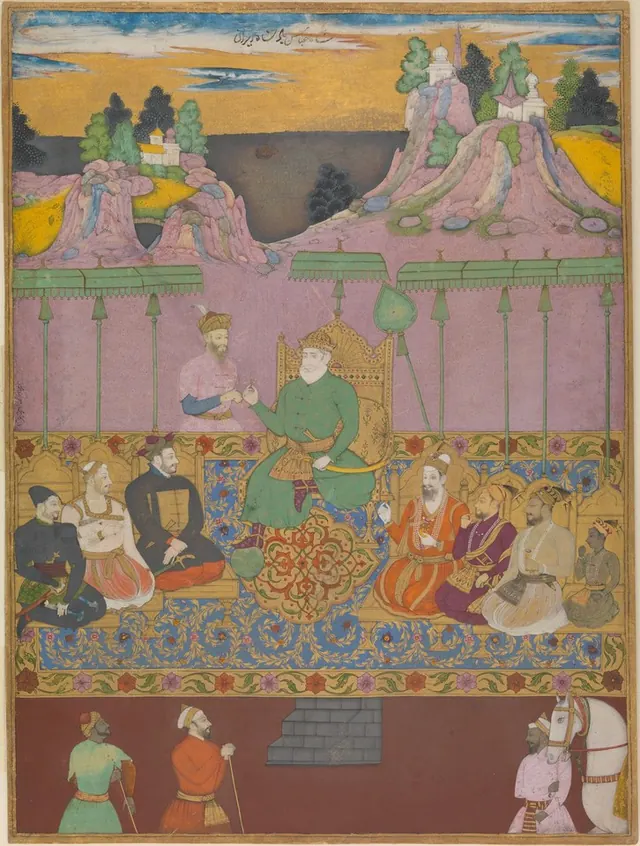
The painting’s story and details
The small boy at the far right, Sikandar, was the last sultan of Bijapur, a Muslim kingdom in southern India. Around 1680 the court painters Kamal Muhammad and Chand Muhammad made this gathering of the ‘Adil Shahi rulers for him. Nearly two centuries separated their reigns, so they could never have met. The artists joined them in a single ceremony that gave the heir a place in the long line of his predecessors. In 1686 the Mughals conquered Bijapur, and the dynasty’s rule came to an end. The sheet outlived the state it was made for.
Yusuf, the dynasty’s founder, who reigned from about 1490 to 1510, sits on the tall golden throne. The other sultans are placed below him on a shared blue carpet, with the boy closing the right-hand row. This seating turns a family tree into a court ceremony. Descent gives each ruler the right to sit beside the founder, and Yusuf’s central position shows where the history of the house begins. The sultans face inward, occupied with one another. Attendants and a staircase stand between the viewer and the rulers.
The man in pink standing at the left hands Yusuf a small key. He is Shah Isma‘il, founder of Iran’s Safavid dynasty, who reigned from 1501 to 1524. The key stands for the recognition of legitimate rule, and the scene recalls that the ‘Adil Shahis, like the Safavids, considered themselves Shi‘a. For a dynasty ruling far from Iran, that link was part of its identity. A later inscription along the upper edge wrongly names the standing figure Shah ‘Abbas, a better-known ruler of the same house. The later caption changed the meaning of the scene by attributing the gesture to a different ruler.
Third from the right, according to the museum, is Ibrahim II, who ruled in the late sixteenth and early seventeenth centuries. Bijapur flourished under him, and the museum describes the sultan as a freethinker. He was tolerant of Hinduism and of Sufism, the mystical strand of Islam, and in 1583 he made Sunni Islam the state religion, which it remained until the end of his reign. The image speaks of unwavering loyalty to the Shi‘a creed, while the dynasty’s history is more complicated. The dynastic gathering can be read as a selective account of the past. A shared ceremony unites rulers whose religious policies differed considerably.
The early rulers on the left wear daggers with hilts of an older type. The museum catalogue distinguishes a straight, split-ended western Asian hilt from a curving South Indian one shaped like two leaves. The later sultans on the right carry katars, push daggers with a crossbar grip held in the fist. The difference in weapons marks the two hundred years that separate the sitters. The painters did not dress everyone alike; they gave each generation its own time. The swirling blue carpet and the flat ceremonial umbrellas above the platform reflect the taste of the Deccan itself, and similar umbrellas appear in early sculpture from Andhra.
Beyond the ceremonial platform, dark water with a small sailing boat opens between pink cliffs. The museum connects this view with the memory of Bijapur’s former possessions. At its height the kingdom reached the Arabian Sea and included Goa, contested several times with the Portuguese during the sixteenth century. The mountains are painted in the manner of Iranian painting and the sky is flooded with gold, so the view makes no claim to the accuracy of a map. The landscape enlarges the scale of the family gathering. Carpet and throne show the court; the distant horizon recalls the lands over which the sultans once ruled.
At the bottom a grey staircase climbs toward the carpet, yet there is no building or dais beneath the platform. The steps rise straight out of the bare red ground. The museum counts such inconsistencies, together with abrupt shifts of scale and an abundance of pink, among the distinctive features of the Bijapur school. Scholars of Deccani painting often speak of its “otherworldly” mood. The stairs mark the passage from the ground, where the servants stand, to the carpet, where the dynasty sits.
Attendants stand at the foot of the platform against a dark red ground. Their figures are noticeably smaller than the seated rulers, and at the right a groom holds a white horse. The blue carpet is crowded, yet none of the servants joins the sultans’ row. Courtly rank is expressed through simple distinctions between those who sit, those who stand, and those allowed near the throne.
The museum regards Mughal dynastic portraits, in which emperors likewise meet outside time, as the likely model for this gathering. Bijapur’s court could borrow a form familiar to its rival in order to affirm its own succession. Little is known about the painters themselves. A signature near the left edge names both, and collaboration between two masters was standard practice in Mughal workshops too. After the fall of Bijapur the sheet kept its value. Several later versions are known; one entered the album of the Italian physician Niccolò Manucci, another is dated to around 1750. The original was kept in Paris by the collector Kevork Essayan and was bought by the museum in 1982. For Sikandar the image presented his inheritance. For a viewer after the state’s destruction, the same sheet preserves a carefully selected memory of it, with ancestral grandeur, shared faith, and former territory.
Featured in tours
The courtly book. Iran and India
Poets, scribes, painters and rulers make an illustrated manuscript.
Indian painting. Recognising a story
Jain manuscripts, Hindu subjects and regional court life.
More paintings to compare
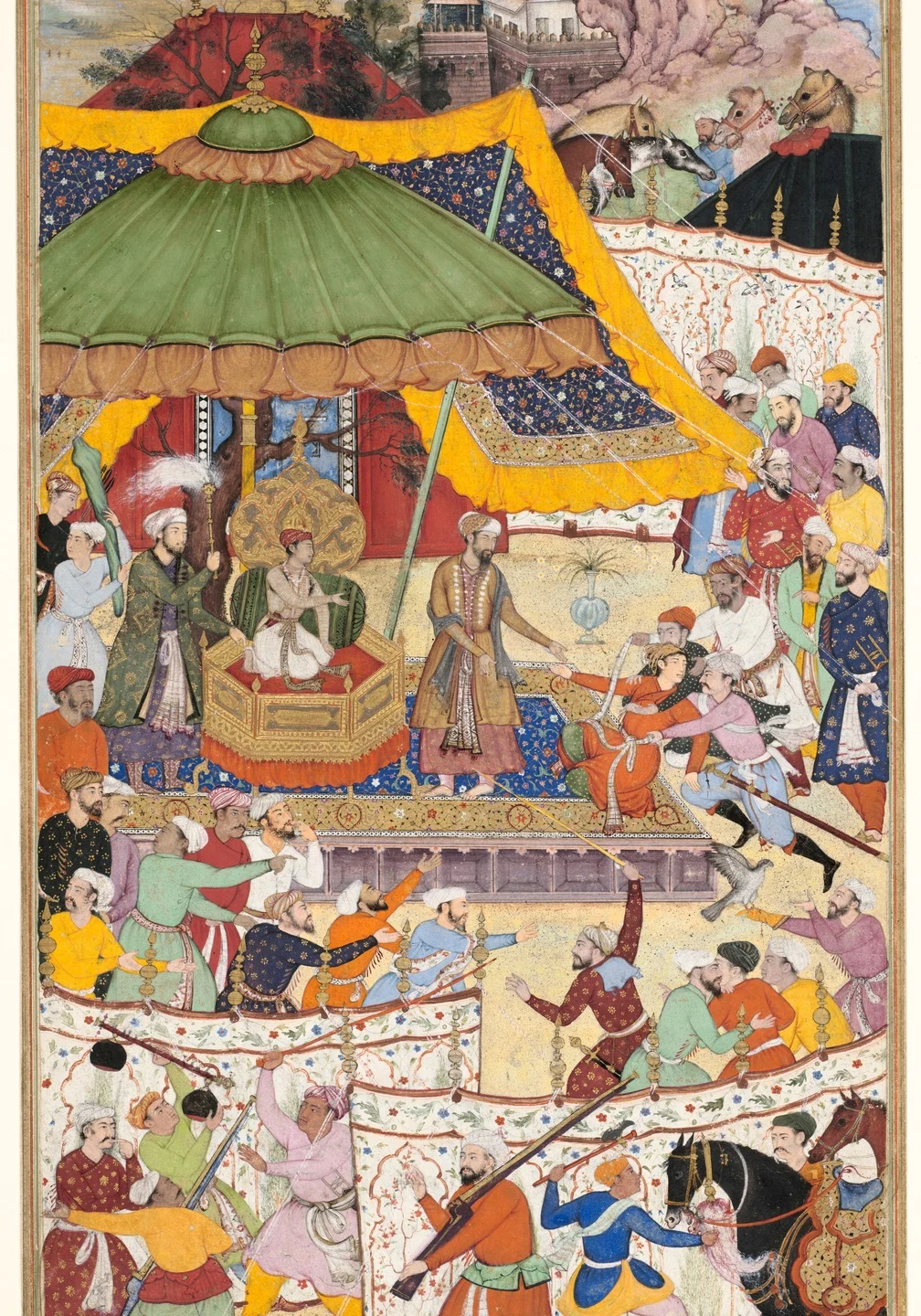 Designed by Basawan, painted by Shankar
The Young Emperor Akbar Arrests the Insolent Shah Abu’l-Maali, Page from a Manuscript of the Akbarnama
Mughal dynasty (1526-1857), c. 1590-1595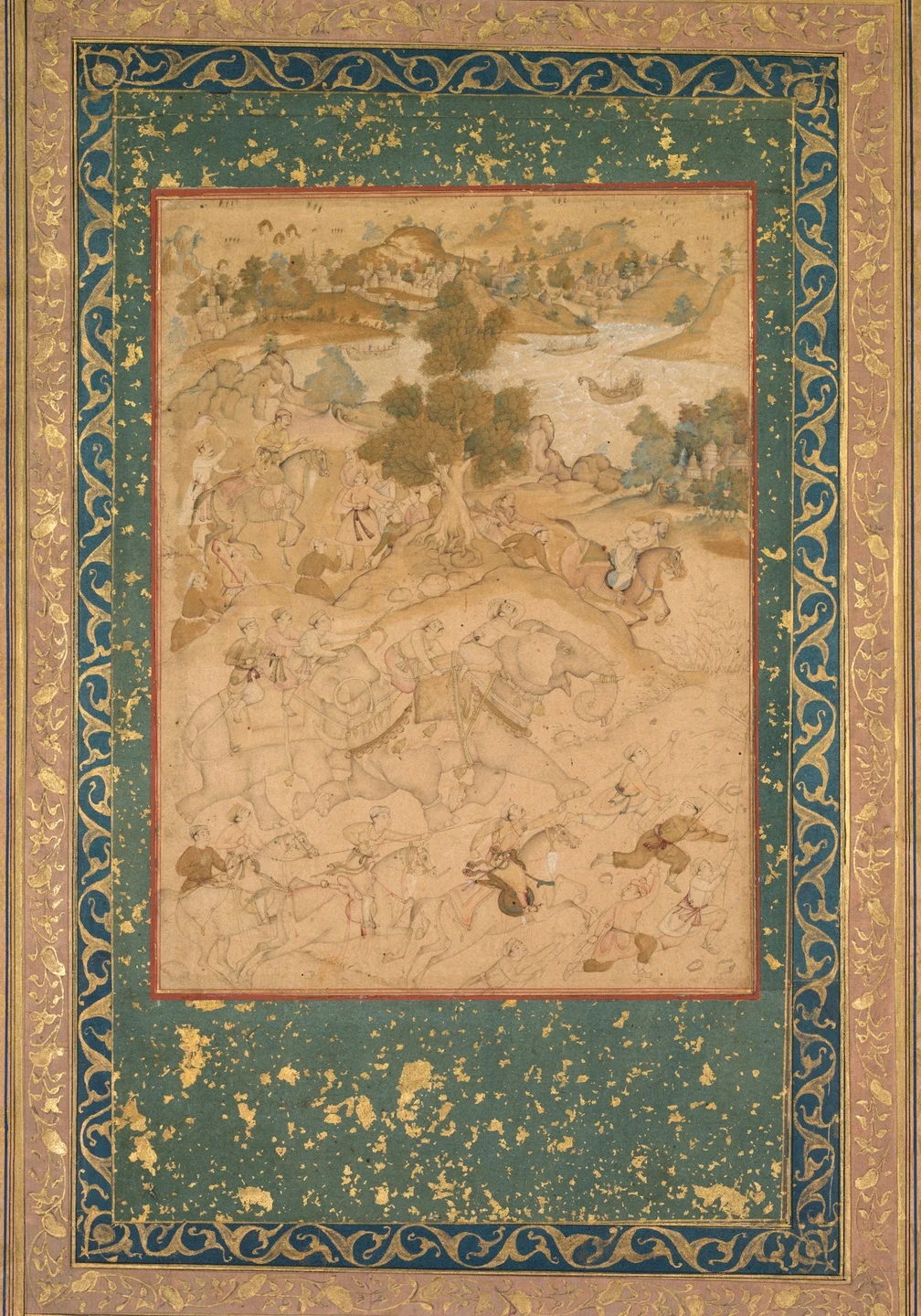 Farukh Chela, Govardhan or Dhanraj; attribution debated
Akbar Supervising the Capture of Wild Elephants
c. 1602–3; borders added c. 1700sPeriod, style and subject
- Movement
- Mughal painting
- Genre
- History painting
- Medium
- Ink, opaque watercolor, gold, and silver on paper
- Collection
- The Metropolitan Museum of Art
- Dimensions
- Page, 41.3 cm
- Accession number
- 1982.213
Sources
Image provided under CC0. Image licence