The Kangxi Emperor's Southern Inspection Tour, Scroll Three: Ji'nan to Mount Tai
Wang Hui and assistants · datable to 1698
Explore the painting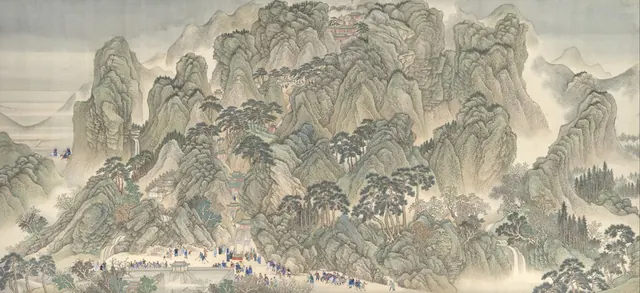
The painting’s story and details
In 1689 the Kangxi emperor toured southern China. His Manchu Qing dynasty had gained power through conquest, and the journey helped consolidate its authority. Wang Hui and assistants recorded the route in twelve scrolls. This is a section of the third, showing Mount Tai, completed after the journey in 1698.
People, horses and attendants gather at the foot of the mountain. Clothing appears in small patches of blue and red. Despite the figures’ size, separate groups and the intervals between them remain distinct. Preparations for the imperial arrival appear as an organised collective undertaking.
From the gates, a route climbs between the rocks. Steps and roofs appear one above another before the path disappears behind ledges. The painter joins sections that could not be seen from one fixed position. Successive buildings and passages make the ascent legible.
Mount Tai was a pilgrimage site and a setting for imperial rituals associated with legitimate rule. Kangxi visited the mountain but did not perform a sacrifice to Heaven there. The visit itself positioned a Manchu ruler within Chinese state tradition. Small temples at the summit place that tradition within the vast landscape.
Pines rise in tiers along slopes covered with dense short strokes. Wang Hui had not visited Mount Tai and worked from maps and prints. He connected recognisable sites with invented passages in the manner of older masters. Descriptive detail therefore does not make this an exact record of the terrain.
On the right, a waterfall disappears into pale mist. Openings between the rocks admit air, while green and blue tones connect the mountain masses. This palette refers to an older landscape tradition. A contemporary imperial itinerary takes on an appearance associated with a revered past.
A workshop divided the labour among specialists in buildings, figures and landscape. The emperor approved the designs. Yet the finished series was not shown to a general public; it was stored with maps and imperial portraits. The costly commission created an official record of the reign for posterity.
Featured in tours
World classics. Altar, palace, exhibition
Familiar paintings and the people for whom they were made.
Chinese landscape. The scholar’s life
Public service, retirement, gardens, poetry and the memory of earlier masters.
More paintings to compare
Period, style and subject
- Movement
- Chinese painting
- Genre
- History painting
- Medium
- Handscroll; ink and color on silk
- Collection
- The Metropolitan Museum of Art
- Dimensions
- Image, 67.9 × 1393.8 cm
- Accession number
- 1979.5a–d
Sources
Image provided under CC0. A detail of the scroll. The complete work extends beyond this museum reproduction. Image licence