World classics. Altar, palace, exhibition
Familiar paintings and the people for whom they were made.
Open the tour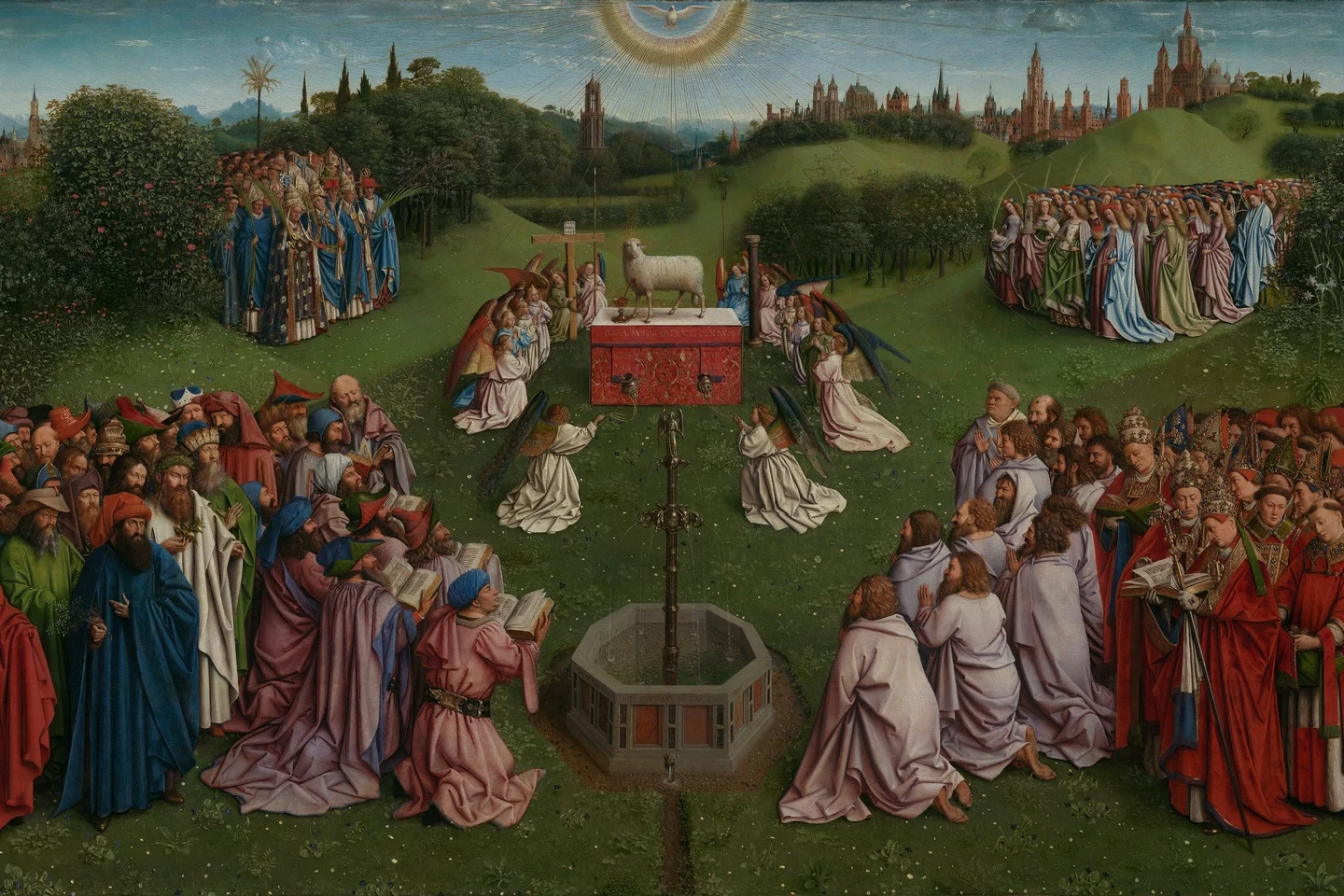 Hubert and Jan van Eyck
Adoration of the Mystic Lamb — original central panel of the Ghent Altarpiece
Completed 1432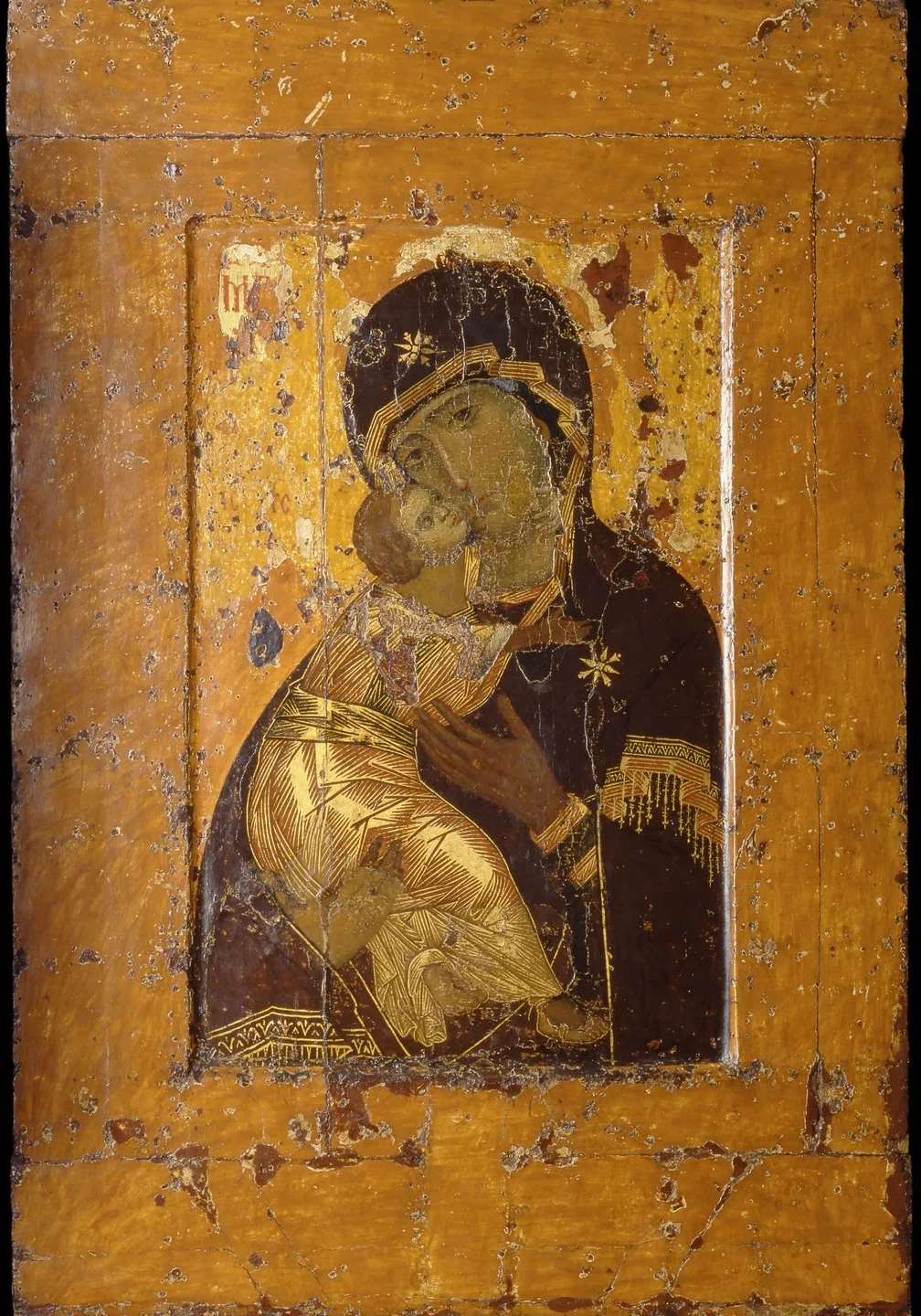 Unknown Byzantine icon painter
The Vladimir Mother of God
First third of the 12th century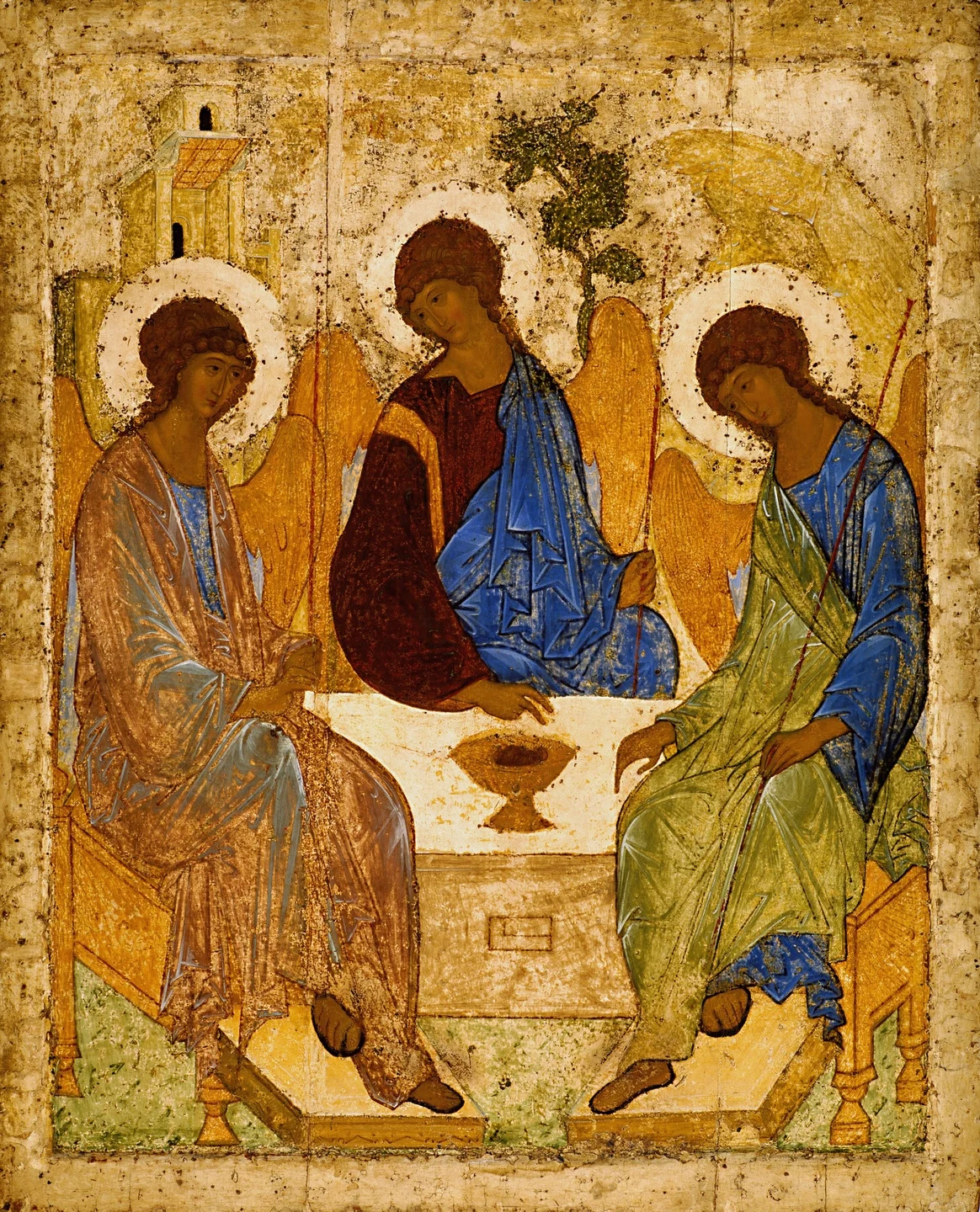 Andrei Rublev
The Trinity
Probably 1422–1427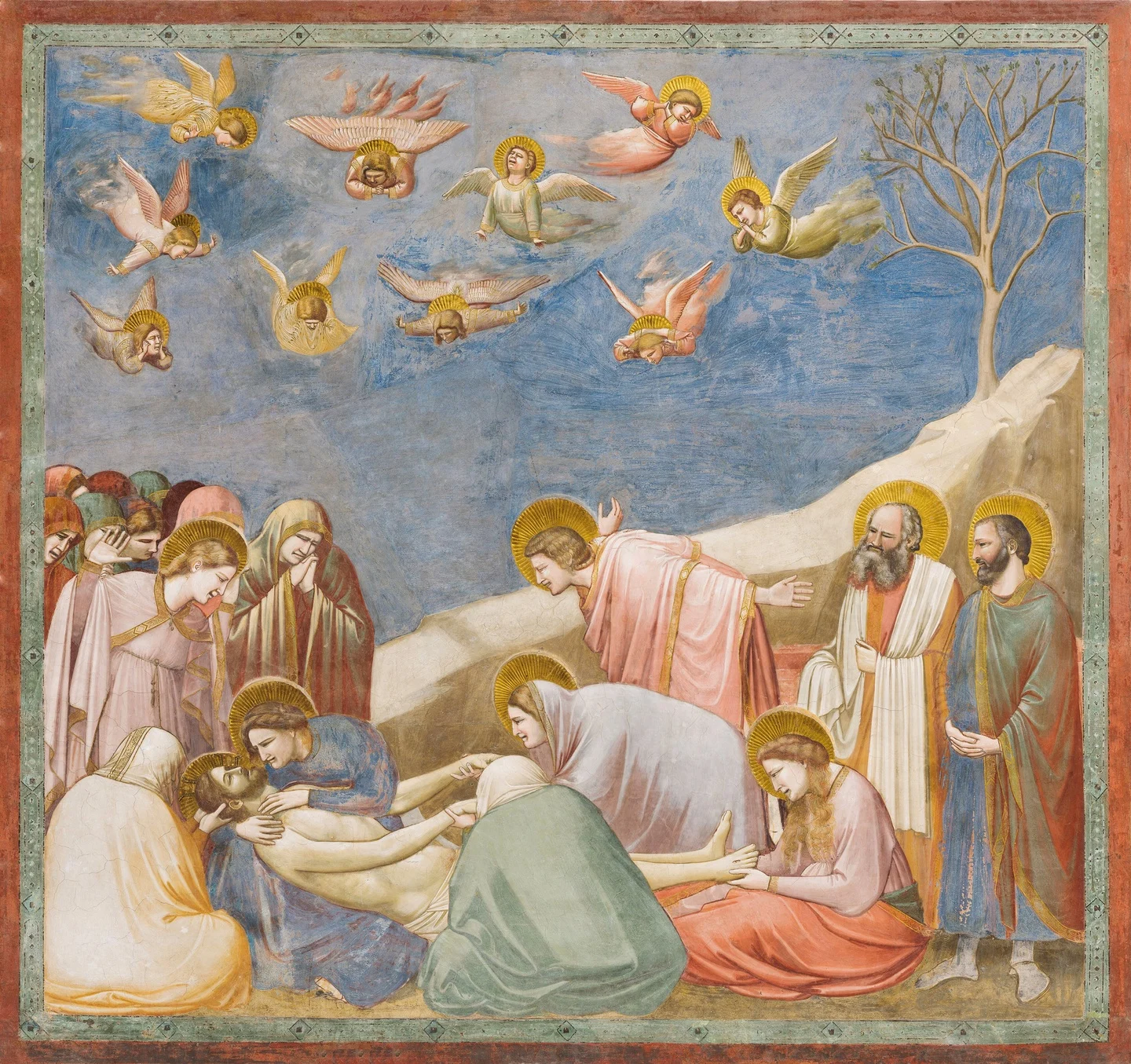 Giotto di Bondone
Lamentation
1303–1305Familiar paintings and the people for whom they were made.
Paintings had lives before museums. They could be commissioned for prayer, a family home, state ceremony or a public exhibition. We move through these settings to see how they shaped subjects, scale and technique. “Classics” refers here to broad recognition, without ranking different cultures.
Church and prayer
An image occupied a particular place among other images and actions. Its later independence as a museum object came afterwards.
Adoration of the Mystic Lamb — original central panel of the Ghent Altarpiece
Hubert and Jan van Eyck · Completed 1432
The central Ghent Altarpiece panel presents the Lamb as Christ among worshippers. The ensemble was completed in 1432 for Joos Vijd and Elisabeth Borluut's chapel. A private donation became a large religious setting. This is the original central panel in official macrophotography after the restoration completed in 2019.
The Vladimir Mother of God
Unknown Byzantine icon painter · First third of the 12th century
Painted in Byzantium in the first third of the twelfth century, the icon was brought from Constantinople to Rus around 1130. It was repeatedly repainted over the centuries. Its present surface combines early painting with later alterations.
The Trinity
Andrei Rublev · Probably 1422–1427
Three angels sit at a table with a single cup. Rublev painted the icon for the Trinity Cathedral of the Trinity–Sergius monastery, probably in 1422–27. Abraham’s three visitors form the basis of this Orthodox image of the Trinity.
Lamentation
Giotto di Bondone · 1303–1305
Giotto told the life of Christ through a sequence of frescoes in the Scrovegni Chapel. Painted in 1303–05, the Lamentation shows the body on the ground, surrounded by mourners. Each has a different gesture, giving the shared event individual human responses.
Annunciation at San Marco
Fra Angelico · About 1440–1450
The friars of San Marco encountered this fresco beside the stairs to their living quarters. Fra Angelico painted it around 1440–50, after the monastery’s rebuilding under Cosimo de’ Medici’s patronage. Gabriel announces Christ’s birth to Mary.
The Last Supper
Leonardo da Vinci · 1495–1498
Leonardo painted the dining hall of Santa Maria delle Grazie in Milan. He worked on dry plaster, allowing him to revise the composition and develop gradual tonal changes. The fragile technique soon began to fail. The apostles respond to Christ's announcement that one of them will betray him, above the room where the monks took their meals.
The Creation of Adam
Michelangelo · 1508–1512 (Sistine Chapel ceiling cycle)
This is one of the central scenes on the Sistine Chapel ceiling. Approaching fingers join the Creator's movement with Adam's reclining body. Michelangelo conveys the gift of life through bodily arrangement and a small gap between hands. The famous detail originally belonged to a large biblical cycle overhead.
The Sistine Madonna
Raphael · 1512–1513
Raphael made the altarpiece for San Sisto in Piacenza, almost certainly on a commission from Julius II. Saints Sixtus and Barbara, venerated there, accompany Mary. The two familiar angels below were added late in the painting process. In 1754 Augustus III acquired the work for Dresden after two years of negotiations.
The wealthy home
Portraits, mythological scenes and still lifes presented the owner’s interests and standing.
The Arnolfini Portrait
Jan van Eyck · 1434
The man is usually identified as Giovanni di Nicolao Arnolfini, with his wife. Their room and belongings display wealth. Two more figures appear in the convex mirror beneath the painter's conspicuous inscription. The portrait's function remains debated, so it cannot be treated as an established record of a wedding.
The Birth of Venus
Sandro Botticelli · c. 1485
Venus arrives on a shell as wind carries her toward a figure holding a cloak. Despite the familiar title, the Uffizi describes her arrival on Cyprus. The welcoming figure is identified as a Hora or Grace. The ancient subject belongs to Florentine patrons' interest in classical poetry and images of beauty.
Spring (Primavera)
Sandro Botticelli · About 1480
Spring occupied a wall in a Florentine home. By the late fifteenth century it belonged to Lorenzo di Pierfrancesco de’ Medici’s heirs and hung above a chest-bench. Its original patron and intended programme remain uncertain.
Mona Lisa (Portrait of Lisa Gherardini)
Leonardo da Vinci · 1503–1519
The sitter is Lisa Gherardini, wife of the Florentine merchant Francesco del Giocondo. Leonardo kept the painting, which later entered the French royal collection. Soft transitions known as sfumato join the face with the distant landscape. The edges of eyes and mouth remain responsive to changing visual attention.
Venus of Urbino
Titian · 1538
A letter records Guidobaldo II della Rovere buying this painting directly from Titian in 1538. The Uffizi relates its imagery to marriage and domestic ritual. Roses identify Venus, while attendants handle household possessions behind her. The work later reached Florence through Vittoria della Rovere's dowry when she married into the Medici family.
Aristotle with a Bust of Homer
Rembrandt van Rijn · 1653
A Sicilian patron commissioned Aristotle touching a bust of Homer. The philosopher wears a medallion of Alexander the Great on a gold chain. Poet, thinker and ruler invite reflection on worldly reputation and the endurance of artistic fame.
The Milkmaid
Johannes Vermeer · c. 1660
A household servant pours milk in a spare interior. Vermeer removed objects while working, including a jug rack and a basket used for warming babies and drying nappies. Similar objects appear in his estate inventory. The final arrangement concentrates attention on one ordinary task and the changing light across food, fabric and pottery.
The Basket of Apples
Paul Cézanne · About 1893
Cézanne painted The Basket of Apples around 1893. Every object is recognisable, yet the table edges fail to align across the cloth. Different viewpoints coexist within one arrangement on the canvas.
Power and public commissions
Rulers and civic groups used painting to present themselves. Artists had to consider their intended audience.
The School of Athens
Raphael · 1508–1511 (Stanza della Segnatura cycle)
Raphael painted this gathering of philosophers for a room Julius II used as a library and private office. Its decoration joined philosophy, theology, law and poetry. The ancient thinkers share architecture recalling Bramante's plans for Saint Peter's, while several have the features of artists working in Renaissance Rome.
The Ambassadors
Hans Holbein the Younger · 1533
Jean de Dinteville was in England reporting to Francis I on Henry VIII's marriage to Anne Boleyn. His friend Georges de Selve visited in 1533. Holbein placed them among instruments, books and signs of status during a period of religious upheaval. Their portrait later hung in the Great Hall of Dinteville's château at Polisy.
Las Meninas
Diego Velázquez · 1656
Velázquez painted Infanta Margarita and her attendants in 1656, including himself beside a large canvas. Several people look towards us, while the royal couple appears in a distant mirror. A court portrait becomes a complex scene of an artist at work.
The Night Watch
Rembrandt van Rijn · 1642
In 1642 Rembrandt painted a group portrait of an Amsterdam militia company. Captain Frans Banninck Cocq and Lieutenant Willem van Ruytenburch step forward. The title The Night Watch came much later, when the darkened painting was taken for a nocturnal scene.
"Shah Jahan on a Terrace, Holding a Pendant Set With His Portrait", Folio from the Shah Jahan Album
Chitarman · recto: dated 1627–28; verso: ca. 1530–50
Chitarman painted this image soon after Shah Jahan's accession. The emperor holds a jeweled pendant bearing his own portrait. A halo, European-derived angels, textiles, and architecture proclaim imperial authority while displaying the skills of the workshops supplying the court.
The Kangxi Emperor's Southern Inspection Tour, Scroll Three: Ji'nan to Mount Tai
Wang Hui and assistants · datable to 1698
This belongs to twelve monumental scrolls recording Kangxi’s southern tour of 1689. Wang Hui and assistants depict the route from Jinan to Mount Tai. Maps and prints supplied information, while documented sites meet invented classical landscapes in a representation of imperial territory and authority.
Portrait of Yun Dongseom (1710–1795)
Unidentified Korean painters · ca. 1790–1805
Comparison with other portraits confirms Yun Dongseom’s identity. A high-rank belt places this work in 1790 or later. It probably served a family ancestral shrine and may have been painted after his death using earlier likenesses.
Painting before a large public
Exhibitions made paintings subjects of debate among strangers. History, politics and contemporary life acquired a new setting.
The Third of May 1808 in Madrid, or The Executions
Francisco Goya · 1814
Goya painted the executions in 1814, six years after the Madrid uprising against Napoleon's troops. Its companion shows the fighting of 2 May. The paintings were commissioned under the Regency and executed after Ferdinand VII returned to Madrid. Goya chose the nighttime killings on the city's outskirts, bringing the victims into the foreground.
The Raft of the Medusa
Théodore Géricault · 1818–1819
In 1816 the Méduse ran aground while carrying a governor to Senegal as France resumed colonial control there. About 150 people were put on a raft; rescuers found only fifteen alive. Géricault interviewed survivors and gave this recent disaster the scale of history painting. The figures try to signal a distant ship.
Liberty Leading the People
Eugène Delacroix · 1830
Delacroix painted this response to the July Revolution of 1830 between September and December that year. Contemporary street fighters follow a personification of Liberty carrying the tricolor. Shown at the Salon in 1831, it brought a recent uprising into the scale of history painting. This photograph records its appearance after the 2023–2024 restoration.
Luncheon on the Grass
Édouard Manet · 1863
Manet exhibited this painting at the Salon des Refusés in 1863. A nude woman sits beside men in contemporary clothes, without the familiar explanation of a mythological subject. The composition draws on revered Renaissance models. Critics objected both to the scene and to its abrupt blocks of light and dark.
Olympia
Édouard Manet · 1863
Manet adapted the pose of Titian's Venus of Urbino for a contemporary courtesan. A servant brings flowers from an admirer or client. At the 1865 Salon, the recognizable social subject, large format and free handling caused a scandal. The reclining model was Victorine Meurent, who also appears in other paintings by Manet.
Paris Street; Rainy Day
Gustave Caillebotte · 1877
Caillebotte painted an intersection near his Paris home. The rebuilding of the city had opened broad avenues through older neighbourhoods. Fashionably dressed pedestrians carry recently introduced collapsible umbrellas. Although he exhibited with the Impressionists, he carefully planned his perspective and the placement of people to make the encounter appear momentary.
Impression, Sunrise
Claude Monet · 1872
Monet painted Le Havre's harbor from a hotel window in only a few hours, according to the Marmottan Museum. The orange sun and boats were added late. Exhibited in 1874, the painting supplied the title that critics turned into the name Impressionism. Its subject was an active modern port with cranes, locks and construction work.
A Sunday on La Grande Jatte
Georges Seurat · 1884–1886; border 1888–1889
Seurat developed this leisure scene in 1884–86 through many preparatory studies. The people on La Grande Jatte appear almost motionless. Their placement and colour relationships are carefully planned around an ordinary Sunday outing.
The Starry Night
Vincent van Gogh · June 1889
Van Gogh painted this nocturnal landscape in several daytime sessions in June 1889, during his stay at Saint-Paul-de-Mausole in Saint-Rémy. A letter to Theo describes the countryside before sunrise and an unusually bright morning star. The painted village and church were invented, bringing observation together with remembered and altered forms.
The Scream
Edvard Munch · 1893
Munch connected this image with anxiety experienced during a walk above the Kristiania fjord. The figure developed from a more clearly defined man in his 1892 painting Despair. This is the National Museum's 1893 version, painted in tempera and grease crayon on cardboard. Its distorted forms helped prepare the way from Symbolism toward Expressionism.
Famous paintings retain traces of their first viewers
Famous paintings retain traces of their first viewers. Worship matters for an altarpiece; the relationship between artist and sitter for a portrait; public response for an exhibition painting.
Purchases, moves and restorations began new chapters. Their later fame also involves collectors, museums and subsequent generations of artists.
Artists in the tour
- Gustave Caillebotte
- Claude Monet
- Vincent van Gogh
- Paul Cezanne
- Rembrandt van Rijn
- Édouard Manet
- Eugène Delacroix
- Sandro Botticelli
- Diego Velázquez
- Unidentified Korean painters
- Jan van Eyck
- Giotto di Bondone
- Francisco Goya
- Georges Seurat
- Titian
- Johannes Vermeer
- Wang Hui
- Painted by Chitarman
- Fra Angelico
- Leonardo da Vinci
- Raphael
- Hans Holbein the Younger
- Hubert and Jan van Eyck
- Michelangelo
- Théodore Géricault
- Edvard Munch
- Andrei Rublev
- Painter of the Vladimir icon
Sources
- Hubert and Jan van Eyck — Adoration of the Mystic Lamb — original central panel of the Ghent Altarpiece
- Unknown Byzantine icon painter — The Vladimir Mother of God
- Andrei Rublev — The Trinity
- Giotto di Bondone — Lamentation
- Fra Angelico — Annunciation at San Marco
- Leonardo da Vinci — The Last Supper
- Michelangelo — The Creation of Adam
- Raphael — The Sistine Madonna
- Jan van Eyck — The Arnolfini Portrait
- Sandro Botticelli — The Birth of Venus
- Sandro Botticelli — Spring (Primavera)
- Leonardo da Vinci — Mona Lisa (Portrait of Lisa Gherardini)
- Titian — Venus of Urbino
- Rembrandt van Rijn — Aristotle with a Bust of Homer
- Johannes Vermeer — The Milkmaid
- Paul Cézanne — The Basket of Apples
- Raphael — The School of Athens
- Hans Holbein the Younger — The Ambassadors
- Diego Velázquez — Las Meninas
- Rembrandt van Rijn — The Night Watch
- Painted by Chitarman — "Shah Jahan on a Terrace, Holding a Pendant Set With His Portrait", Folio from the Shah Jahan Album
- Wang Hui and assistants — The Kangxi Emperor's Southern Inspection Tour, Scroll Three: Ji'nan to Mount Tai
- Unidentified Korean painters — Portrait of Yun Dongseom (1710–1795)
- Francisco Goya — The Third of May 1808 in Madrid, or The Executions
- Théodore Géricault — The Raft of the Medusa
- Eugène Delacroix — Liberty Leading the People
- Édouard Manet — Luncheon on the Grass
- Édouard Manet — Olympia
- Gustave Caillebotte — Paris Street; Rainy Day
- Claude Monet — Impression, Sunrise
- Georges Seurat — A Sunday on La Grande Jatte
- Vincent van Gogh — The Starry Night
- Edvard Munch — The Scream