Outing to Zhang Gong's Grotto
Shitao · ca. 1700
Explore the painting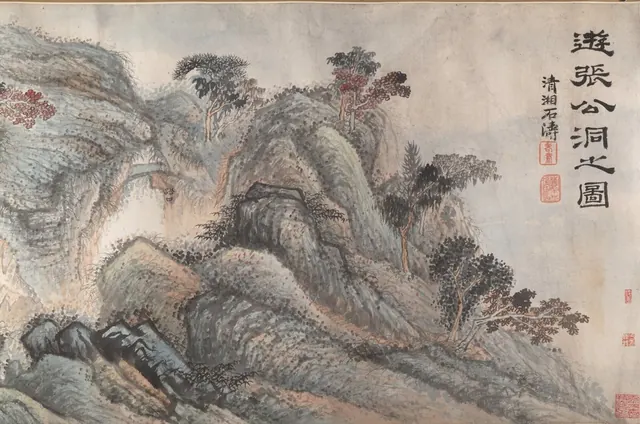
The painting’s story and details
Shitao depicted Zhang Gong’s grotto near Lake Tai. In Daoist tradition, such caves were places where natural forces could renew themselves. This is a detail of a handscroll painted around 1700. By then, after years of travelling, the artist had settled in the commercial city of Yangzhou and earned his living through painting. A sacred landscape belonged to a world in which pictures were objects of contemplation, social exchange and purchase.
Dark bands of ink describe a rocky ledge in the centre. Rounded folds rise above it, while the slope below becomes paler. Shitao used an earlier composition by Shen Zhou, who lived in the fifteenth and sixteenth centuries. The work therefore refers both to an actual place and to an earlier image of it. An informed owner could recognise what the new painter had changed within a familiar landscape.
Near the summit, reddish trunks and crowns stand out among grey-green rocks. Small pink dots also scatter across the slopes, carrying the vegetation’s colour into the stone. Shitao combines ink with translucent colours. Blue and green passages alternate with warm orange. Each turn in the rock seems to call for a different movement of the brush.
On the right, trees bend along the slope. Some leaves form dense dark clusters; others consist of short, fine strokes. The crowns remain distinct without botanical detail. Beside them, the difference between soft wash and a sharply defined brushmark is especially apparent. Several kinds of handling coexist within a small area, preventing vegetation and rock from merging into a uniform pattern.
Thick black lines outline the rocks at the lower left, enclosing pale bluish surfaces. The irregular contour breaks off or widens, recording both the edge of a rock and the movement of a hand. The mountains consist of recurring but varied elements. This darker foreground holds attention near the ground before the slope climbs towards the cave and the trees above it.
A tree with a bending trunk grows on a pale cliff. Below and to the left, a small inscription marks the cave entrance, easily mistaken for a pale interval between rocks. In Yangzhou, Shitao gave up monastic life and made painting his principal occupation. For a buyer, a recognisable manner could contribute to a painting’s value. Here, loose ink handling and unusually active colour make the image recognisable.
The large characters on the right name the outing to the grotto. A smaller inscription and red seals stand beside them. This is the beginning of the scroll; the artist’s long poem occupies another section. Handscrolls were viewed gradually, unrolling from right to left. The title introduces the place, while a written response at the end completes the encounter. This reproduction shows only part of that sequence.
In the concluding poem, Shitao connects his image with the Daoist understanding of the cave’s creative power. At the same time, he freely revises another painter’s design. A familiar composition offered an opportunity for new brushwork, different colour and a personal relationship to a place. Returning to a subject could establish the individuality of an artist.
Featured in tours
Chinese landscape. The scholar’s life
Public service, retirement, gardens, poetry and the memory of earlier masters.
More paintings to compare
 Mi Youren
Cloudy Mountains
1130 Wen Zhengming
Autumn Mountains 秋山圖
Ming dynasty (1368–1644), early 16th century 明朝 Wang Meng
Quiet Life in a Wooded Glen 林麓幽居圖
Yuan dynasty (1279–1368), dated 1361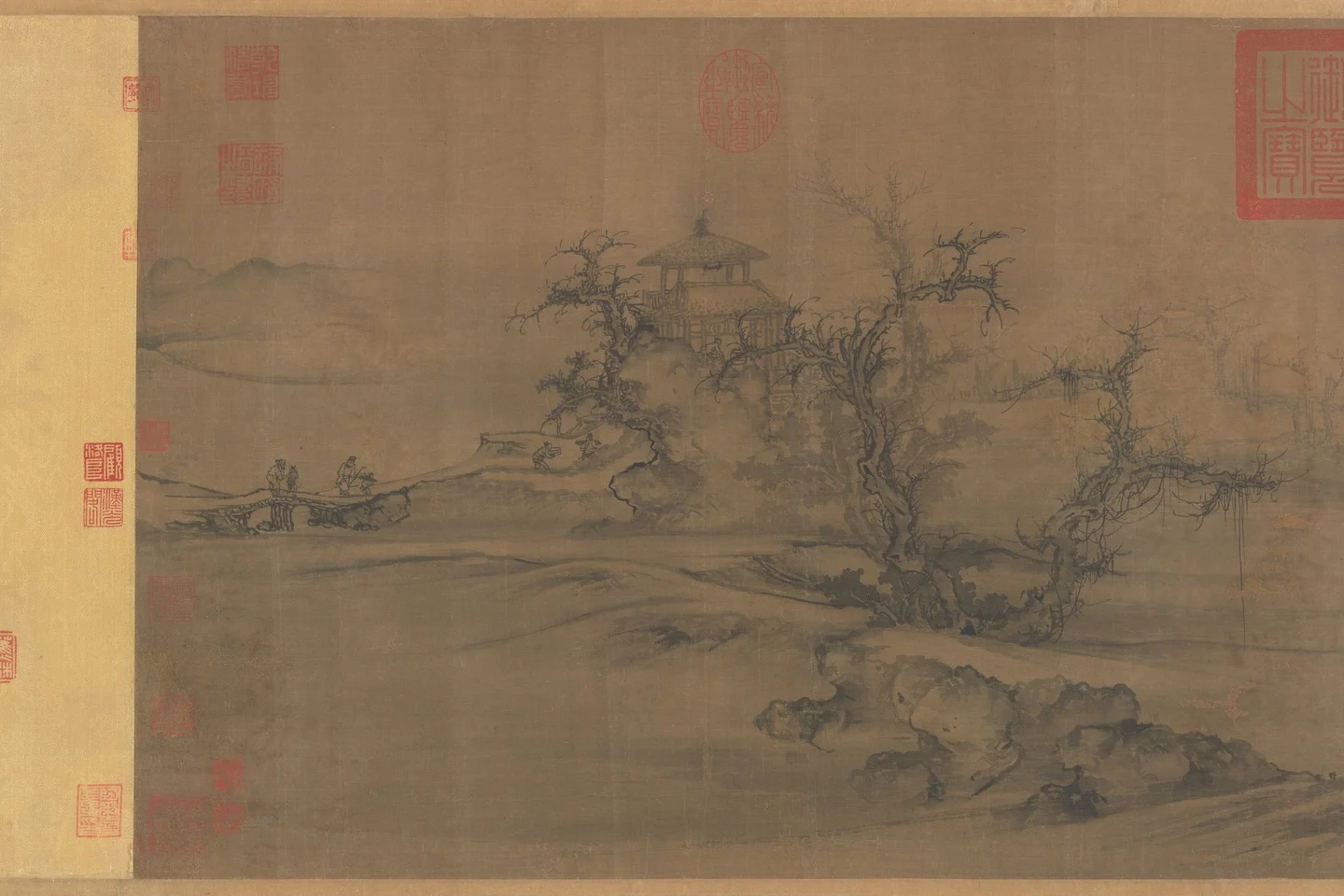 Guo Xi
Old Trees, Level Distance
ca. 1080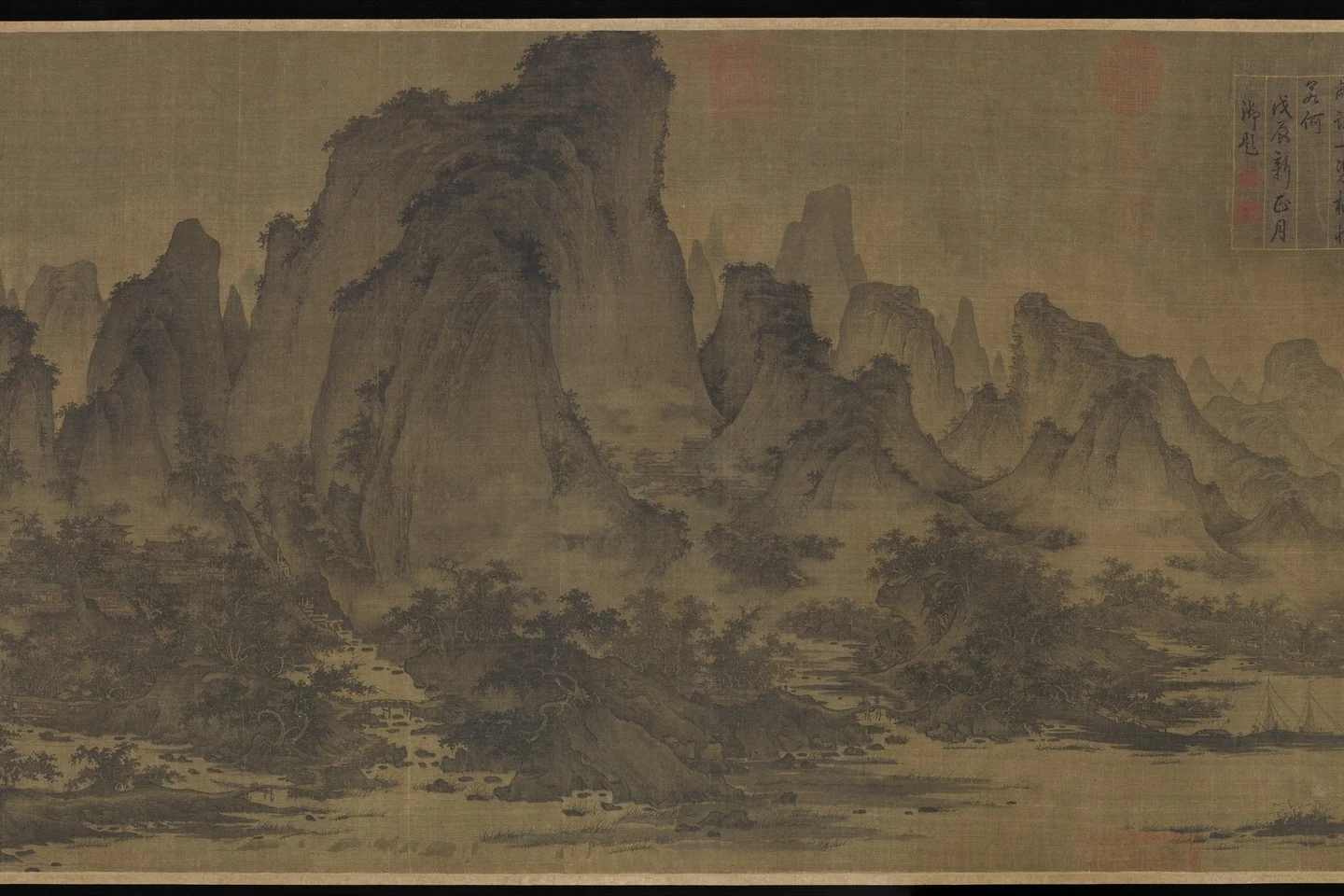 Attributed to Qu Ding
Summer Mountains
ca. 1050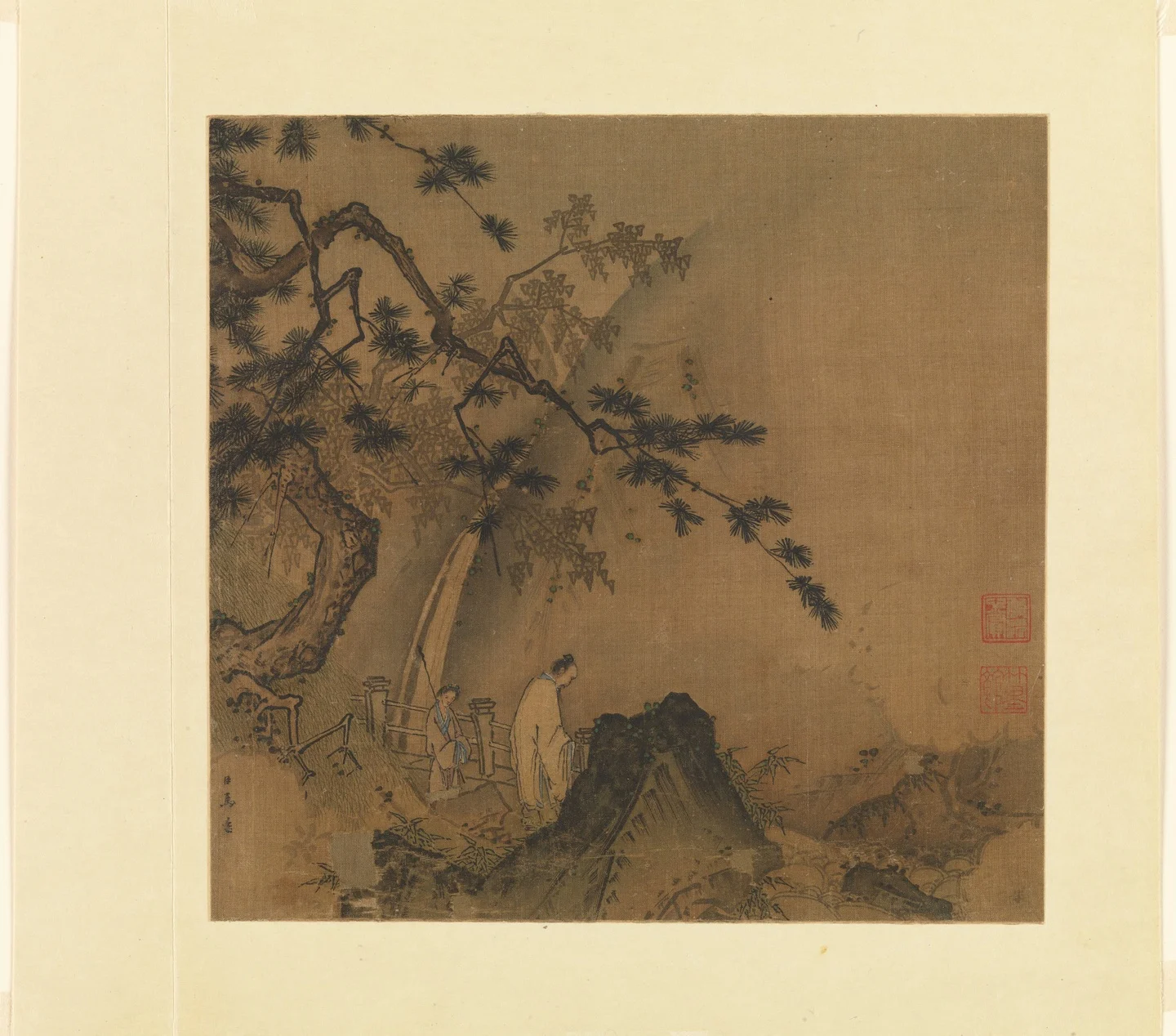 Ma Yuan
Scholar viewing a waterfall
early 13th centuryPeriod, style and subject
- Movement
- Chinese painting
- Genre
- Landscape
- Medium
- Handscroll; ink and color on paper
- Collection
- The Metropolitan Museum of Art
- Dimensions
- Image, 45.9 × 286.4 cm
- Accession number
- 1982.126
Sources
Image provided under CC0. A detail of the scroll. The complete work extends beyond this museum reproduction. Image licence