Forest Scene
Jacob van Ruisdael · c. 1655
Explore the painting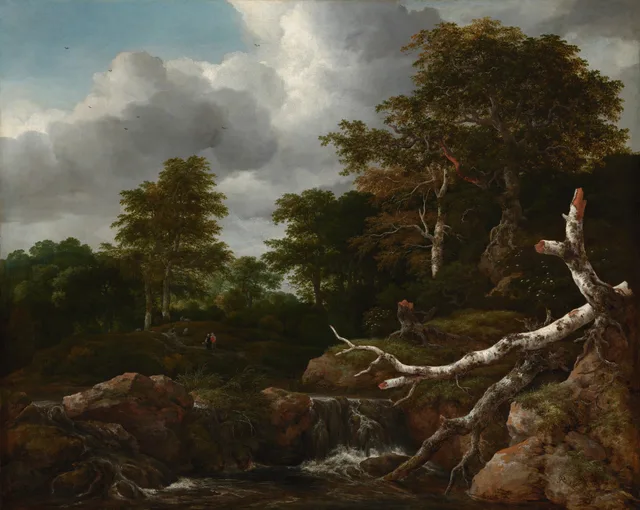
A broken birch lies above a stream with dense woodland behind it. Ruisdael painted the scene around 1655, shortly before moving from Haarlem to Amsterdam. Landscape had become an independent genre in Dutch painting, finding buyers without a required biblical event. Trees, water, and rock dominate here, while people occupy a small area farther back.
The fallen tree’s pale bark stands out against dark green. Its trunk crosses the stream and directs attention inward from the right. Broken branches and exposed roots make damage the landscape’s most conspicuous event. The tree serves both observed nature and composition, while the cause of its fall remains outside the scene.
Water breaks over rocks below. Short light strokes describe foam while dark intervals preserve depth. Ruisdael combines the rocks’ immobility with the stream’s continuing movement. Different durations coexist: the tree grew over years before falling, while water passes through the stones in the present.
Two small figures walk along a path near grazing sheep. They establish the scale of trees and rocks, which would be harder to judge without them. They also continue an ordinary journey beside the fallen trunk. Human activity and natural processes coexist without sharing the same scale.
Standing trees form a dense, tall mass on the right. Greens and browns distinguish their crowns, while lighter trunks create depth. Beside the fallen birch they show different conditions within one wood. A traditional reading connects this contrast with mortality, made persuasive through close attention to natural forms.
Large clouds cross diagonally above the woodland. Light upper edges and dark bases continue the alternation of illumination and shadow below. Sky is an active part of the composition, connecting its areas through weather and strengthening the sense of natural change independent of human presence.
The landscape sustains attention to particular trees and to time itself. The broken trunk is convincing as a natural form and meaningful as an image of destruction. A large painting could bring woodland into an urban buyer’s interior. Today it also invites attention to how the artist distributes importance between people and their surroundings.
More works by Jacob van Ruisdael
- Medium
- oil on canvas
- Collection
- National Gallery of Art, Washington
- Dimensions
- 105.5 × 123.4 cm
- Accession number
- 1942.9.80
Sources
Museum reproduction. Public domain, NGA Open Access. Image licence