Piazza San Marco
Canaletto · late 1720s
Explore the painting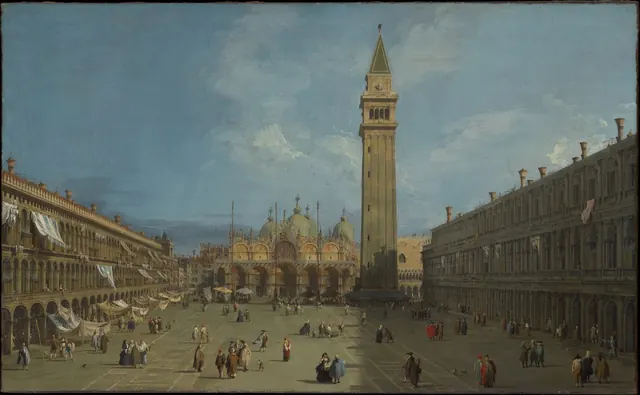
The painting’s story and details
Canaletto’s Piazza San Marco appears open and clearly legible. The painting dates to the late 1720s, when Venice attracted travelers through architecture, festivals, and art, even as its former political power waned. City views became sought-after objects. A foreign visitor could take home a carefully organized image of a journey.
Saint Mark’s Basilica closes the square. Domes and arches stand against the sky, yet distance places them within the larger ensemble. Canaletto preserves the main landmark’s recognizability while fitting its scale to a broad space that can be mentally crossed from foreground to façade.
The bell tower supplies the principal vertical. Museum research notes that Canaletto reduced its windows and lengthened the flagpoles. These are small but deliberate alterations to visible architecture. The view’s precision is selective: overall persuasiveness could involve simplified detail and adjusted proportions.
Arcades at the left repeat and gradually diminish. Pale walls alternate with dark openings, creating a regular rhythm that makes distance easy to judge. Perspective orders the broad square so that its complex architecture can be examined with few obstructions.
Awnings and small groups animate the lower arcades. The square accommodates encounters and commerce, with monumental buildings surrounding everyday urban life. People are small against the façades, yet their presence makes the open space’s actual scale tangible.
The paving pattern guides attention into depth. The square’s condition helps date the painting in relation to work carried out in 1725–1727. Beneath the pedestrians’ feet is evidence of a specific urban change. A view valued as a memory of Venice can now help investigate the city’s material history.
Travelers, especially British visitors, readily bought Canaletto’s views. Their expectations helped shape how Venice appeared to the rest of Europe. The painting preserves real buildings and traces of change while offering an orderly city convenient to survey. A small but significant distance emerges between the square’s life and its role as a beautiful memory.
More paintings to compare
Period, style and subject
- Movement
- Baroque
- Genre
- Landscape
- Medium
- Oil on canvas
- Collection
- The Metropolitan Museum of Art
- Dimensions
- 68.6 × 112.4 cm
- Accession number
- 1988.162
Sources
Image provided under CC0. Image licence