The Adoration of the Magi
Sandro Botticelli · c. 1478/1482
Explore the painting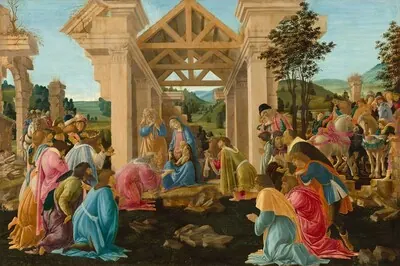
The painting’s story and details
Three Magi have approached Mary and the infant, while their companions pause on either side. Botticelli painted this version of the Adoration around 1478–1482. In Florence, the subject belonged to civic life. An influential confraternity devoted to the Magi organized processions in which hundreds of participants reenacted the journey to Bethlehem. The biblical story became a public celebration, offering prominent citizens an opportunity to display their devotion before the city.
Mary and Jesus occupy the central axis beneath an open wooden roof. A clear space remains before them, with the crowd gathering to either side. Viewers receive their own approach to the principal group. Botticelli organizes the encounter so that numerous figures do not conceal its centre.
People on the left bow their heads, kneel and join their hands. Their poses offer several ways to express reverence. The museum contrasts this concentration with the grander processions in earlier Adorations. Rich fabrics and horses remain in Botticelli’s picture, but those closest to the child stop and bend towards him. The artist draws the attention of a large retinue into the small central group.
Elegantly dressed companions stand and kneel on the right. Bright fabrics and decorated vessels preserve distinctions of social position. Their wealth becomes an offering to the infant. A noble viewer could combine devotion with recognition of familiar clothing and ceremony. Reverence appears through an established language of courtly behaviour.
A wooden roof stands among the remains of a classical building. For Christian viewers, the ruins could signify the pagan world within which the new faith emerged. Yet Botticelli carefully depicts its columns and carved stone. Antiquity serves both as a sign of an earlier age and as a model of beautiful architecture. That coexistence helps explain the Renaissance, when Christian patrons valued and studied the ancient world’s legacy.
Columns at the left edge continue the ancient structure beyond the crowd. The museum considers this version of the Adoration probably painted in Rome. In 1481–1482, Botticelli participated in decorating the Sistine Chapel walls for Sixtus IV. This panel’s place of origin remains uncertain. His work in the chapel nevertheless shows how closely the study of antiquity and papal patronage coexisted in his career.
The painting brings together civic processions, a Christian subject and an interest in antiquity. They belonged to a shared culture of patronage and celebration. Dress and gifts reveal differences of social standing, but before the child the participants bow and kneel. We can read this as an order in which earthly distinction acknowledges a higher authority. Public display of wealth and personal devotion could coexist in a single gesture.
Featured in tours
Florence and Rome. Patrons of the Renaissance
Merchants, monasteries, the Medici and the papal court. The changing work of artists from the thirteenth to the sixteenth century.
More paintings to compare


Period, style and subject
- Movement
- Renaissance
- Genre
- Religious art
- Medium
- tempera and oil on poplar panel
- Collection
- National Gallery of Art, Washington
- Dimensions
- Painted surface, 68 × 102 cm
- Accession number
- 1937.1.22
Sources
Reproduction of a public-domain artwork. Image licence