Spring (Primavera)
Sandro Botticelli · About 1480
Explore the painting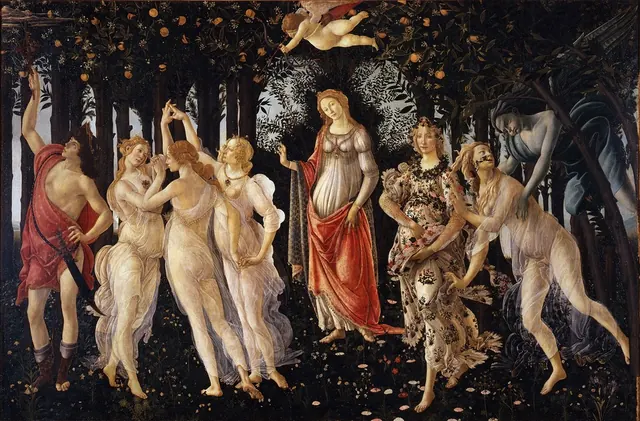
The painting’s story and details
Pursuit, transformation and a dance share Botticelli’s garden. These classical gods were painted for a Florentine home. By the late fifteenth century the picture belonged to the heirs of Lorenzo di Pierfrancesco de’ Medici and hung above a chest-bench. The commission’s precise programme is unknown. One of its stories, however, can be followed through an ancient poem and the figures’ gestures.
Botticelli was a tanner’s son who trained with Filippo Lippi. By 1470 he ran his own workshop. Commissions from the Medici and their circle supported large mythological compositions. He continued to paint religious subjects and received a commission for Sistine Chapel frescoes in 1481. Classical poetry and Christian subjects belonged to the same painter’s working life.
At the right, the blue Zephyrus seizes Chloris. Her body moves one way while her head turns sharply towards her pursuer. In Book Five of Ovid’s Fasti, Flora recalls that she was once called Chloris. Zephyrus saw her in spring, pursued her and overpowered her. The poem then describes their marriage. The story begins with violence, retained in the painting’s grasp and the nymph’s attempt to escape.
Flowers emerge from Chloris’s mouth. Ovid likewise describes roses coming from the goddess’s lips as she speaks. Botticelli makes this detail visible during the pursuit itself. The neighbouring woman in a flowered dress is Flora, Chloris after her transformation. Two figures represent different moments in one life. Treating this group as three separate participants in a love scene would miss its structure.
Flora holds roses in the folds of her dress and takes them out with one hand. In Ovid, Zephyrus gives her a garden of perpetual spring and authority over flowers. The poem helps explain both her clothing and her action. Blossoms recur in her wreath, collar, fabric and the ground below. Beside Chloris’s disrupted movement, Flora advances with a steady step.
The flowering garden can initially seem serene. Chloris’s story changes that impression. One image combines the seizure of a woman with the abundance that follows in the ancient myth. A present-day viewer can ask how pictorial beauty affects our response to violence in a story. Flowers and dancing may distract from the pursuit; close attention to the right-hand group restores it to the whole. This is a question raised by the image, not a documented intention of Botticelli.
Venus stands slightly behind the others. Branches open around her head, making the tilt of her face clear against the sky. Above her, blindfolded Cupid aims towards the dancers. He connects the central figure with the group on the left. The goddess of love stands between pursuit on the right and the Graces’ coordinated movement on the left.
The Graces join hands in a round dance. One turns her back to us, while the other two face towards her, allowing us to follow the circle into depth. Transparent fabric reveals the turns of shoulders and legs; its folds change with each body. Botticelli connects the figures through touch and recurring curves while keeping their individual movements legible.
At the left edge Mercury raises his staff towards a small cloud. Wings on his footwear identify the messenger of the gods. He looks upwards, turned away from the other figures, and his extended arm closes the group at the picture’s edge. Why Mercury belongs in this particular garden remains part of the debate over Primavera.
Plants densely cover the lower part of the picture. Individual stems and flowers can be examined almost as small drawings in their own right. Yet the garden recedes only a short distance. Dense dark foliage stands behind the light bodies and fabrics. This makes Botticelli’s reliance on clear contours especially evident. We can follow a figure’s edge almost continuously, even where the clothing is translucent.
Seen as a whole, the transformation joins the dance, flowering plants and the presence of Venus. The Uffizi describes a celebration of love, peace and prosperity while leaving the complete meaning open. Ovid’s poem explains the right-hand group much more precisely than it explains the whole garden. Chloris’s story can be reconstructed from the text; the painting’s unified programme remains a subject of interpretation.
Featured in tours
Florence and Rome. Patrons of the Renaissance
Merchants, monasteries, the Medici and the papal court. The changing work of artists from the thirteenth to the sixteenth century.
Love, marriage and encounters
Gods, lovers, spouses and people whose relationships remain unknown.
World classics. Altar, palace, exhibition
Familiar paintings and the people for whom they were made.
More paintings to compare
 Sandro Botticelli
Adoration of the Magi
1470–1475 Sandro Botticelli
Virgin and Child with an Angel
1475–85 Sandro Botticelli
The Last Communion of Saint Jerome
early 1490s Sandro Botticelli
The Adoration of the Magi
c. 1478/1482 Sandro Botticelli
The Birth of Venus
c. 1485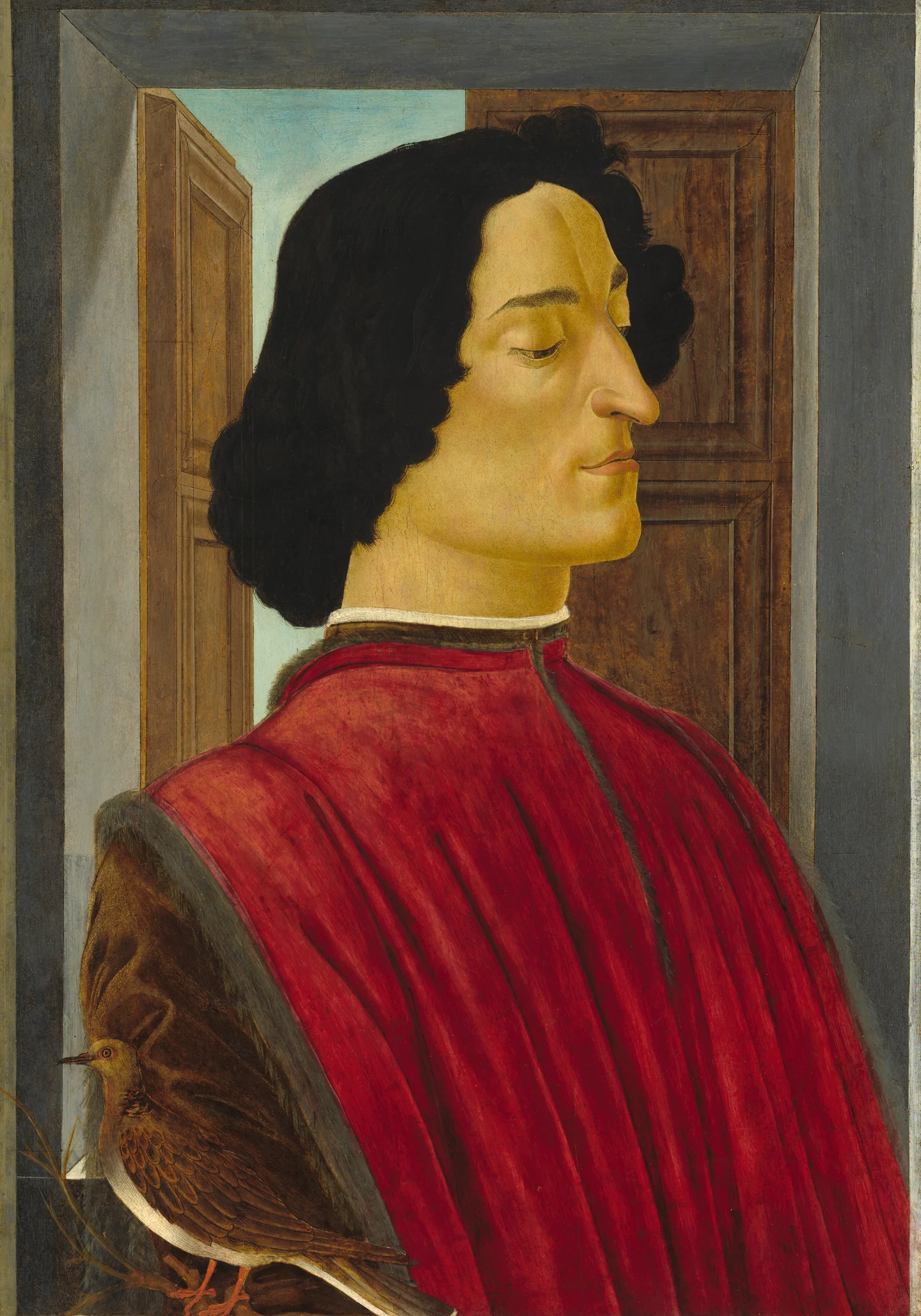 Sandro Botticelli
Giuliano de' Medici
c. 1478/1480Period, style and subject
- Movement
- Renaissance
- Genre
- Imagined worlds
- Medium
- Tempera grassa on wood
- Collection
- Gallerie degli Uffizi, Florence
- Accession number
- 1890 n. 8360
Sources
Public Domain. Resized previews and tiles prepared for display; no retouching or upscaling. Image licence