The Small Crucifixion
Matthias Grünewald · c. 1511/1520
Explore the painting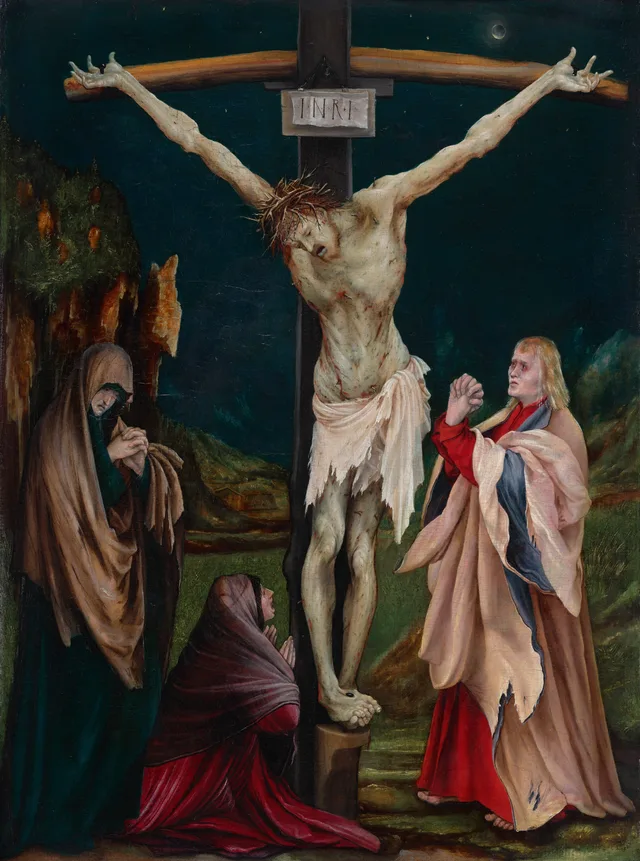
Christ’s body hangs heavily from the cross above Mary, John, and the kneeling Mary Magdalene. Grünewald painted the small panel around 1511–1520. It belongs to a devotional culture in which close meditation on Christ’s suffering supported prayer. Physical pain is intensified so that recognition of the familiar Crucifixion scheme cannot remain merely automatic.
Chest and abdomen stretch downward under the body’s weight. Pale, sometimes greenish skin is marked by wounds. Vulnerability becomes central. This differs from the idealized anatomy favored by many Italian Renaissance painters, revealing different contemporary answers to what truth a painted human body should convey.
Arms extend along the crossbeam and fingers spread and curl sharply. The outline becomes painfully angular. Distortion intensifies the experience. Grünewald uses drawing to make the gesture physically apprehensible, allowing an emphatic line to convey tension as forcefully as a carefully rendered wound.
Mary lowers her head and joins her hands on the left, enclosed by dark clothing. Opposite, John’s pale and red garments accompany a more open, tense gesture. Different responses remain distinct. Space between the figures allows several human reactions to the same event to be seen separately.
Mary Magdalene kneels at the cross’s base. Her smaller figure reaches upward as drapery spreads over the ground. Scale and position make her especially dependent on the great vertical above. The viewer is offered another possible relation to the event: low down, close to earth, looking upward.
A small darkened disk appears in the sky. The surrounding gloom relates to the Gospel account of darkness at the Crucifixion. Bodies nevertheless receive a sharp, unusual light. Illumination serves the event’s meaning, making the landscape a setting in which the ordinary order of day has been disrupted.
In a museum the work is often approached through Grünewald’s expressive power. For an early devotional viewer it had a practical role in concentrating attention on suffering and compassion. Changed conditions have not removed its physical force. Religious art could deliberately challenge the eye and seek a response through pain rather than reassurance.
- Medium
- oil on panel
- Collection
- National Gallery of Art, Washington
- Dimensions
- 61.3 × 46 cm
- Accession number
- 1961.9.19
Sources
Museum reproduction. Public domain, NGA Open Access. Image licence