Ginevra de' Benci [obverse]
Leonardo da Vinci · c. 1474/1478
Explore the painting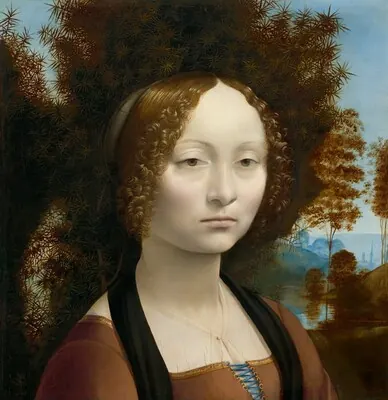
The painting’s story and details
Leonardo painted Ginevra de’ Benci in Florence around 1474–1478. She came from a wealthy banking family, received an education and wrote poetry. The portrait has been connected either with her marriage to Luigi Niccolini in 1474 or with a commission from an admirer, the Venetian ambassador Bernardo Bembo. Both proposals explain why a young woman’s likeness was accompanied by reflections on virtue and beauty.
Her face turns almost three-quarters towards us. Profile views were more customary for Florentine portraits of women. This turn gives Leonardo greater scope for soft shadows beneath the chin and around the eyes. In an early experiment with oils, he uses slow drying and thin layers to connect illuminated skin gradually with shaded passages.
Juniper forms a dark setting around her head. Its Italian name, ginepro, echoes Ginevra’s. A landscape detail therefore also identifies the sitter. Sharp needles emphasize the face’s smoothness. Wordplay is particularly appropriate for the portrait of a woman known to her contemporaries as a poet.
On the right, water recedes between trees towards a blue distance. Leonardo communicates depth through weakened contrasts and changing colour. Placing the woman directly before a landscape expands the portrait’s space. Fingerprints on the surface show that he also achieved soft transitions by touching paint while it remained wet.
Blue lacing crosses the dress, and a small gold pin holds the translucent fabric over her chest. The limited adornment fits informal dress, although Ginevra came from a wealthy family. The present format also affects our impression. The panel was later cut down at the bottom, bringing the face closer to the picture’s edge. A surviving Leonardo drawing has informed a reconstruction with hands held at the waist. Their precise gesture remains conjectural.
Small curls frame her cheeks, while her expression stays restrained. Curator Eve Straussman-Pflanzer points to differing modern responses: some viewers perceive coldness, others confidence and composure. The same steady gaze permits contrasting assessments, exposing our own expectations of women’s portraits.
On the panel’s reverse, juniper, laurel and palm accompany the motto “Beauty Adorns Virtue.” Examination revealed Bernardo Bembo’s personal motto, “Virtue and Honour,” underneath. He very likely commissioned the reverse; whether he also ordered the portrait remains unproven. The two sides illuminate a culture that accompanied a woman’s likeness with praise of her moral and intellectual virtues. Almost none of Ginevra’s poetry survives. We can see her face and read the emblems dedicated to her, while her own voice reaches us only in fragments.
Featured in tours
Florence and Rome. Patrons of the Renaissance
Merchants, monasteries, the Medici and the papal court. The changing work of artists from the thirteenth to the sixteenth century.
Portraits. How people presented themselves
Rulers, merchants, artists and private patrons before a viewer.
More paintings to compare


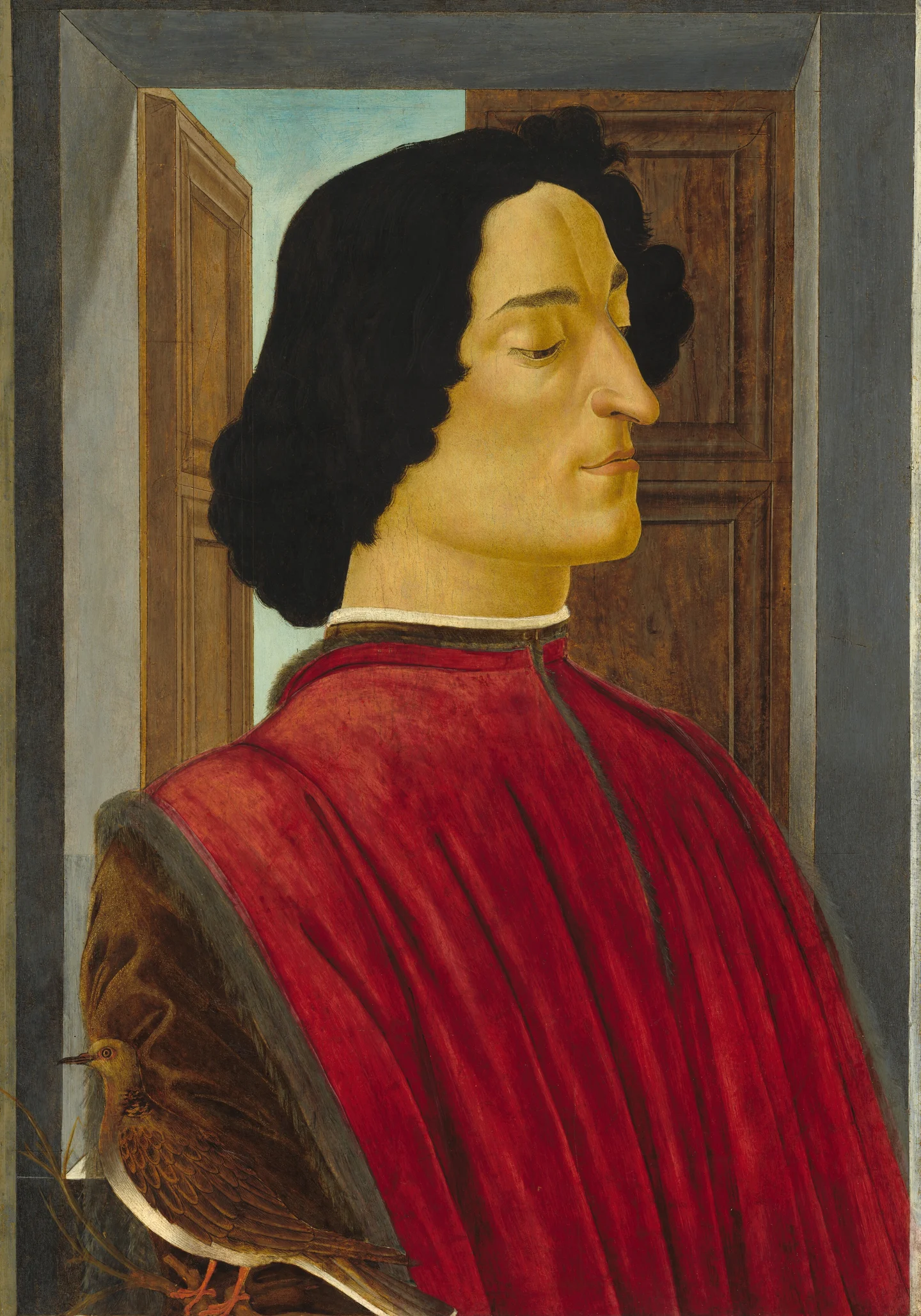
Period, style and subject
- Movement
- Renaissance
- Genre
- Portrait
- Medium
- oil on panel
- Collection
- National Gallery of Art, Washington
- Dimensions
- Overall (original panel only), 38.1 × 37 cm
- Accession number
- 1967.6.1.a
Sources
Reproduction of a public-domain artwork. Image licence