The Voyage of Life: Youth
Thomas Cole · 1842
Explore the painting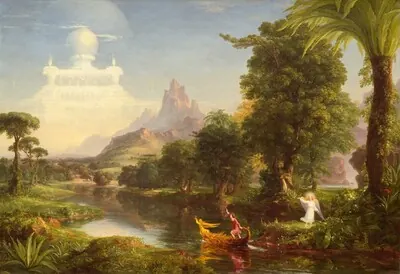
The painting’s story and details
A young man raises his hand towards a palace in the clouds. His golden boat leaves the bank, with a bright valley opening ahead. This is the second part of The Voyage of Life, four paintings about childhood, youth, adulthood and old age. We see the 1842 version. Cole tells a human story through landscape, changing light, current and vegetation with the traveller’s age.
The boat carries a winged figure holding an hourglass. The youth reaches towards his goal and directs his own movement. In the first painting the child depended on a guardian angel; now independence has arrived. Yet the hourglass already accompanies him. Even amid luxuriant growth, Cole retains a reminder of time steadily running out.
At first the river seems to lead straight towards the palace in the air. Farther on, however, its course turns right towards rocks. The difference between the direction of desire and the direction of the water becomes the painting’s principal event. The traveller sees an attractive goal, while we can follow the route farther ahead. Cole anticipates future trials through the visible geography of an imaginary place.
The palace is almost transparent. Columns, towers and a great dome share the clouds’ pale colours, and the building has no earthly foundation. In the museum’s reading, it represents youthful dreams of glory and greatness. The artist makes them detailed enough for us to feel their attraction and weightless enough for us to notice their fragility.
The angel remains on the right bank. Its white figure is clearly visible beneath the enormous trees, one hand raised towards the youth. The boat is released while the guardian’s presence continues to accompany the journey. This detail connects human independence with the cycle’s Christian framework. In its final part, salvation comes through faith when the traveller’s own strength is no longer sufficient.
Leaves and flowers fill the near bank. Water reflects the greenery, and warm light makes the valley generous and inviting. This is nature suited to the feeling of possibilities opening. Its abundant detail lets us experience youth’s promise before judging its overconfidence. Beauty is essential to the story because it explains why the traveller moves forward so eagerly.
Cole made two versions of the cycle; the earlier one, from 1840, belongs to the Munson museum. In the Washington series, landscape unfolds a Christian account of an entire life. Scholars also allow a comparison between the youth and a young America absorbed in growth and territorial expansion. That is an additional reading. The river’s turn poses a broader question about freedom when a desired goal obscures the actual course of events.
Featured in tours
American landscape. Land and its inhabitants
Nature, territorial expansion, the Civil War and urban life in American painting.
More paintings to compare
Period, style and subject
- Movement
- Romanticism
- Genre
- Myths & allegories
- Medium
- oil on canvas
- Collection
- National Gallery of Art, Washington
- Dimensions
- Overall, 134.3 × 194.9 cm
- Accession number
- 1971.16.2
Sources
Reproduction of a public-domain artwork. Image licence