Mrs. Richard Brinsley Sheridan
Thomas Gainsborough · 1785-1787
Explore the painting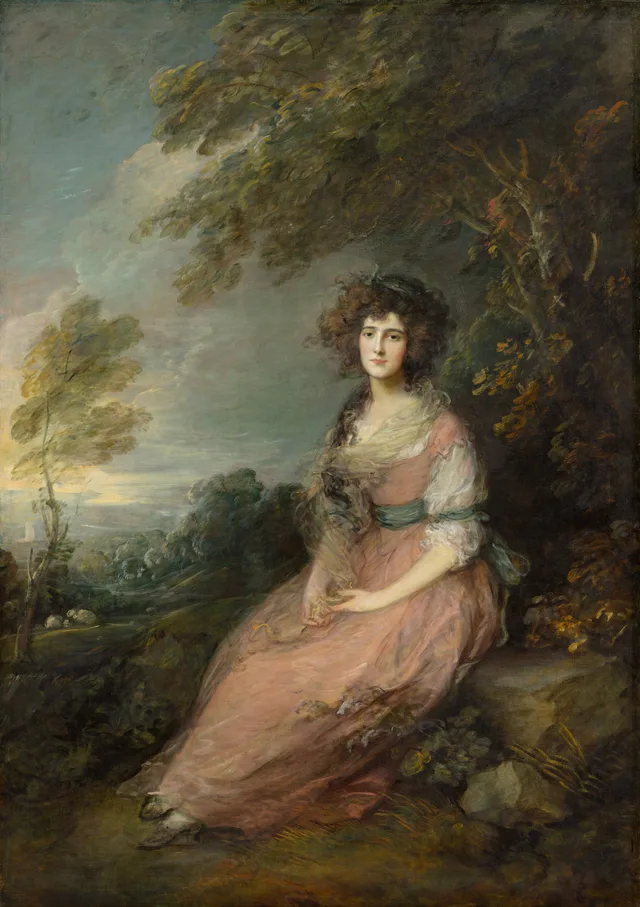
The sitter is Elizabeth Linley, a celebrated singer who married the playwright Richard Brinsley Sheridan. After their wedding he forbade her to perform professionally. Gainsborough painted her in 1785–1787, seated among trees with a landscape opening beyond. The conventional title chiefly preserves her husband’s name. Her biography restores a woman with an accomplished career of her own.
The face turns toward the viewer although the body angles away. Softly painted features sit among loose strands of hair. Her gaze provides stability within mobile brushwork. Landscape and biography may encourage a reading of solitude or sadness, yet the expression remains more complex than a single emotion. A formal portrait’s distance is preserved.
Her hands rest quietly in her lap, holding the ends of a light scarf. No score, instrument, or other direct reference to her singing appears. Expensive, loosely arranged fabric takes their place. Commissioned portraiture could present a woman through refinement and social position while leaving her professional activity outside the image.
Long strokes describe the pink skirt. Highlights lack rigid outlines, making the fabric seem light and mobile. Gainsborough uses related brush movements in the foliage. Figure and landscape are connected through the act of painting, even though the costume is hardly practical for an ordinary woodland walk.
Trunk and branches bend over the woman in a broad frame, echoing the figure’s inclination and the dress. The landscape is carefully composed around her, creating a sheltered position while opening space to the left. This asymmetry lends a formal portrait an ease difficult to achieve against a plain wall.
A distant valley brightens on the left beneath a band of light in the clouds. Painted more broadly than the face, it establishes air and distance without demanding recognition of a particular estate. Gainsborough combines two genres central to his practice. The figure supplies scale while the landscape alters the experience of her presence.
The portrait holds a tension between public achievement and private restriction. Linley’s talent had brought recognition, but marriage limited her freedom to use it. Gainsborough does not turn that history into an explicit narrative. Knowing it changes how we read the missing professional attributes and how a beautiful image can preserve a person while concealing part of her life.
- Medium
- oil on canvas
- Collection
- National Gallery of Art, Washington
- Dimensions
- 219.7 × 153.7 cm
- Accession number
- 1937.1.92
Sources
Museum reproduction. Public domain, NGA Open Access. Image licence