María Teresa de Borbón y Vallabriga, later Condesa de Chinchón
Francisco Goya · 1783
Explore the painting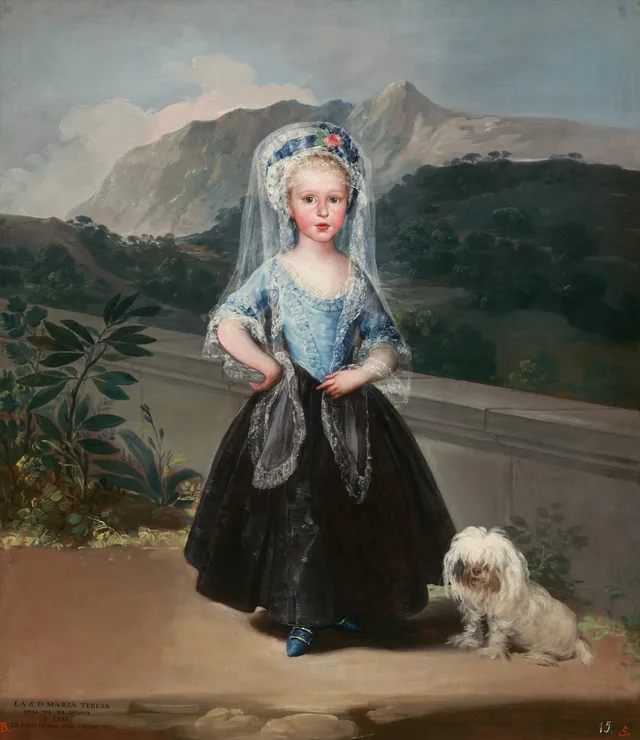
The inscription gives the girl’s age as two years and nine months. Goya painted María Teresa in 1783. Her father, the Infante Don Luis, was Charles III’s brother. The family lived at Arenas de San Pedro, where the artist worked for them. The portrait brings a very young child into the formal language of court representation.
Rounded cheeks and a small chin preserve a child’s face. A direct gaze meets the viewer without an elaborate turn. Goya does not make the features conform to the costume’s adult formality. The difference between young face and ceremonial dress keeps the figure alive beneath her family position.
A white lace mantilla falls from head to shoulders. Blue ribbon and flower decorate the cap, with pale patterns continuing across the bodice. These clothes present the girl to others, leaving little suggestion of movement or play. She appears within a world whose rules adults have chosen.
The dark skirt broadens downward while her hands hold the transparent fabric. The figure becomes stable and nearly symmetrical, suited to a formal portrait in which position should be read quickly. Small hands and short stature continually register the difference between ceremonial form and the sitter’s age.
A white dog sits nearby, its fur described in free, long strokes unlike the carefully rendered lace. The animal introduces familiar company and softens the pose’s stillness. It also establishes the girl’s small size. Goya leaves room for a domestic presence within the formal image.
The Sierra de Gredos rises behind the terrace, linking the portrait with the family’s surroundings. Distant mountains and the small foreground figure create a marked spatial contrast. Landscape lends scale while light on face and clothes preserves the child’s prominence. Nature supports the formal setting without overwhelming it.
Goya later painted María Teresa as an adult in the celebrated portrait of the Countess of Chinchón now in the Prado. The early work shows public presentation beginning before personal choice. Dress, pose, and an inscription of parentage are already required. Yet the child’s face remains more expressive than the signs of position arranged around her.
More works by Francisco Goya
- Medium
- oil on canvas
- Collection
- National Gallery of Art, Washington
- Dimensions
- 134.5 × 117.5 cm
- Accession number
- 1970.17.123
Sources
Museum reproduction. Public domain, NGA Open Access. Image licence