The Vladimir Mother of God
Unknown Byzantine icon painter · First third of the 12th century
Explore the painting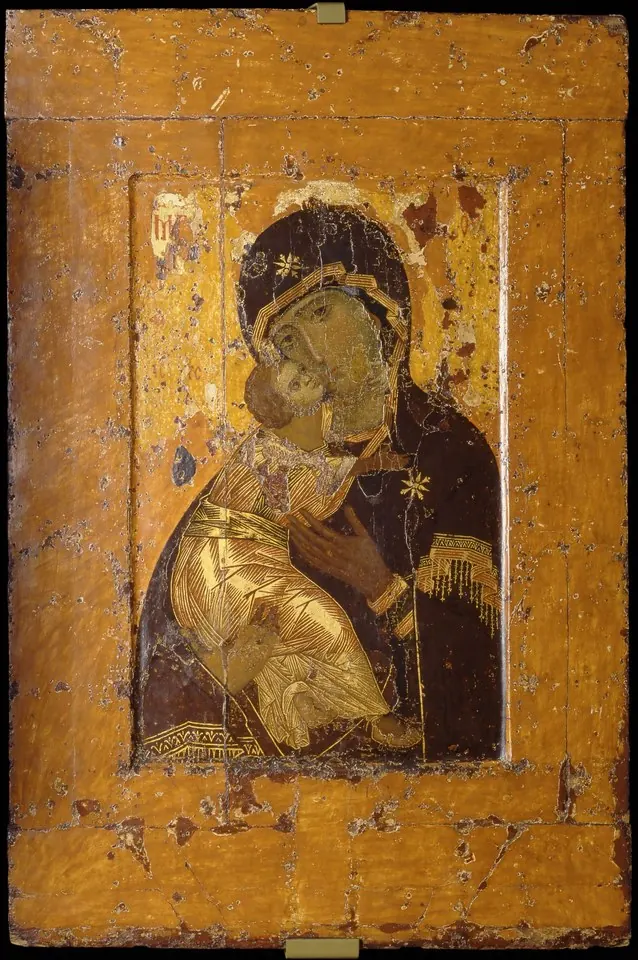
The painting’s story and details
A child embraces his mother as she looks towards us. An unknown Constantinopolitan painter made this image in the first third of the twelfth century. Its name, Vladimir, came later. In 1155 Prince Andrei Bogolyubsky took it from Vyshhorod near Kyiv to northeastern Rus. It became the principal sacred image in Vladimir’s new Dormition Cathedral.
Christ presses his cheek against Mary’s. In Rus, this type of image became known as Tenderness. The familiar embrace makes Christ’s human nature imaginable. Jesus appears as a child seeking closeness to his mother. For a believer, this belongs to the story of God becoming human.
Mary’s long fingers point towards the child. This left hand is raised in prayer; the other hand, lower down, supports him. The distinction matters to the icon’s meaning. Mary appears both as Christ’s mother and as an intercessor addressing him in prayer.
Colour changes gently around the eyes and nose. The painter laid thin light layers over a dark preparation, using small white touches on illuminated areas. The face gains volume without a sharp boundary between light and shade. Close viewing reveals Byzantine painting preserved beneath later repainting.
Gold lines on Christ’s clothing are much sharper than the tonal transitions on the face. They follow folds and gather in dense clusters. Close viewing reveals how differently cloth and skin are painted. The gold pattern makes the child’s body stand out against Mary’s dark mantle.
Losses and cracks mark the broad margins. This reproduction shows the surface without its precious covering. In the early fifteenth century, Metropolitan Photius commissioned Greek craftsmen to make a gold covering for the icon. Such commissions joined veneration to goldsmiths’ work and expenditure from the church treasury. Painters and those who adorned the image both shaped its appearance.
In 1395 the icon was brought to Moscow as Timur’s army threatened the city. His withdrawal was attributed to the Virgin’s intercession. A story of protection for an entire city developed, and many copies of the venerated image were made. These carried its composition farther afield and brought the memory of Moscow’s deliverance into the histories of new icons.
Rites for choosing church leaders and crowning rulers were performed before the Vladimir icon. A familiar embrace became part of the state’s public life. Its history invites us to consider how one image acquires different significance for an individual worshipper, an assembled city or a ruler about to be crowned.
Featured in tours
Christian images. From mosaic to Caravaggio
Icons, manuscripts, domestic devotional pictures and church altarpieces.
World classics. Altar, palace, exhibition
Familiar paintings and the people for whom they were made.
More paintings to compare
Period, style and subject
- Movement
- Icon painting
- Genre
- Religious art
- Medium
- Tempera on a gessoed wood panel
- Collection
- Historical Tretyakov Gallery catalogue
- Accession number
- 14243
Sources
Public Domain. Resized previews and tiles prepared for display; no retouching or upscaling. Image licence