The Garden of Earthly Delights (open triptych)
Hieronymus Bosch · 1490–1500
Explore the painting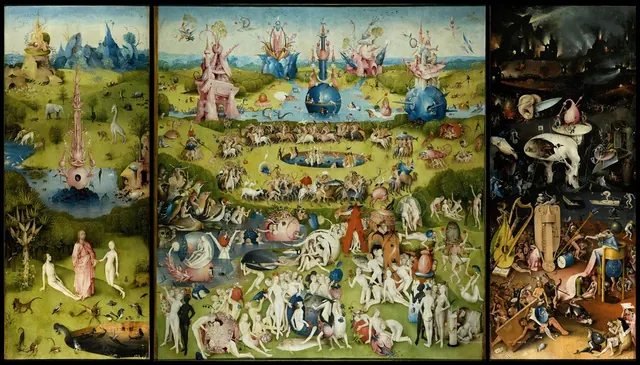
The painting’s story and details
Bosch’s open triptych combines Eden at left, a world crowded with pleasures in the centre and Hell at right. It was in the Nassau palace in Brussels by 1517, and the Prado connects its commission with that aristocratic family. Its form recalls a church altarpiece, but it belonged in a private palace. Viewers could debate human desires while enjoying the picture’s invention. That double pleasure matters to its meaning.
On the left wing God presents Eve to Adam. The small group stands among familiar and unfamiliar plants and animals. Human history begins within an already abundant world. Pale skin and pink clothing stand out against grass. The centre panel retains this green environment and bodily presence but replaces the single couple with an immense multitude.
The pink fountain above the first pair combines mineral, plant and architectural forms. Its cavities, projections and slender shoots look elaborately specified, although no such whole exists in nature. This is one of Bosch’s central devices. Familiar parts make an impossible combination believable. Fantasy becomes more persuasive than a vague mist: we can almost investigate it as a real object.
In the centre people bathe, gather and carry enormous fruit. Ordinary differences of scale break down. A berry can shelter a person; a bird becomes their equal. In 1605 José de Sigüenza connected the strawberry with the brief taste of pleasure. This early reading helps explain the abundance’s fragility. Yet the painting also makes us admire what it asks us to judge morally. Visual enjoyment becomes part of the question.
At right the same disruptions of scale become painful. A huge pale body opens like a room containing small people, while its legs become wooden supports. What allowed people to shelter inside fruit and play with forms in the centre now destroys bodily integrity. The panels are connected by more than a change of subject. Bosch turns his own attractive inventions against their inhabitants.
Above the fantastic torments a town burns. Flashes reflect in water and buildings dissolve into smoke. This is closer to an earthly disaster than the creatures below. Hell includes a recognisably ruined human environment. Darkness does not conceal everything but makes us search for separate sources of light. After the evenly green centre panel, we encounter a world that can no longer be surveyed freely.
When the wings close, the coloured abundance gives way to creation rendered in grey. Opening changes colour, population and the way of looking almost at once. A palace owner could stage that transition for guests. A moral warning thus existed as a rare expensive possession and an intellectual entertainment. Does pleasure in the extraordinary spectacle strengthen the warning, or let us enjoy what it condemns?
More paintings to compare
Period, style and subject
- Movement
- Northern Renaissance
- Genre
- Religious art
- Medium
- Oil and grisaille on oak panels
- Collection
- Museo Nacional del Prado, Madrid
- Accession number
- P002823
Sources
Reproduction of a public-domain artwork. Image licence