Woman Mending
Camille Pissarro · 1895
Explore the painting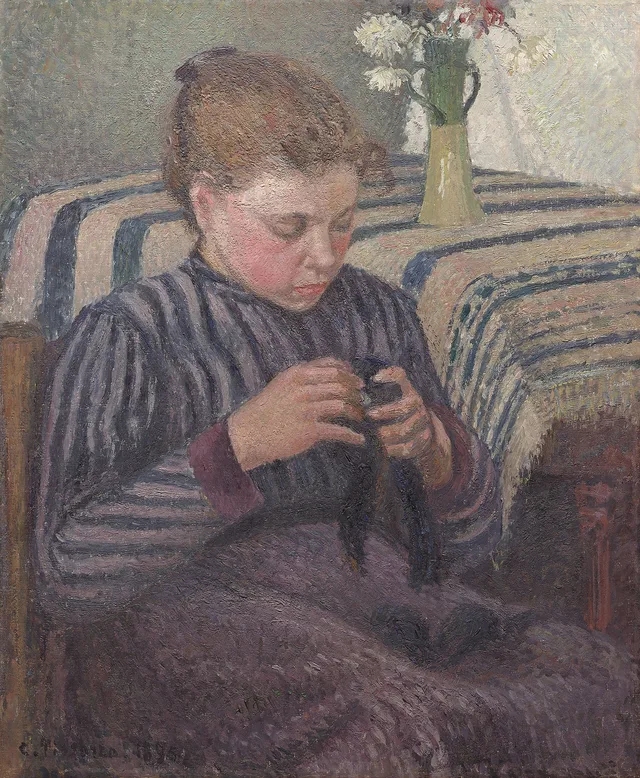
In 1895 Pissarro painted Rosa, his family’s maid, mending clothes. Her name is known from his correspondence. In a letter to his son Lucien he expressed satisfaction with this painting, although he often hesitated over whether a work was finished. By then Pissarro owned his house in Éragny. His improved circumstances allowed him to observe domestic labour at close quarters within his own household.
Rosa bends her head over her sewing. Her face appears in three-quarter view, with her hair gathered behind. She does not meet the viewer’s gaze; the turn of her head directs attention towards her hands. Her features are specific enough to preserve her individuality. Yet the painting’s title emphasises an activity, making it easy for museum visitors to forget her name.
Pale fingers stand out against dark fabric. The hands draw together and the shoulders lean slightly forward. Their small movement determines the entire pose. Mending may look peaceful to us, but the painting cannot establish the length of Rosa’s working day or her thoughts. It does show the concentration demanded by an inconspicuous task that sustains everyday household life.
The blouse’s stripes change direction across the shoulders and sleeves, making the body’s volume legible amid many short strokes. Lilac, grey and pinkish tones carry light through the fabric. Pissarro leaves the painted surface visible. Close up, numerous separate touches can be seen assembling into a sleeve and a bent arm.
The skirt fills the lower canvas with a broad checked surface. Its pattern is larger and calmer than the blouse’s stripes. The dark sewing lies between the two fabrics and connects them. There is little empty space around the sitter. This proximity gives a modest domestic scene the presence usually associated with an independent portrait.
A vase of white flowers stands on the table behind Rosa. Upright stems extend the room’s pattern, and pale petals echo small highlights on her face and hands. The still life remains secondary but makes the interior feel inhabited. The maid’s work takes place among objects that create domestic comfort for her employer’s family.
The portrait can also be read as evidence of relationships within a household. Pissarro carefully depicts a woman whose work supports his own daily life, preserving her image for future viewers. Yet access to her time, and the ability to turn it into a painting, belonged to the artist. Sympathy does not erase that difference in position; recognising it clarifies the social dimension of this quiet interior.
Featured in tours
Domestic life. Leisure and care
Sixteen paintings about reading, music, children and the work that makes domestic comfort possible.
More works by Camille Pissarro


- Medium
- Oil on canvas
- Collection
- Art Institute of Chicago
- Accession number
- 1959.636
Sources
Wikimedia Commons reproduction. CC0. Image licence