Jalais Hill, Pontoise
Camille Pissarro · 1867
Explore the painting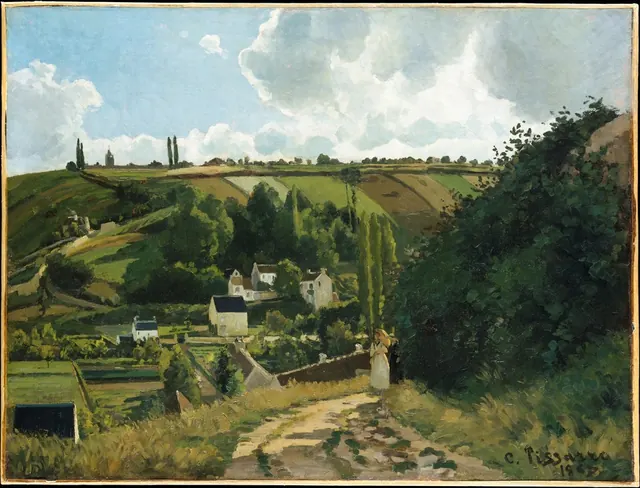
The painting’s story and details
In 1867 Pissarro painted the countryside near his home at Pontoise, northwest of Paris. A low hill, gardens and scattered houses filled a canvas more than a metre wide. Émile Zola noticed it at the following year’s Salon. The writer recognised a modern countryside: land that people had dug, divided and adapted to everyday life.
The stony path comes right up to us. Greenish shadows fall between pale stones, with grass growing along the edges. It narrows beside a wall and leads towards the houses. Pissarro begins with the ground beneath our feet, allowing the distance to the opposite hillside to emerge gradually.
Two figures walk beside the wall. One wears a light dress that stands out sharply against the foliage; the other, in dark clothes and a hat, is partly concealed alongside. Their small scale establishes the depth of the descent. The lighting can make them look like a single person, but separate heads and outlines are visible.
Houses are scattered among gardens. Pale walls, rectangular roofs and fences divide the greenery into smaller plots. A whole way of inhabiting the countryside is visible here: settling beside a road, enclosing land, leaving routes through it. The village results from many people’s decisions, each altering the shape of the landscape.
Fields form broad strips across the distant slope. Boundaries and hedges separate green areas from brown ones. Here the feature Zola recognised becomes particularly clear. Even at a distance, labour has visibly organised the hill’s surface. The cultivated land itself supplies a substantial account of rural life.
Bushes form a dense dark mass at the right. Broad strokes suggest individual leaves and remain clearly visible when enlarged. Paint spreads in longer bands across the bright hillside. Pissarro changes the movement of his brush with the surface he describes: dense foliage or an even stretch of field.
Clouds occupy roughly the upper third of the canvas. Grey undersides and white projections give them volume, while openings of blue sky extend the distance. Light is unevenly distributed. The foreground alternates between shade and brightness, whereas some distant fields receive almost uninterrupted sunlight.
Pissarro was born on the Caribbean island of St Thomas and spent much of his career painting around Paris. Corot and Millet were important precedents. Large, stable forms here precede the more broken brushwork of Impressionism. A few years later he participated in the first Impressionist exhibition of 1874. An ordinary rural view was already acquiring the scale of an ambitious exhibition subject in his work.
Featured in tours
Early Impressionism. Paris 1860–1879
The Salon, the first independent exhibition, railway stations, studios and leisure on the Seine.
More paintings to compare


Period, style and subject
- Movement
- Impressionism
- Genre
- Landscape
- Medium
- Oil on canvas
- Collection
- The Metropolitan Museum of Art
- Dimensions
- 87 × 114.9 cm
- Accession number
- 51.30.2
Sources
Image provided under CC0. Image licence