Woman and Child at the Well
Camille Pissarro · 1882
Explore the painting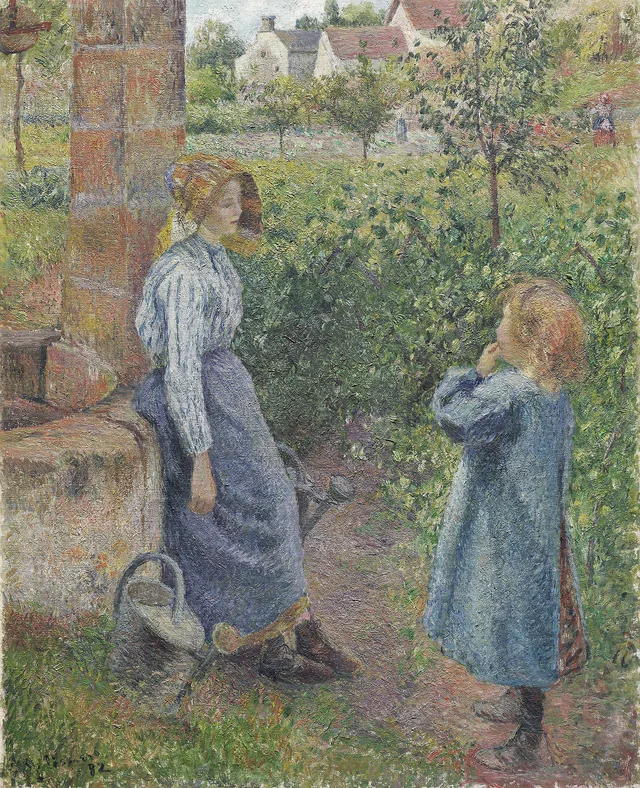
A woman and child have paused beside a well. We seem to be witnessing an interruption in an ordinary country task, although Pissarro leaves its precise cause open. He painted this in 1882, when the human figure was becoming much more prominent in his work. Of thirty-six paintings he exhibited at the seventh Impressionist exhibition, twenty-seven focused on figures. Rural life had become a subject for sustained investigation in its own right, rather than simply an addition to landscape.
The woman stands in profile, one hand lowered beside her skirt. A striped blouse and headscarf suggest everyday clothing, while her stance is settled enough for a pause. Pissarro emphasises neither strenuous labour nor festive leisure. He preserves an intermediate state familiar to anyone occupied with a task. The work is still nearby, but attention has briefly shifted to another person. This uncertainty contributes to the scene’s sense of life.
The child raises a hand to his face and turns towards the woman. Pissarro’s four-year-old son Ludovic-Rodolphe posed for this figure. The museum record tells us that the long blue garment belongs to a boy, although a modern viewer might read it as a girl’s dress. Knowing the model prevents a misidentification, but does not explain the situation the artist constructed. We do not know precisely what passes between the figures or what relationship Pissarro intended within the painting.
A brick support and the rounded edge of the well occupy the left side. They explain why people might meet here. Water required daily labour and the carrying of weight, while the place where it was collected became a point of contact. Pissarro presents this infrastructure without technical description. Warm bricks, rope and stone join the same broken texture of paint as clothing and greenery. The setting of work remains part of an inhabited, everyday environment.
The vessel beside the woman’s feet brings attention back to an unfinished task. Its rounded form contrasts with her almost upright figure, while wooden footwear marks the position of her feet on the path. These small objects need no hidden symbolism. They connect the encounter to the bodily and material side of life. The pause could end at any moment, when the objects would be needed again. They give the quiet scene a sense of time extending before and after this instant.
Houses and further small figures appear beyond the fence. The foreground belongs to the surrounding village rather than forming a closed world. Short strokes of varied colour build leaves, walls and earth within shared light. Against them, the blue clothing makes the two main figures a clear pair. Pissarro uses Impressionist colour for a scene concerned with people’s unhurried presence. The effect of a passing glance coexists with a carefully calculated arrangement.
The work invites reflection on how an urban viewer looks at rural labour. No catastrophe or exceptional achievement is required to justify sustained artistic attention. Two people’s ordinary time receives value. A prosperous buyer might nevertheless have seen an attractive image of simplicity, leaving the difficulties of village life outside the frame. Pissarro does not settle that tension with an explanatory caption. He gives the figures enough weight to resist becoming mere decoration within a green landscape.
Featured in tours
Domestic life. Leisure and care
Sixteen paintings about reading, music, children and the work that makes domestic comfort possible.
More works by Camille Pissarro


- Medium
- Oil on canvas
- Collection
- Art Institute of Chicago
- Accession number
- 1922.436
Sources
Wikimedia Commons reproduction. CC0. Image licence