Haymaking at Éragny
Camille Pissarro · 1892
Explore the painting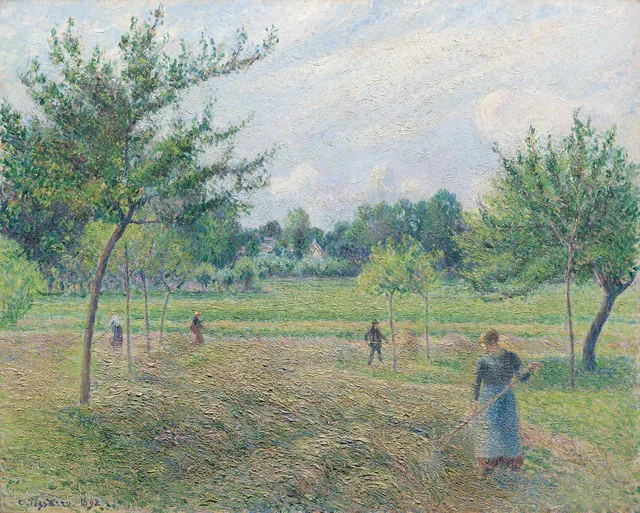
Pissarro painted the surroundings of Éragny for years, observing changes in fields, trees and his neighbours’ work. Haymaking was completed in 1892 and appeared in a major exhibition at dealer Paul Durand-Ruel’s gallery the following spring. His market position had improved by then. Rural labour, which he had long considered worthy of serious painting, was attracting more urban buyers.
The woman on the right holds a long rake directed towards the lower edge. Her lean, extended foot and two hands explain the tool’s movement. Occupying the foreground, she establishes the scale of the scene. Pissarro returned to a similar pose in other works. Museum research shows that he added the worker after his initial work on the landscape.
Farther away, workers are spaced widely across the field. Each occupies a separate patch and holds a different pose. Their diminishing size establishes distance while suggesting the scale of the task. Cut grass still lies on the ground, waiting to be gathered. The landscape remains an open, sunlit space in which people continue their repetitive movements.
A young tree on the left bends over the field. Its branches and leaves cover part of the sky, while the thin trunk almost disappears into the grass. Its curve is conspicuous beside the straight bands of land. Pissarro painted a recently planted orchard near his home, but could adjust the trees’ arrangement to suit the composition. Long familiarity with the place left room for choice.
Roofs and a line of trees emerge beyond the field. Small differences in colour distinguish distance from foreground without a sharp dividing line. There is no visual break between the houses and the workers. This village encompasses homes, an orchard and cultivated ground: an everyday environment the artist knew through repeated observation from his studio window.
Short strokes point in different directions across the foreground grass. Green mingles with ochre and pink, making the surface seem active even where nobody is working. Pissarro had spent several years using the strict dotted technique of Neo-Impressionism. Separate touches of colour remain here, but their size and direction vary freely with the surface represented.
The painting looks like a summer day caught at a glance, although it was made in several stages. Pissarro combined observation with previously developed figures and carefully arranged trees. This complicates the familiar idea of Impressionism as an instantaneous record. A convincing scene could require prolonged studio work, while a familiar rural subject became part of the modern art market.
More works by Camille Pissarro


- Medium
- Oil on canvas
- Collection
- Art Institute of Chicago
- Accession number
- 1961.791
Sources
Wikimedia Commons reproduction. Public domain. Image licence