Still Life—Strawberries, Nuts, &c.
Raphaelle Peale · 1822
Explore the painting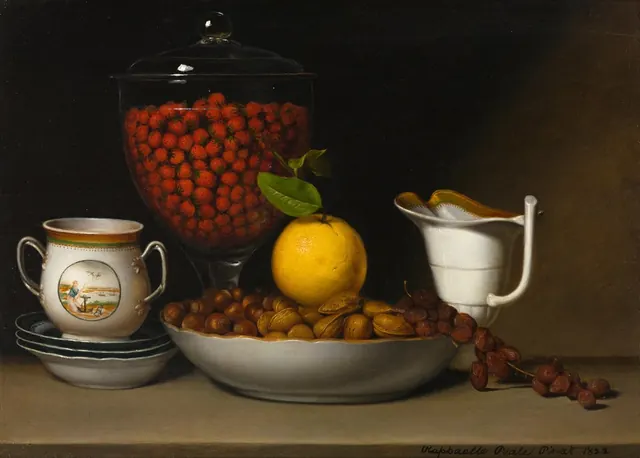
The painting’s story and details
Strawberries, nuts and grapes stand beside an orange, a sugar bowl and a cream jug. Raphaelle Peale painted this dessert still life in 1822. Apparently simple food contains a history of horticulture, trade and prosperity in Philadelphia, where he worked. Produce from different seasons shares space with costly tableware.
Strawberries fill a covered glass vessel. Museum researchers associate their presence beside winter produce with cultivation outside the usual season. The origins of the depicted berries remain unknown. The Peale family did take an active interest in horticultural experiments.
The transparent lid rises above the group. Glass displays its contents while protecting them. Fine highlights distinguish the vessel from the dark background. The object makes both its maker’s skill and the painter’s particularly apparent.
An orange lies near the centre with a green leaf. Citrus could be cultivated in protected growing spaces. A fruit familiar to modern viewers belonged to a different system of expense, knowledge and care. A varied table depended on the ability to overcome season and distance.
The white cream jug is Chinese export porcelain made for the American market. Its presence involves long-distance trade. A small domestic object carries a port city’s international economy. The still life’s comfort depends on exchanges among people the painting never shows.
The matching vessel on the left is a sugar bowl, also made in China. Together with the jug it explains how the berries might be served. This is dessert prepared for a prosperous table. Decoration and handles make ordinary food service a display of taste and material means.
Hazelnuts and almonds occupy the foreground. Rough shells differ from smooth porcelain and transparent glass. Peale belonged to a large artistic family, but specialising in still life was difficult. Academic hierarchies valued ordinary objects below portraits and historical subjects.
Dark grapes at the edge are partly shrivelling. They introduce another condition of fruit and complicate its simultaneous availability. The composition might record a carefully assembled dessert or combine observations. Horticultural history helps researchers compare these possibilities.
A modest genre contains numerous connections. Horticultural knowledge, Chinese porcelain, maritime trade and social position meet on one table. The absence of people lends objects particular force while leaving unseen the labour of those who grew, transported and manufactured this prosperity.
Featured in tours
Still life. The value and structure of things
Food, flowers, vessels, books and instruments in an owner’s life and a painter’s work.
More paintings to compare
Period, style and subject
- Movement
- American painting
- Genre
- Still life
- Medium
- Oil on wood panel
- Collection
- Art Institute of Chicago
- Dimensions
- 41.1 × 57.8 cm
- Accession number
- 1991.100
Sources
Image provided under CC0. Image licence
Adapted and translated from Art Institute of Chicago materials. · Text licence