Still Life with Cake
Raphaelle Peale · 1818
Explore the painting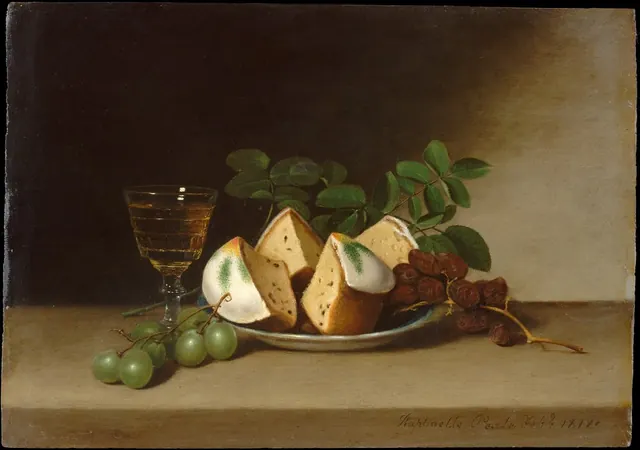
The painting’s story and details
In 1818 Raphaelle Peale painted a small panel of cake, grapes, and wine. Choosing this subject carried a professional cost. His father, the painter Charles Willson Peale, urged him to paint portraits. Still lifes brought fewer commissions and less prestige. The son nevertheless made this genre central to his later career.
The cake is cut and opened to expose crumb, crust, and white icing. Each wedge presents a different surface. Dark flecks inside and green decoration outside invite scrutiny as close as that given to a portrait. On a panel less than forty centimeters wide, everything is arranged for an intimate encounter with objects.
Peale grew up in a family where painting accompanied museum work and the study of nature. He assisted his father, painted portraits and miniatures, and collected natural specimens. The ability to distinguish materials is evident in the glass here. Light passes through the wine, catches its facets, and leaves two white reflections on the glass.
The grapes on the left are smooth, round, and translucent. The dark bunch on the right is shriveled. These different states of fruit can suggest the passage of time. Peale makes the difference visible through taut skin, wrinkles, sheen, and color.
A leafy branch rises behind the cake, while the ends of the bunches extend along the table. The objects cluster tightly in the middle, surrounded by ample empty wall. The small dessert cannot disappear into a domestic setting. Peale has removed almost everything that could compete with the food and its surfaces.
The front edge bears his name and the date, placing the signature seemingly in the same space as the plate. Peale exhibited still lifes at the Pennsylvania Academy of the Fine Arts. This may be the work shown in 1819 under a title listing wine, cakes, and grapes. The museum treats that catalogue identification as tentative.
Still life held a low position among painting genres in the early nineteenth century. Peale continued to choose it while remaining financially dependent on his father. His small pictures demand skills associated with more prestigious work: precise drawing, controlled light, and the distinction of numerous shades within an almost motionless scene.
Featured in tours
Still life. The value and structure of things
Food, flowers, vessels, books and instruments in an owner’s life and a painter’s work.
More paintings to compare
Period, style and subject
- Movement
- American painting
- Genre
- Still life
- Medium
- Oil on wood
- Collection
- The Metropolitan Museum of Art
- Dimensions
- 27.3 × 38.7 cm
- Accession number
- 59.166
Sources
Image provided under CC0. Image licence