Still life. The value and structure of things
Food, flowers, vessels, books and instruments in an owner’s life and a painter’s work.
Open the tour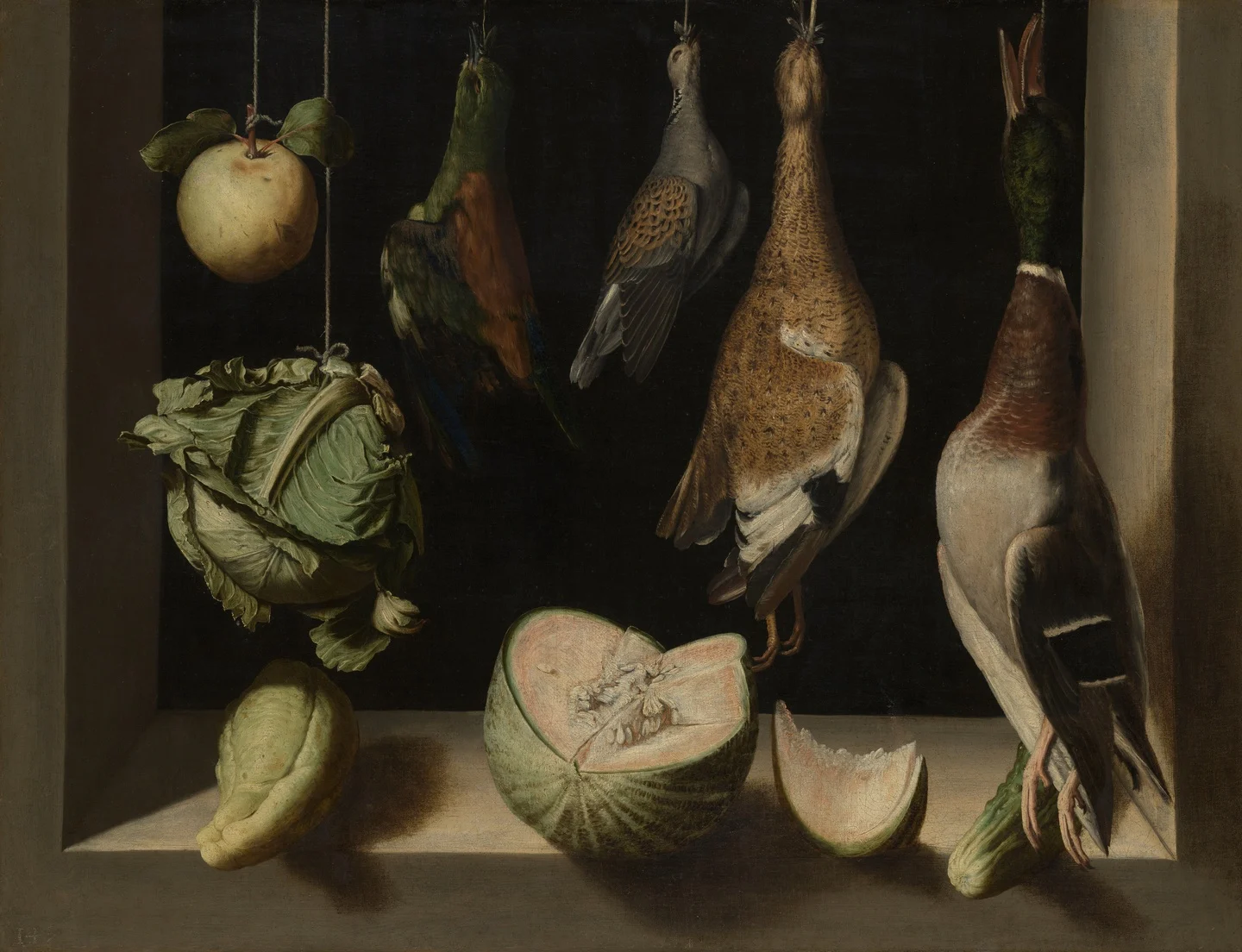 Juan Sánchez Cotán
Still Life with Game Fowl
c. 1600–3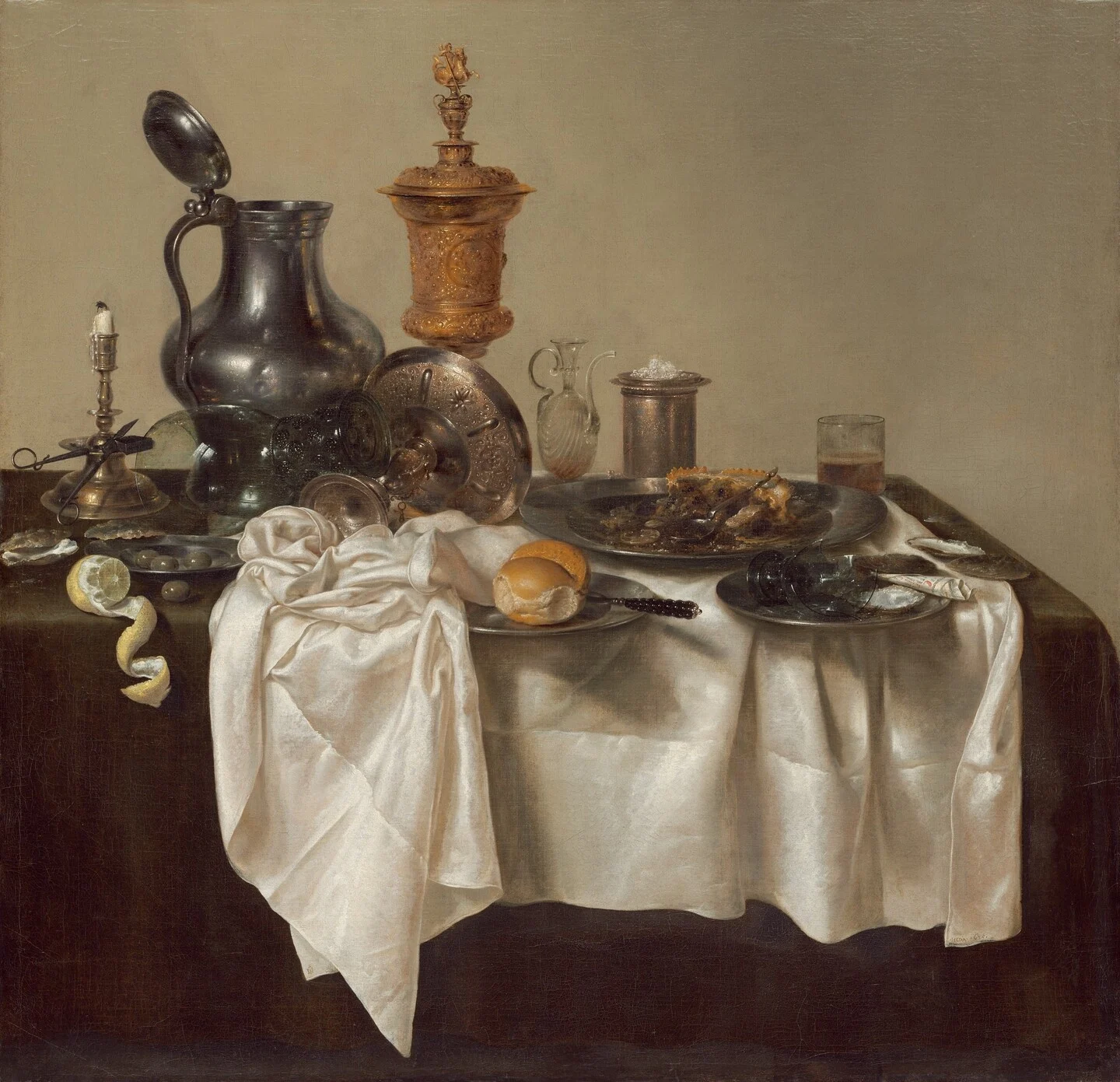 Willem Claesz Heda
Banquet Piece with Mince Pie
1635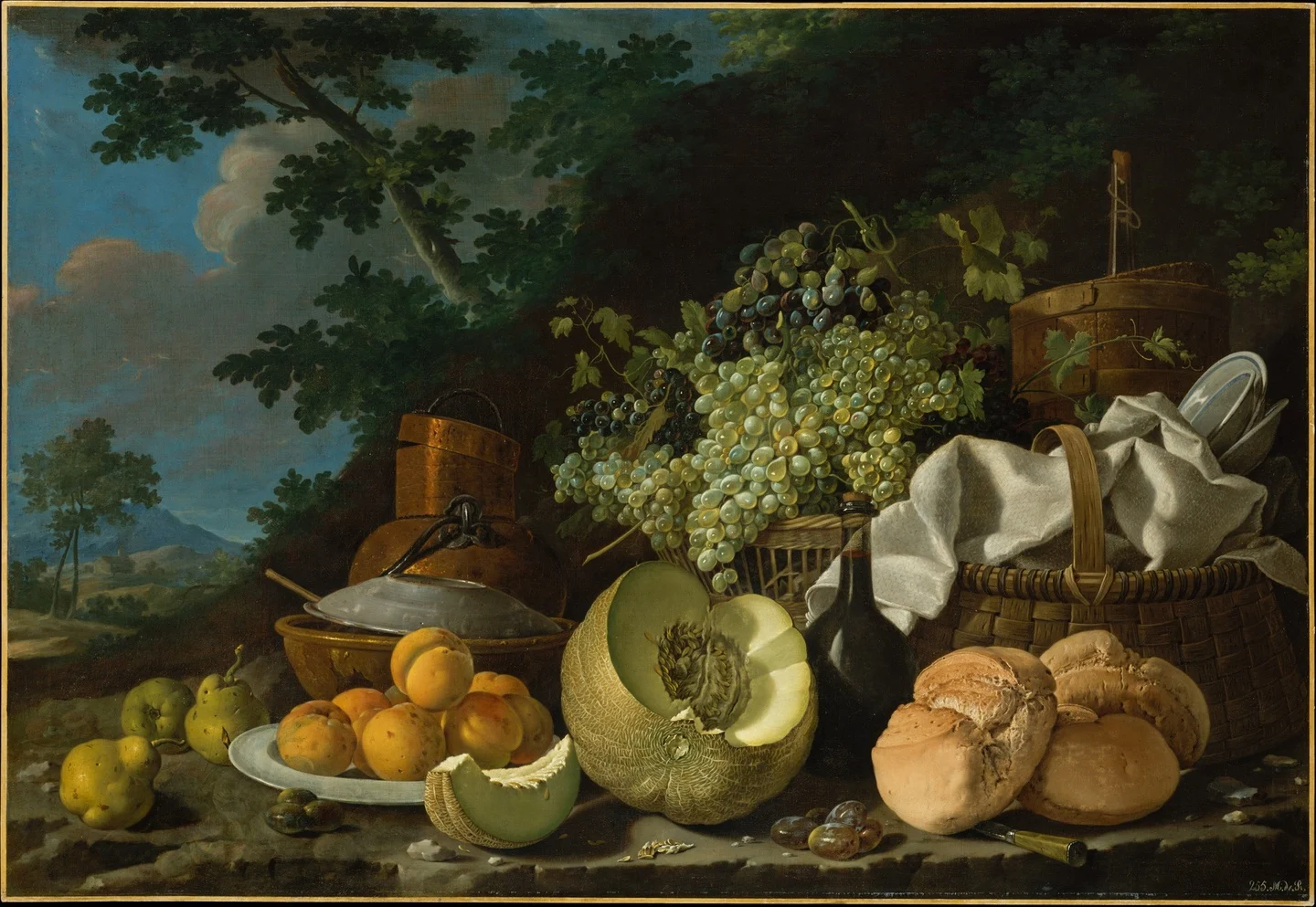 Luis Meléndez
The Afternoon Meal (La Merienda)
ca. 1772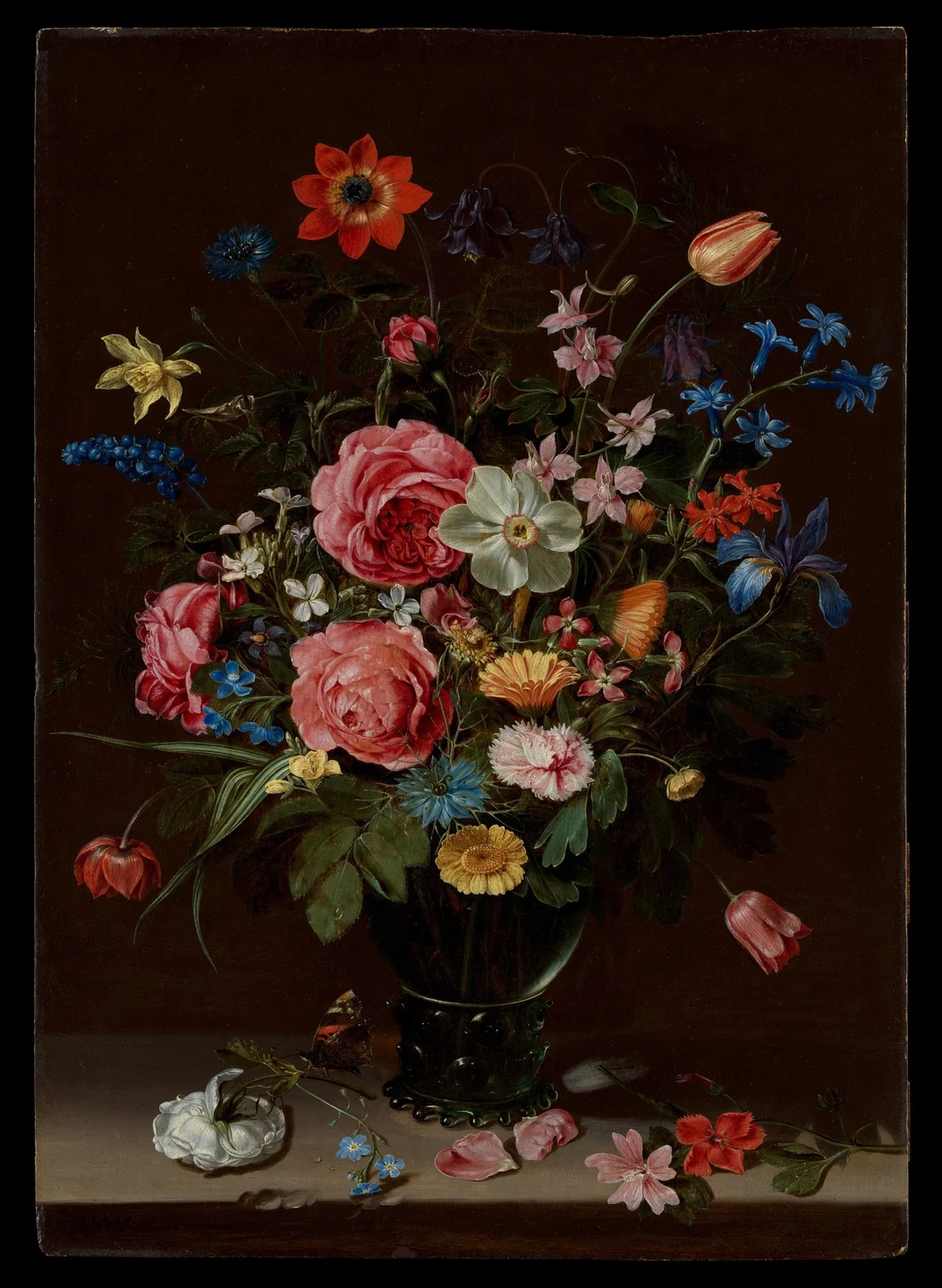 Clara Peeters
A Bouquet of Flowers
ca. 1612Food, flowers, vessels, books and instruments in an owner’s life and a painter’s work.
Objects can be selected and rearranged. Still life let painters study material, form and lighting at length. Tables, bouquets and bookshelves also conveyed habits, trade and wealth. We move from early European arrangements to Korean shelves, American trompe-l’œil and experiments by Cézanne and Matisse.
The table and wealth
Food and vessels reveal habits and exchange. Elaborate arrangements also demonstrated the ability to depict different surfaces.
Still Life with Game Fowl
Juan Sánchez Cotán · c. 1600–3
Sánchez Cotán painted this still life shortly before leaving Toledo for a Carthusian monastery in 1603. He had already enjoyed a successful career of about twenty years. Objects occupy a shallow niche with geometric precision. Hanging birds and fruit let him compare the shapes, weight and surfaces of ordinary things.
Banquet Piece with Mince Pie
Willem Claesz Heda · 1635
The restricted gray and brown palette follows a Dutch fashion of the 1630s. Heda coordinates objects tonally despite their different actual colors. Such arrangements also supplied workshop teaching. His son Gerret later reused related motifs and painting methods.
The Afternoon Meal (La Merienda)
Luis Meléndez · ca. 1772
This painting dates from Meléndez’s commission for forty-four royal still lifes at Aranjuez. A picnic basket, produce and cookware appear before a landscape. Everyday Spanish objects become part of an image of leisure at a royal country residence.
A Bouquet of Flowers
Clara Peeters · ca. 1612
Peeters helped establish European still life, a field accessible to women excluded from nude-model training. Precise flowers include fading blooms and insect damage. Observation of plants accompanies signs of change, while her signature on the ledge asserts authorship.
Household objects
Simple utensils demand choices of light and spacing as careful as precious objects do.
The White Tablecloth
Jean Siméon Chardin · c. 1731–32
The unusual shape reflects the painting’s original use as a fireplace screen. Seen near floor level, it created the illusion of a table recessed into the opening. A projecting knife, overturned glass and meal remnants recall seventeenth-century Dutch still life. Chardin adapted those motifs to a functional object for a domestic room.
Kitchen Utensils with Leeks, Fish, and Eggs
Jean Siméon Chardin · c. 1734
Chardin repeatedly used familiar kitchen objects, changing their positions and the food placed beside them. Already successful by 1730, he began painting small, restrained still lifes. Repeated objects let him test compositional balance. His work developed alongside the more elaborate courtly culture of Rococo.
Still Life with Cake
Raphaelle Peale · 1818
The museum tentatively connects this picture with an 1819 Pennsylvania Academy exhibition. Its concentrated arrangement may reflect Peale’s study of Spanish still life. The early exhibition history remains uncertain, while the objects themselves invite unusually close attention.
Still Life—Strawberries, Nuts, &c.
Raphaelle Peale · 1822
Peale was among the first American painters to specialise in still life, studying Dutch seventeenth-century examples. Chinese porcelain made for the American market connects the domestic table with international trade. The glass vessel may contain hothouse strawberries, which his family experimented with growing outside Philadelphia.
Still Life—Violin and Music
William Michael Harnett · 1888
A partly open door, projecting nails and cast shadows make painted things seem to stand before a real surface. Such trompe-l’oeil pictures appealed particularly to middle-class collectors. Musical equipment supplies both the subject and the means of testing painted depth.
Books and Scholars’ Accoutrements
Yi Taek-gyun · late 1800s
Chaekgado began as an emblem of royal learning and later furnished aristocratic studies. Books and prized objects occupy painted shelf compartments. A hidden seal on the third panel from the right identifies the court artist Yi Taek-gyun. The screen decorates a room while presenting its owner's learned interests.
Magnolias on Light Blue Velvet Cloth
Martin Johnson Heade · 1885–95
After extensive travels, Heade settled in Florida at sixty-four. He began detailed arrangements of local flowers, including magnolias. Velvet heightens differences between smooth petals, leaves and heavy fabric. This late work combines botanical attention with an explicitly decorative studio arrangement.
Repeating an arrangement
Cézanne changes the position of objects and table edges. Still life becomes a study of how sight constructs volume.
The Basket of Apples
Paul Cézanne · About 1893
Cézanne painted The Basket of Apples around 1893. Every object is recognisable, yet the table edges fail to align across the cloth. Different viewpoints coexist within one arrangement on the canvas.
Still Life with Apples and a Pot of Primroses
Paul Cezanne · ca. 1890
Flowering plants were unusual subjects for Cézanne. His slow working process risked outlasting the blooms. Here, the fragile plant joins more durable apples and pottery. Claude Monet, himself an enthusiastic gardener, once owned the painting.
The Peppermint Bottle
Paul Cezanne · 1893/1895
Cézanne returned to the same studio objects to study their relationships. He later included this very canvas within his Still Life with Plaster Cupid. The bottles, fruit, and cloth thus belonged both to an arrangement of things and to his own continuing work with earlier paintings.
Flowers and colour
Van Gogh and Matisse use a familiar subject to arrange areas of colour in different ways.
Irises
Vincent van Gogh · 1890
In May 1890, before leaving the asylum at Saint-Rémy, Van Gogh painted four flower still lifes. This bouquet belonged to that group. Red pigment has faded, turning the originally violet irises blue and paling the pink background.
Roses
Vincent van Gogh · 1890
The roses were originally pink, but fading changed their relationship with the green ground. The paint was so thick that Van Gogh left the canvas at Saint-Rémy to dry in May 1890. It reached him later in Auvers. Present color and transport history reveal the work's material life.
Still Life with Geranium
Henri Matisse · 1906
Matisse placed his own sculptures among plants and vessels. The pale figures were probably plaster casts, later also issued in bronze. Brilliant colour and thick brushwork connect the painting with Fauvism, whose leading painter critics considered him. Still life let him compare painted surfaces with forms he had modelled himself.
An object had meanings before it reached the canvas
An object had meanings before it reached the canvas. Its price, use and origin might be familiar to the first viewer. Such information supports a more precise reading.
By the late nineteenth century, still life had become an important setting for experiments with space and colour. A motionless arrangement allowed repeated work and comparison of different solutions.
Artists in the tour
Sources
- Juan Sánchez Cotán — Still Life with Game Fowl
- Willem Claesz Heda — Banquet Piece with Mince Pie
- Luis Meléndez — The Afternoon Meal (La Merienda)
- Clara Peeters — A Bouquet of Flowers
- Jean Siméon Chardin — The White Tablecloth
- Jean Siméon Chardin — Kitchen Utensils with Leeks, Fish, and Eggs
- Raphaelle Peale — Still Life with Cake
- Raphaelle Peale — Still Life—Strawberries, Nuts, &c.
- William Michael Harnett — Still Life—Violin and Music
- Yi Taek-gyun — Books and Scholars’ Accoutrements
- Martin Johnson Heade — Magnolias on Light Blue Velvet Cloth
- Paul Cézanne — The Basket of Apples
- Paul Cezanne — Still Life with Apples and a Pot of Primroses
- Paul Cezanne — The Peppermint Bottle
- Vincent van Gogh — Irises
- Vincent van Gogh — Roses
- Henri Matisse — Still Life with Geranium