The Rock of Hautepierre
Gustave Courbet · c. 1869
Explore the painting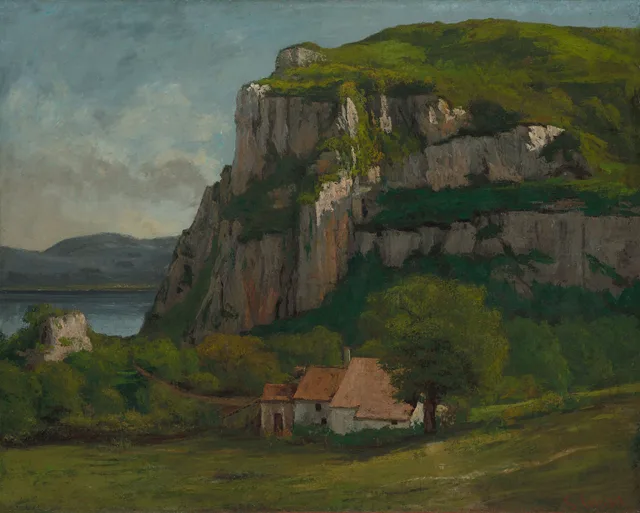
The cliffs of his native Franche-Comté occupied an important place in Courbet’s art. He regularly returned from Paris to family and familiar scenery, and painted some views from memory in his studio. The Rock of Hautepierre, dated around 1869, belongs to this group of subjects. A huge rocky slope rises above a small house. Little happens, but the difference in scale between human shelter and surrounding terrain is unmistakable.
Pale precipices separated by green bands form the upper cliff. Large, dense areas of paint suggest uneven stone. Courbet does not smooth the surface into a photographic illusion. The material presence of paint helps convey the rock’s weight and roughness. We can recognise a cliff while also seeing it constructed from a limited number of coloured masses.
A white house with reddish roofs stands at the foot. Small dark windows and a door suffice to identify a dwelling. Compared with the cliff it seems fragile, although no immediate threat is depicted. Their proximity suggests life in this terrain. People adapt a small area to their needs, while geological relief continues to determine the scale and character of the view.
A separate pale outcrop appears among trees on the left. It repeats the large cliff’s colour, connecting near greenery with distant relief. Courbet avoids an evenly symmetrical arrangement. The main mass shifts right, leaving an opening towards far hills on the left. The heavy slope consequently does not seal the picture, and the eye can travel around it.
Dark vegetation forms bands between rocky ledges. Green varies from near-black to yellow, indicating depth and illumination. Individual plants need not be distinguished. Masses of foliage convincingly show where stone is covered and where exposed. The landscape depends on contrasting dense materials Courbet knew through repeated observation of familiar terrain.
Sky fills the open left and a narrow strip above. Its blue-grey surface is quieter than the rock, making the dense relief more noticeable. No spectacular sunset or storm justifies the subject through an exceptional event. The place itself receives significance. Courbet could grant local scenery the scale and attention commonly reserved for famous views or historical subjects.
Attachment to Franche-Comté was part of Courbet’s public identity in Paris. He emphasised his origins and knowledge of his home terrain. A familiar slope could therefore be both landscape and a statement about the source of his art. The painting invites consideration of why some places seem museum-worthy in advance, while others need a painter to persuade viewers to look closely.
More works by Gustave Courbet


- Medium
- Oil on canvas
- Collection
- Art Institute of Chicago
- Accession number
- 1967.140
Sources
Wikimedia Commons reproduction. Public domain. Image licence