Woman with a Parrot
Gustave Courbet · 1866
Explore the painting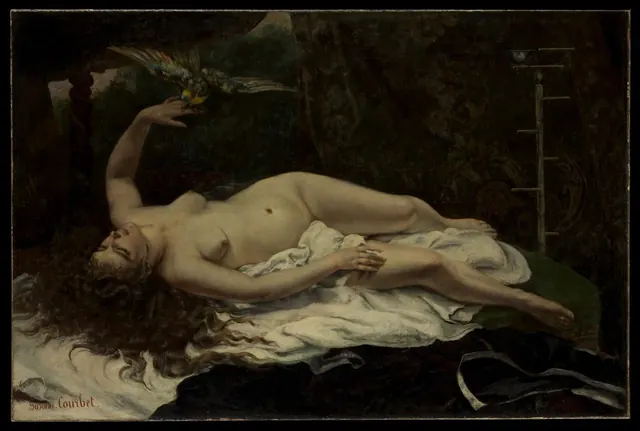
The painting’s story and details
When Courbet showed Woman with a Parrot at the Salon of 1866, he already had a reputation for scandal. He had painted rural people on enormous canvases and challenged exhibition juries. Here he turned to the nude, a subject long accepted in prestigious painting. Yet the familiar genre again provoked disagreement. Critics objected to the woman’s pose, her hair and what they considered poor taste.
Her body stretches across almost the full width of the canvas. Courbet differentiates warm and cool passages of skin, soft shadows and illuminated curves. No attributes securely identify her as a goddess. That absence affected the terms on which nudity was presented. A Salon visitor encountered the physical presence of a contemporary model without the customary explanation supplied by mythology.
The parrot spreads its wings above her raised hand. The bright bird carries the arm’s movement upwards into the space above her face. Its open silhouette contrasts with the weight and horizontal position of her body. Contact with a living bird already gives her pose a particular purpose and joins both figures in one action.
Her hair spreads across the white fabric in dark strands. Its disorder reinforces the position of her head and breaks up the pale bedding. Details highlighted by the museum include her visible teeth and the hair against her forehead. These features sat uneasily with expectations of a perfected, generalised body. The dispute concerned an artist’s freedom to retain recognisable human individuality in a nude.
The white sheet gathers beneath her legs. Its cool, bright passages make the skin’s different tones more apparent, while sharp folds surround the softer contours of the body. The sheet also connects the woman to the edge of the bed. Courbet develops the material setting carefully, giving this nude the credibility of an ordinary physical situation.
A tall bird stand occupies the right side. Its perches and small bowls establish that the parrot belongs in this room. Its vertical structure anchors an area that would otherwise remain largely dark. The object connects the woman’s play with the room’s furnishings.
Dark clothing with a pale waistband lies at the lower right. This detail suggests undressing and links the model particularly closely to contemporary life. The picture exposes the conventions governing respectability. The nude carried academic prestige, yet an everyday detail could make that same nudity unacceptable to part of the public.
In 1855 Courbet had opened his own Pavilion of Realism beside an official exhibition. He fought for freedom to choose his subjects and opportunities to show them publicly. Woman with a Parrot continued that dispute within an established genre. Its history shows how artistic innovation can involve the specificity of a body and its surroundings, even when the overall subject is familiar.
Featured in tours
Early Impressionism. Paris 1860–1879
The Salon, the first independent exhibition, railway stations, studios and leisure on the Seine.
More paintings to compare


Period, style and subject
- Movement
- Realism
- Genre
- The nude
- Medium
- Oil on canvas
- Collection
- The Metropolitan Museum of Art
- Dimensions
- 129.5 × 195.6 cm
- Accession number
- 29.100.57
Sources
Image provided under CC0. Image licence